 Back
Water and Carbon: Properties, Chemistry, and Biological Importance
Study Guide - Smart Notes
 Tailored notes based on your materials, expanded with key definitions, examples, and context.
Water: Basic Chemistry and Properties
Structure and Hydrogen Bonding
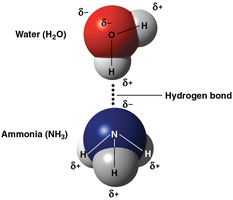
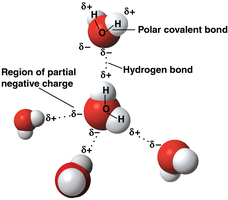
Water is a polar molecule, meaning its charge is unevenly distributed due to the electronegativity of oxygen. This polarity allows water molecules to form hydrogen bonds with each other and with other electronegative atoms such as nitrogen.
Hydrogen Bond: A weak bond formed when a hydrogen atom covalently bonded to one electronegative atom is attracted to another electronegative atom.
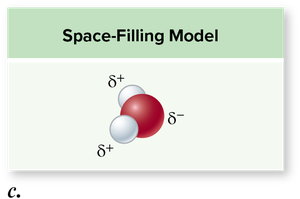
Polarity: Water's polar covalent bonds result in partial positive (δ+) and partial negative (δ−) charges.
Biological Relevance: Hydrogen bonds are crucial for the structure and function of biomolecules.
Example: Hydrogen bonding between water and ammonia demonstrates the attraction between polar molecules.
Models of Water Molecule
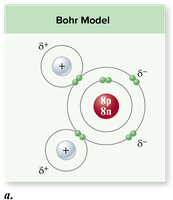
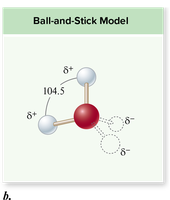
Different models are used to represent the structure of water, each highlighting specific aspects of its geometry and charge distribution.
Bohr Model: Shows electrons orbiting the nucleus, indicating charge distribution.
Ball-and-Stick Model: Illustrates bond angles and partial charges.
Space-Filling Model: Demonstrates the spatial arrangement and polarity.
Four Emergent Properties of Water Vital for Life
Cohesion and Surface Tension
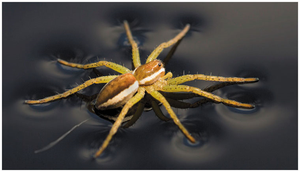
Cohesion refers to the attraction between water molecules due to hydrogen bonding, resulting in high surface tension. This property enables certain organisms to move across water surfaces.
Cohesion: Collective hydrogen bonding holds water molecules together.
Surface Tension: The difficulty in stretching or breaking the surface of water.
Example: Some insects can walk on water due to surface tension.
Cohesion vs. Adhesion
Cohesion helps transport water and nutrients against gravity in plants, while adhesion is the attraction between water and other substances, such as plant cell walls.
Adhesion: Attraction between water and other materials, countering gravity in plants.
Example: Water moves upward in plant vessels due to both cohesion and adhesion.
Temperature Moderation
Water moderates temperature by absorbing and releasing heat with minimal change in its own temperature, due to its high specific heat.
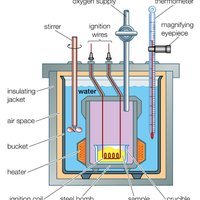
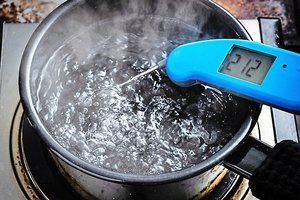
Specific Heat: The amount of heat required to change the temperature of 1 g of water by 1ºC. For water, it is 1 cal/(g·ºC).
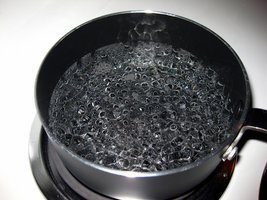
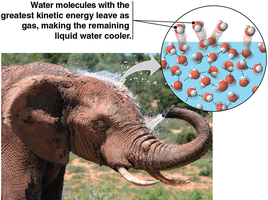
Heat of Vaporization: The heat needed for 1 g of water to convert to gas, enabling evaporative cooling.
Example: Large bodies of water stabilize climate; evaporative cooling helps organisms regulate temperature.
Units of Energy
Energy is measured in calories and joules. The calorie is the amount of heat needed to raise 1 g of water by 1ºC, and food energy is measured in kilocalories (kcal).
Conversion: 1 J = 0.239 cal; 1 cal = 4.184 J.
Expansion Upon Freezing
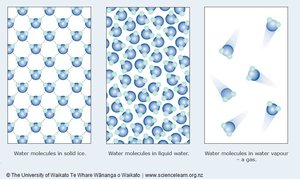
Water expands when it freezes due to the formation of a crystalline lattice, making ice less dense than liquid water. This property is essential for aquatic life.
Density: Ice is ~10% less dense than liquid water; water is densest at 4ºC.
Example: Ice floats, preventing bodies of water from freezing solid.
Snowball Earth Hypothesis
If ice sank, all water bodies would freeze solid, making life impossible. The snowball earth theory suggests that Earth's surface was nearly entirely frozen during the Cryogenian period.
Implication: Floating ice insulates liquid water below, supporting life.

Versatility as a Solvent
Water is known as the universal solvent due to its ability to dissolve a wide range of substances, especially ionic and polar compounds.
Solution: Homogeneous mixture of substances; water is the solvent in aqueous solutions.
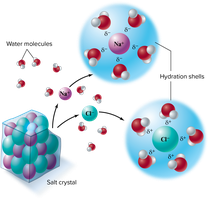
Hydration Shell: Water molecules surround dissolved ions, stabilizing them in solution.
Example: Salt dissolving in water forms hydration shells around Na+ and Cl– ions.
Hydrophilic vs. Hydrophobic Substances
Substances with an affinity for water are hydrophilic, while those that repel water are hydrophobic. This distinction is important for biological molecules and cell membranes.
Hydrophilic: Proteins, carbohydrates, ionic compounds.
Hydrophobic: Alkanes, oils, fats.
Acids, Bases, and Buffers
Dissociation of Water
Water molecules can dissociate into hydrogen ions (H+) and hydroxide ions (OH–), which is fundamental to acid-base chemistry.
Hydronium Ion: H3O+ (often represented as H+).
Hydroxide Ion: OH–.
Acids and Bases
Acids increase the concentration of H+ in solution, while bases decrease it. The pH scale measures the acidity or basicity of a solution.
Acid: Substance that increases H+ concentration (e.g., HCl).
Base: Substance that reduces H+ concentration (e.g., NaOH, NH3).
pH Scale: pH = –log [H+]; neutral water has pH 7.
Equation:
Buffers
Buffers are substances that minimize changes in pH by combining reversibly with H+ ions. Most biological systems maintain a pH close to 7 using buffers.
Composition: Weak acid and its corresponding base.
Function: Stabilizes pH in cells and biological fluids.
Basic Chemistry of Carbon
Carbon as the Backbone of Biological Molecules
Carbon is central to organic chemistry, forming the backbone of biological molecules. Its ability to form four covalent bonds allows for diverse molecular structures.
Organic Compounds: Range from simple to complex molecules.
Valence: Carbon has four valence electrons, enabling tetrahedral geometry.
Double Bonds: When two carbons are joined by a double bond, atoms are in the same plane.
Origins of Life and Abiotic Synthesis
Stanley Miller's experiment demonstrated the abiotic synthesis of organic compounds, supporting theories about the origin of life.
Application: Organic molecules could form near volcanoes or other natural settings.
Carbon Skeleton Variation and Molecular Diversity
Variation in carbon skeletons generates molecular diversity, forming the basis for different biological molecules.
Hydrocarbons: Organic molecules consisting only of carbon and hydrogen; important in fats and energy storage.
Energy: Hydrocarbons release energy during reactions.
Isomers
Isomers are compounds with the same molecular formula but different structures and properties.
Structural Isomers: Different covalent arrangements.
Cis-Trans Isomers: Same covalent bonds, different spatial arrangements.
Enantiomers: Mirror images of each other.
Functional Groups
Functional groups are specific groups of atoms within molecules that are responsible for characteristic chemical reactions. The number and arrangement of functional groups determine the properties of organic molecules.
Importance: Functional groups define the reactivity and function of biomolecules.
Calculating Solute Concentrations
Moles and Molarity
Molecular mass is the sum of the masses of all atoms in a molecule. The mole is a unit for counting molecules, and molarity is the number of moles of solute per liter of solution.
Avogadro’s Number: molecules per mole.
Molarity (M): Number of moles of solute per liter of solution.
Dalton: Unit of atomic mass; 1 g = daltons.
