 Back
BackWater and Carbon: The Chemical Basis of Life – Study Notes
Study Guide - Smart Notes
 Tailored notes based on your materials, expanded with key definitions, examples, and context.
Chapter 2: Water and Carbon – The Chemical Basis of Life
Introduction to Chemical Evolution
Chemical evolution is the leading explanation for the origin of life on Earth. It describes the process by which simple molecules formed increasingly complex carbon-containing substances, eventually leading to molecules capable of self-replication and the transition from chemical to biological evolution. Once these molecules could replicate, natural selection drove the evolution of life, fulfilling the five characteristics of living organisms.
Atoms, Ions, and Molecules: The Building Blocks of Chemical Evolution
Basic Atomic Structure
Atoms consist of a nucleus (protons and neutrons) surrounded by electrons.
Protons have a positive charge (+1), neutrons are neutral, and electrons have a negative charge.
Atoms are electrically neutral when the number of protons equals the number of electrons.
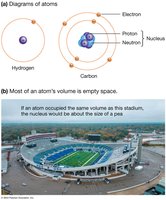
Elements are defined by their atomic number (number of protons).
Mass number is the sum of protons and neutrons.
Isotopes are atoms of the same element with different numbers of neutrons.
Atomic weight is the average mass of all isotopes, weighted by abundance.
Radioactive isotopes are unstable and decay over time.
The most abundant elements in living organisms are C, H, N, O, P, and S, making up over 99% of the atoms in the body.
Electron Arrangement and Chemical Bonds
Electrons occupy orbitals, which are grouped into electron shells.
The valence shell is the outermost shell; electrons here are called valence electrons.
Atoms are most stable when their valence shells are full, often achieved by forming chemical bonds.
Covalent bonds form when atoms share valence electrons, creating molecules.
Types of Chemical Bonds
Nonpolar covalent bonds: Electrons are shared equally (e.g., H2).
Polar covalent bonds: Electrons are shared unequally due to differences in electronegativity (e.g., H2O).
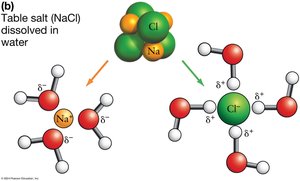
Ionic bonds: Electrons are transferred from one atom to another, forming ions (cations and anions).
Electronegativity increases up and to the right on the periodic table: O > N > S, C, H, P.
Properties of Water and the Early Oceans
Water’s Structure and Solvent Properties
Water is a small, bent molecule with highly polar covalent bonds, making it an excellent solvent. Its polarity allows it to dissolve ions and polar molecules (hydrophilic), while nonpolar molecules (hydrophobic) do not dissolve in water.
Cohesion, Adhesion, and Surface Tension
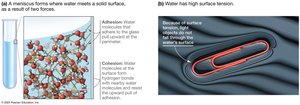
Cohesion: Attraction between like molecules (water to water).
Adhesion: Attraction between unlike molecules (water to other substances).
Surface tension: Cohesive force at the surface of water, making it act like an elastic membrane.
Density and Thermal Properties of Water
Water is denser as a liquid than as a solid due to its open crystal structure in ice, causing ice to float.
Water has a high specific heat and heat of vaporization, meaning it can absorb or release large amounts of energy with little temperature change.
Acid–Base Chemistry in Water
Water can dissociate into hydrogen ions (H+) and hydroxide ions (OH−).
Acids increase the concentration of H+ in solution; bases decrease it.
pH is a logarithmic measure of H+ concentration; pH < 7 is acidic, pH > 7 is basic, and pH = 7 is neutral.
Buffers help maintain stable pH in biological systems.




Chemical Reactions, Energy, and Chemical Evolution
How Chemical Reactions Occur
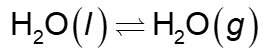
Chemical reactions involve breaking and forming bonds, often written as equations.
Reactions can be endothermic (absorb energy) or exothermic (release energy).

Energy in Chemical Systems
Potential energy is stored energy due to position or arrangement (e.g., in chemical bonds).
Kinetic energy is energy of motion (e.g., thermal energy).
The first law of thermodynamics states that energy cannot be created or destroyed, only transformed.
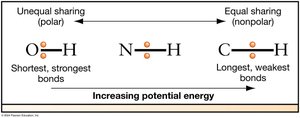
Spontaneity and Entropy
Spontaneous reactions proceed without external energy input if products have lower potential energy and/or higher entropy (disorder) than reactants.
The second law of thermodynamics states that entropy always increases in spontaneous processes.
Investigating Chemical Evolution
Miller’s Experiment
Stanley Miller’s 1953 experiment demonstrated that complex organic molecules, such as amino acids, could be synthesized from simple molecules under conditions thought to resemble early Earth. This supported the idea that chemical evolution could lead to the origin of life.
Life is Carbon-Based
Carbon’s Unique Properties
Carbon forms four covalent bonds, allowing for a variety of molecular shapes and sizes.
Organic compounds contain carbon bonded to other elements, forming the backbone of biological molecules.
Functional Groups in Organic Molecules
Amino groups (–NH2): Act as bases.
Carboxyl groups (–COOH): Act as acids.
Carbonyl groups (–C=O): Sites for linking molecules.
Hydroxyl groups (–OH): Act as weak acids.
Phosphate groups (–PO4): Carry two negative charges.
Sulfhydryl groups (–SH): Form disulfide bonds.
Macromolecules and Polymerization
Macromolecules are large molecules made of repeating subunits (monomers).
Polymerization occurs via condensation (dehydration) reactions, releasing water.
Hydrolysis breaks polymers into monomers, increasing entropy and favoring free monomers.
Additional info: These foundational chemical principles are essential for understanding the molecular basis of life, including the structure and function of proteins, nucleic acids, carbohydrates, and lipids, which are covered in subsequent chapters.
