 Back
BackWater and Carbon: The Chemical Basis of Life – Study Notes
Study Guide - Smart Notes
 Tailored notes based on your materials, expanded with key definitions, examples, and context.
Water and Carbon: The Chemical Basis of Life
Introduction to Chemical Evolution
Chemical evolution is the leading explanation for the origin of life on Earth. It describes the formation of increasingly complex carbon-containing substances, which eventually led to molecules capable of self-replication. This process marked the transition from chemical to biological evolution, as these molecules became metabolically active and acquired membranes, fulfilling the five characteristics of life.
Chemical evolution: Formation of complex molecules from simpler ones.
Biological evolution: Driven by natural selection after the emergence of self-replicating molecules.
Key transition: Acquisition of metabolic activity and membranes.
Properties of Water and the Early Oceans
Life is fundamentally based on water, which constitutes about 75% of a cell's mass. Water is an excellent solvent, meaning it can dissolve a wide variety of substances, facilitating chemical reactions necessary for life.
Solvent: The substance in which solutes dissolve to form a solution.
Reactivity: Substances are more likely to react when dissolved in water.
Water’s Structure and Unique Properties
Water is unique due to its small size, bent shape, and highly polar covalent bonds, resulting in overall polarity. These structural features are responsible for water's remarkable properties.
Bent shape: Causes partial charges on oxygen and hydrogen atoms.
Polarity: Leads to hydrogen bonding between water molecules.
Water as an Efficient Solvent
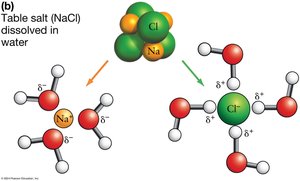
Water’s polarity allows it to dissolve many substances, especially ions and polar molecules. Hydrogen bonds form between water molecules and solutes, making water an efficient solvent for hydrophilic substances.
Hydrophilic: "Water-loving" molecules (ions and polar compounds) dissolve readily in water.
Hydrogen bonds: Weak electrical interactions between partial charges.
Example: Table salt (NaCl) dissolves in water as water molecules surround and stabilize Na+ and Cl- ions.
Hydrophobic Molecules
Hydrophobic ("water-fearing") molecules are uncharged and nonpolar, so they do not dissolve in water. Instead, they cluster together, stabilized by van der Waals interactions.
Hydrophobic interaction: Nonpolar molecules aggregate to minimize contact with water.
van der Waals interactions: Weak attractions that increase stability of hydrophobic clusters.
Cohesion, Adhesion, and Surface Tension
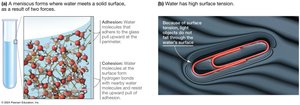
Water exhibits both cohesion (attraction between like molecules) and adhesion (attraction between unlike molecules). These properties are due to hydrogen bonding and are essential for phenomena such as surface tension.
Cohesion: Water molecules stick together.
Adhesion: Water molecules stick to other surfaces.
Surface tension: Cohesive force at the surface of water, making it act like an elastic membrane.
Example: Water forms a meniscus in a test tube due to adhesion and cohesion, and supports small objects due to high surface tension.
Density of Water: Liquid vs. Solid
Unlike most substances, water is denser as a liquid than as a solid. As water freezes, it forms an open crystal structure, causing ice to float and act as an insulating layer on water surfaces.
Crystal structure: Hydrogen bonds create open lattice in ice.
Biological significance: Ice insulates aquatic environments.
Water’s Capacity for Absorbing Energy
Water has a high specific heat and heat of vaporization, meaning it can absorb large amounts of energy before changing temperature or state. This property is crucial for temperature regulation in organisms.
Specific heat: Energy needed to raise temperature of 1 gram of water by 1°C.
Heat of vaporization: Energy required to convert 1 gram of water from liquid to gas.
Biological application: Sweating cools organisms by evaporating water.
Acid–Base Chemistry and pH
Acids donate protons (H+) and increase hydronium ion concentration, while bases accept protons and decrease it. The pH scale is a logarithmic measure of proton concentration, with buffers helping maintain stable pH in organisms.
Acids: pH < 7
Bases: pH > 7
Neutral: pH = 7 (typical of living cells)
Buffers: Minimize changes in pH, maintaining homeostasis.
Equation: pH is calculated as:
Chemical Reactions, Energy, and Chemical Evolution
Chemical evolution may have begun in the atmosphere or deep-sea hydrothermal vents. Spontaneous chemical reactions occur when products have lower potential energy and higher entropy (disorder) than reactants.
Spontaneous reaction: Proceeds without external energy input.
Entropy: Measure of disorder in a system.
Investigating Chemical Evolution
Stanley Miller’s 1953 experiment demonstrated that complex organic molecules, such as amino acids, could be synthesized from simple molecules under conditions simulating early Earth. This supported the concept of chemical evolution.
Miller’s experiment: Used heat and electrical sparks to produce amino acids from simple gases.
Conclusion: Chemical evolution occurs readily with high free energy and kinetic energy.
Life is Carbon-Based
Carbon is the backbone of most biological molecules, forming four covalent bonds and enabling a limitless array of molecular shapes. Organic compounds contain carbon bonded to other elements, with various functional groups defining their chemical behavior.
Organic compounds: Molecules with carbon bonded to H, N, O, P, or S.
Functional groups: Amino, carboxyl, carbonyl, hydroxyl, phosphate, sulfhydryl.
Assembly of Large Organic Molecules
Small organic molecules can assemble into macromolecules (polymers) through condensation reactions, which join monomers and release water. Hydrolysis is the reverse process, breaking polymers into monomers and increasing entropy.
Macromolecules: Large molecules made of monomers (e.g., proteins, nucleic acids, carbohydrates).
Condensation reaction: Polymerization with loss of water.
Hydrolysis: Addition of water to break bonds and release monomers.
Equation: General condensation reaction:
Equation: General hydrolysis reaction:
Additional info: Polymerization is energetically unfavorable unless monomer concentration is high; hydrolysis is favored due to increased entropy.
