 Back
BackWater and Carbon: The Chemical Basis of Life – Structure and Properties of Water
Study Guide - Smart Notes
 Tailored notes based on your materials, expanded with key definitions, examples, and context.
Water and Carbon: The Chemical Basis of Life
Atomic Structure and Valence
The chemical behavior of atoms is determined by the arrangement of electrons in electron shells, especially the outermost shell known as the valence shell. Atoms with incomplete valence shells tend to form bonds to achieve stability. The most common elements in biological molecules are carbon (C), hydrogen (H), nitrogen (N), oxygen (O), phosphorus (P), and sulfur (S).
Valence refers to the number of unpaired electrons in the outer shell, dictating how many bonds an atom can form.
For example, carbon has a valence of 4, nitrogen 3, oxygen 2, and hydrogen 1.
Example: The structure of water (H2O) is determined by the valence of hydrogen and oxygen.
Structure of the Water Molecule
Water is a simple molecule composed of two hydrogen atoms covalently bonded to one oxygen atom. The oxygen atom is more electronegative, causing an unequal sharing of electrons and resulting in a polar molecule.
Polar covalent bond: A type of covalent bond where electrons are shared unequally, leading to partial charges on atoms.
Oxygen has a partial negative charge (δ-), and hydrogens have partial positive charges (δ+).
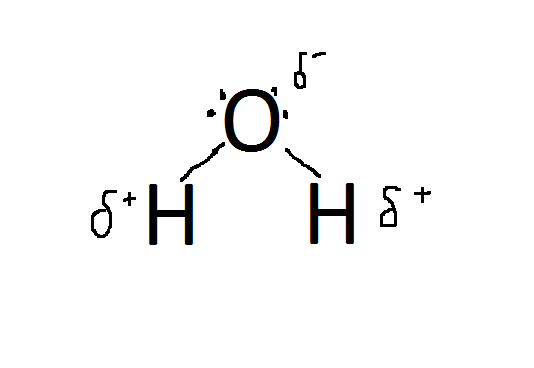
Example: The bent shape and polarity of water allow it to form hydrogen bonds with other molecules.
Hydrogen Bonding in Water
Hydrogen bonds are weak attractions between the partially positive hydrogen atom of one water molecule and the partially negative oxygen atom of another. These bonds are responsible for many of water's unique properties.
Hydrogen bond: An intermolecular force between a hydrogen atom covalently bonded to an electronegative atom (like O or N) and another electronegative atom.
Each water molecule can form up to four hydrogen bonds.
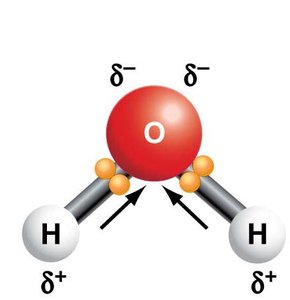
Example: Hydrogen bonding explains why water has a high boiling point compared to similar-sized molecules.
Properties of Water
1. Water as an Excellent Solvent
Water's polarity allows it to dissolve many ionic and polar substances, making it an excellent solvent. This property is crucial for biological reactions and transport of molecules in cells.
Ionic compounds like sodium chloride (NaCl) dissociate in water as the positive and negative ions are stabilized by interactions with the partial charges of water molecules.
Polar molecules such as sugars also dissolve well in water due to hydrogen bonding.
Nonpolar molecules (e.g., oils, fats) do not dissolve in water because they cannot form favorable interactions with water molecules.
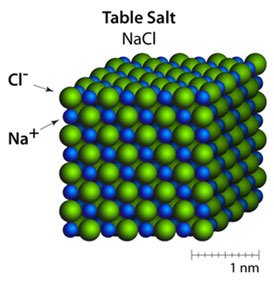
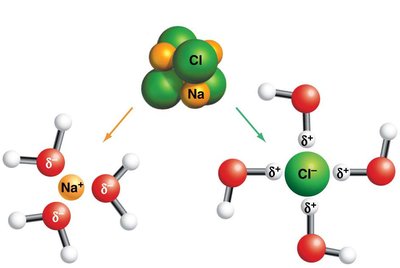
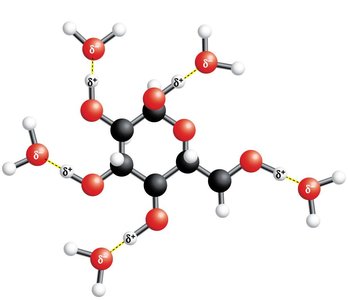
Example: When NaCl is added to water, the Na+ and Cl- ions are surrounded by water molecules, separating them and keeping them dissolved.
2. Cohesion, Adhesion, and Surface Tension
Water molecules stick to each other (cohesion) and to other polar surfaces (adhesion), resulting in high surface tension. These properties are essential for processes like water transport in plants and the formation of droplets.
Cohesion: Attraction between water molecules due to hydrogen bonding.
Adhesion: Attraction between water molecules and other polar or charged surfaces.
Surface tension: The energy required to increase the surface area of a liquid, caused by cohesive forces at the surface.
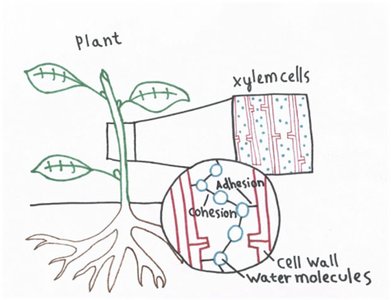
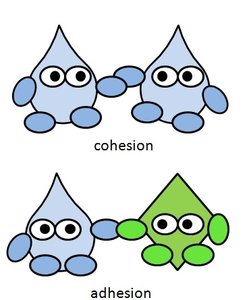
Example: Water moves up plant stems through xylem vessels due to cohesion and adhesion, enabling transpiration.
3. High Specific Heat and Heat of Vaporization
Water can absorb or release large amounts of heat with only a slight change in its own temperature, due to hydrogen bonding. This property helps stabilize temperatures in organisms and environments.
Specific heat: The amount of energy required to raise the temperature of 1 gram of a substance by 1°C.
Heat of vaporization: The energy required to convert 1 gram of a liquid into a gas at its boiling point.
When water evaporates, hydrogen bonds must be broken, which requires significant energy.
Example: Sweating cools the body because the evaporation of water from the skin absorbs heat energy.
Comparison of Bond Types in Water and Other Molecules
Bond Type | Strength | Example |
|---|---|---|
Covalent (polar) | Strong | O-H in H2O |
Hydrogen bond | Weak (individually) | Between H2O molecules |
Ionic bond | Strong (in crystal) | NaCl |
Nonpolar covalent | Strong | C-H in methane |
Additional info: Hydrogen bonds, while weak individually, are collectively strong and give water its unique properties.
Summary Table: Properties of Water
Property | Biological Importance |
|---|---|
Excellent solvent | Facilitates chemical reactions and transport |
Cohesion & Adhesion | Enables water transport in plants |
High specific heat | Stabilizes temperature in organisms |
High heat of vaporization | Allows for evaporative cooling |
Surface tension | Supports small organisms on water surface |
