 Back
Water and Carbon: The Chemical Basis of Life (General Biology, Chapter 2 Study Notes)
Study Guide - Smart Notes
 Tailored notes based on your materials, expanded with key definitions, examples, and context.
Water and Carbon: The Chemical Basis of Life
Atoms, Ions, and Molecules: The Building Blocks of Living Things
All living organisms are composed of atoms, ions, and molecules. Understanding their structure and interactions is fundamental to biology, as these chemical components form the basis for life’s complexity.
Element: A pure chemical substance consisting of one type of atom.
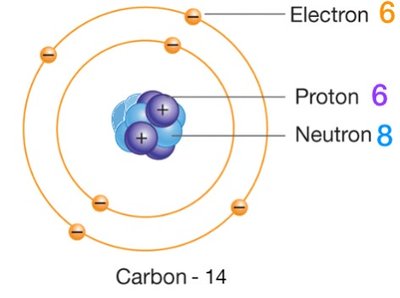
Atom: The smallest unit of an element, electrically neutral, composed of a nucleus (protons and neutrons) and orbiting electrons.
Atomic Number: Number of protons in the nucleus; defines the element.
Mass Number: Sum of protons and neutrons in the nucleus.
Isotopes: Atoms of the same element with different numbers of neutrons, resulting in different masses. Some isotopes are stable, others are radioactive and decay over time.
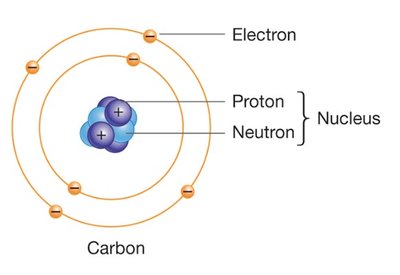
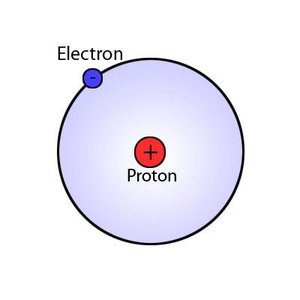
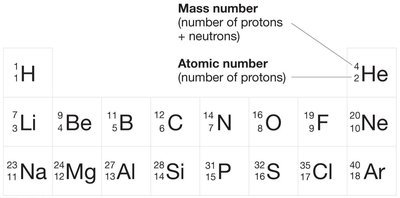
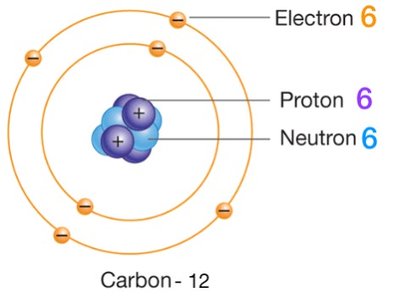
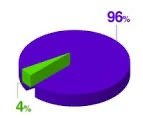
Major elements in living organisms: Hydrogen, carbon, nitrogen, and oxygen make up 96% of matter in organisms.
Electron Arrangement and Chemical Bonds
The arrangement of electrons in atoms determines how they interact and bond with other atoms. The number of unpaired electrons in the valence shell dictates the number of bonds an atom can form.
Covalent Bond: A chemical bond formed when two atoms share one or more pairs of electrons.
Molecule: Two or more atoms held together by covalent bonds (e.g., H2, H2O).
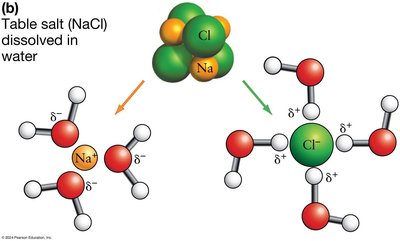
Compound: A substance made of atoms of different elements (e.g., H2O, NaCl).
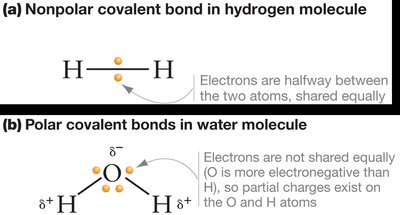
Electronegativity: The ability of an atom to attract electrons in a covalent bond. Oxygen is more electronegative than nitrogen, which is more electronegative than carbon and hydrogen (O > N > C = H).
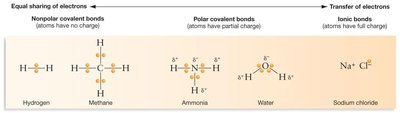
Polar Covalent Bond: Electrons are shared unequally, creating partial charges (e.g., in water).
Nonpolar Covalent Bond: Electrons are shared equally (e.g., in H2 or CH4).
Ions: Atoms or molecules that carry a charge due to loss or gain of electrons.
Cation: Positively charged ion (loss of electron).
Anion: Negatively charged ion (gain of electron).
Ionic Bond: Formed when electrons are completely transferred from one atom to another, resulting in oppositely charged ions that attract each other (e.g., NaCl).
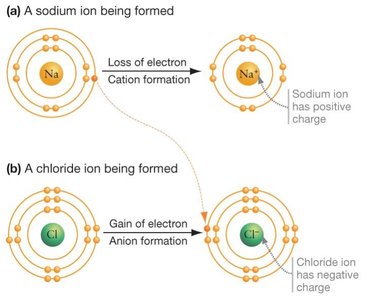
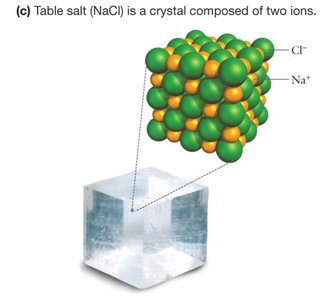
Electron-sharing continuum: Bonds range from equal sharing (nonpolar covalent) to unequal sharing (polar covalent) to complete transfer (ionic).
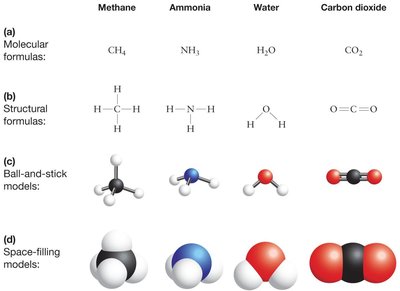
Multiple Bonds: Atoms with more than one unpaired electron can form double or triple bonds.
Properties of Water
Water is essential for life, making up about 75% of a cell’s mass. Its unique properties arise from its molecular structure and ability to form hydrogen bonds.
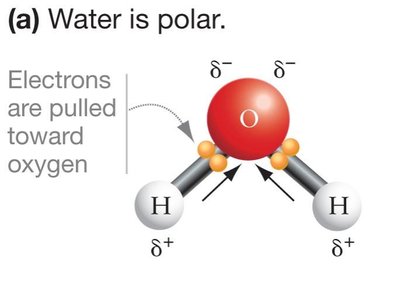
Polarity: Water is a polar molecule with a bent geometry, resulting in partial positive (δ+) charges on hydrogen and a partial negative (δ−) charge on oxygen.
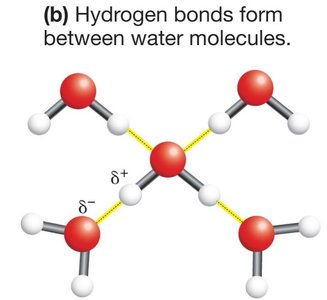
Hydrogen Bonds: Weak electrical attractions between the partial charges of water molecules. These are noncovalent interactions.
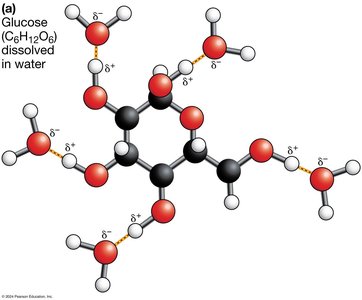
Solvent Properties: Water dissolves ions and polar molecules (hydrophilic), but not nonpolar molecules (hydrophobic).
Hydrophilic: "Water-loving"; ions and polar molecules interact with water’s partial charges and dissolve easily.
Hydrophobic: "Water-fearing"; nonpolar molecules do not dissolve and tend to aggregate via hydrophobic interactions.
Unique Properties of Water
Water’s ability to form hydrogen bonds gives rise to several remarkable properties that are critical for life.
Cohesion: Water molecules stick to each other via hydrogen bonds, resulting in surface tension.
Adhesion: Water molecules stick to other polar or charged surfaces.
Surface Tension: The cohesive force at the surface of water allows light objects to rest on it without sinking.
Density: Water is denser as a liquid than as a solid; ice floats because hydrogen bonds form a crystal lattice that is less dense than liquid water.
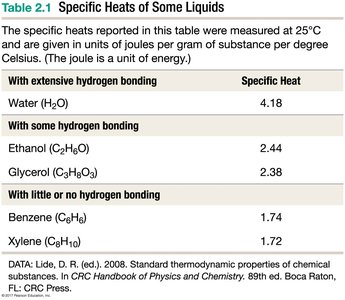
High Specific Heat: Water can absorb a lot of energy before increasing in temperature, due to the energy required to break hydrogen bonds.
High Heat of Vaporization: Water requires a large amount of energy to change from liquid to gas.
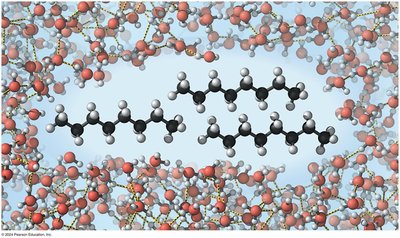
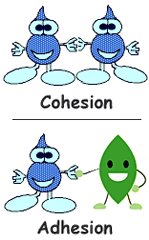
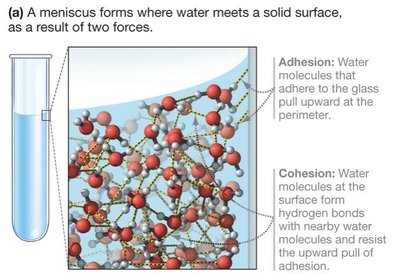
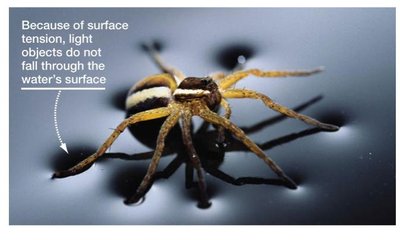
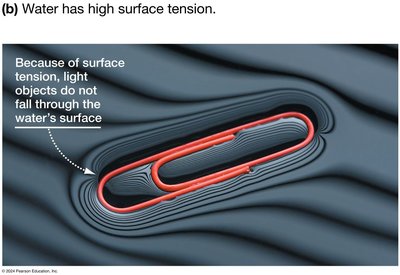
Table: Specific Heats of Some Liquids
Substance | Specific Heat (J/g°C) |
|---|---|
Water (H2O) | 4.18 |
Ethanol (C2H6O) | 2.44 |
Glycerol (C3H8O3) | 2.38 |
Benzene (C6H6) | 1.74 |
Xylene (C8H10) | 1.72 |
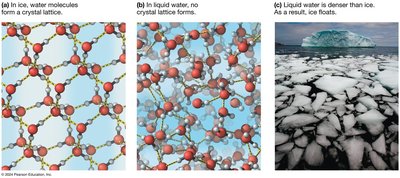
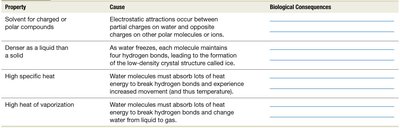
Table: Properties of Water, Causes, and Biological Consequences
Property | Cause | Biological Consequences |
|---|---|---|
Solvent for charged or polar compounds | Electrostatic attractions between partial charges on water and opposite charges on other polar molecules or ions | Facilitates chemical reactions in cells |
Denser as a liquid than a solid | Hydrogen bonds form a low-density crystal lattice in ice | Ice floats, insulating aquatic environments |
High specific heat | Many hydrogen bonds must be broken for water molecules to move faster | Stabilizes temperature in organisms and environments |
High heat of vaporization | Water must absorb lots of heat energy to break hydrogen bonds and change from liquid to gas | Evaporative cooling (e.g., sweating) |
The Role of Water in Acid-Base Chemical Reactions
Water can dissociate into hydrogen ions (H+) and hydroxide ions (OH−), a reversible reaction that reaches equilibrium. The concentration of hydrogen ions determines the acidity or basicity of a solution, measured by the pH scale.
Acid: Substance that donates protons (H+), increasing hydronium ion concentration (H3O+).
Base: Substance that accepts protons, decreasing hydronium ion concentration.
pH Scale: ; pure water has a pH of 7 (neutral).
Acids: pH < 7; Bases: pH > 7; Neutral: pH = 7.
Buffers: Substances that minimize changes in pH, helping maintain homeostasis in organisms.
Example: The solution inside living cells is typically around pH 7, and buffers are crucial for maintaining this stable environment.
