 Back
Water and Carbon: The Chemical Basis of Life
Study Guide - Smart Notes
 Tailored notes based on your materials, expanded with key definitions, examples, and context.
Water and Carbon: The Chemical Basis of Life
Atoms, Ions, and Molecules: The Building Blocks of Chemical Evolution
The origin of life is deeply connected to the chemistry of atoms and molecules. Understanding the structure and behavior of atoms such as hydrogen, carbon, nitrogen, and oxygen is essential for grasping how life began through chemical evolution.
Atom: The smallest identifiable unit of matter, composed of protons, neutrons, and electrons.
Element: A substance consisting entirely of one type of atom, defined by its atomic number (number of protons).
Isotope: Atoms of the same element with different numbers of neutrons, resulting in different mass numbers.
Valence Electrons: Electrons in the outermost shell, determining an atom's bonding behavior.
Covalent Bond: A chemical bond formed by the sharing of electron pairs between atoms.
Ionic Bond: A bond formed by the complete transfer of electrons from one atom to another, resulting in oppositely charged ions.

Example: Carbon has four unpaired valence electrons, allowing it to form four covalent bonds, making it highly versatile in forming complex molecules.
The Electron-Sharing Continuum and Bond Types
The degree to which electrons are shared in chemical bonds forms a continuum from equal sharing (nonpolar covalent bonds) to complete transfer (ionic bonds).
Nonpolar Covalent Bond: Electrons are shared equally (e.g., H2).
Polar Covalent Bond: Electrons are shared unequally due to differences in electronegativity (e.g., H2O).
Ionic Bond: Electrons are transferred, creating ions (e.g., NaCl).
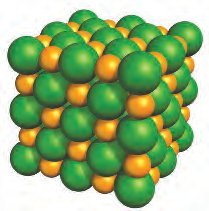
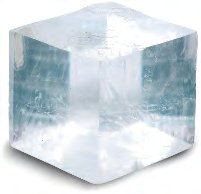
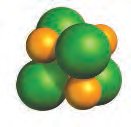
Example: In NaCl, sodium donates an electron to chlorine, forming Na+ and Cl- ions that are held together by ionic bonds.
Molecular Geometry and Representation
The shape of molecules is determined by the arrangement of electron pairs around the central atom, influencing their function and interactions.
Linear: CO2, N2
Tetrahedral: CH4
Bent: H2O
Molecules can be represented as molecular formulas, structural formulas, ball-and-stick models, or space-filling models, each providing different levels of detail about structure and geometry.
Properties of Water and the Early Oceans
Water is the most abundant molecule in living organisms and is essential for life due to its unique properties, which arise from its structure and hydrogen bonding.
Polarity: Water molecules have partial positive (hydrogen) and partial negative (oxygen) charges due to polar covalent bonds and bent geometry.
Hydrogen Bonding: Weak attractions between the partial positive charge on hydrogen and the partial negative charge on oxygen or nitrogen in other molecules.
Solvent Properties: Water dissolves ionic and polar substances (hydrophilic), but not nonpolar substances (hydrophobic).
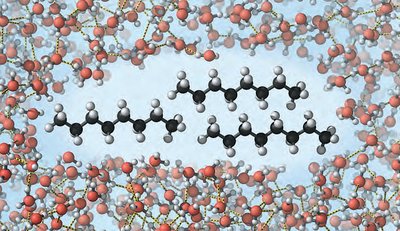
Example: Oil does not dissolve in water because it is nonpolar and hydrophobic, causing water molecules to form a cage-like structure around the oil.
Cohesion, Adhesion, and Surface Tension
Water molecules exhibit cohesion (attraction to each other) and adhesion (attraction to other substances), leading to phenomena such as surface tension and the formation of a meniscus in a glass tube.
Cohesion: Responsible for water's high surface tension.
Adhesion: Allows water to climb up plant vessels and adhere to surfaces.

Density and Phase Changes of Water
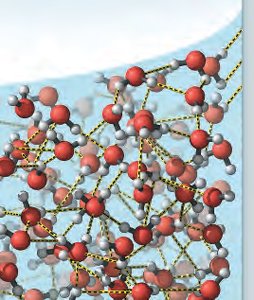
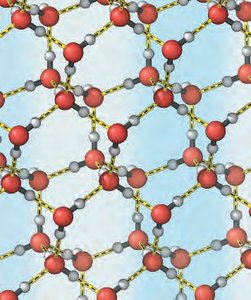
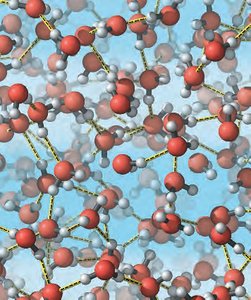
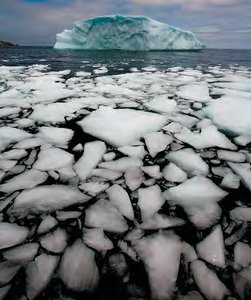
Unlike most substances, water is denser as a liquid than as a solid. Ice floats because its molecules form a crystalline lattice with more open space, which is crucial for aquatic life in cold climates.
Water's High Specific Heat and Heat of Vaporization
Water can absorb or release large amounts of energy with little change in temperature due to hydrogen bonding. This property stabilizes temperatures in organisms and environments.
Specific Heat: Energy required to raise the temperature of 1 gram of water by 1°C.
Heat of Vaporization: Energy required to convert 1 gram of water from liquid to gas.
Acids, Bases, and pH
Water can dissociate into hydrogen ions (H+) and hydroxide ions (OH-), allowing it to participate in acid-base reactions. The concentration of H+ ions determines the pH of a solution.
Acid: Donates protons (H+), increasing hydronium ion concentration.
Base: Accepts protons, decreasing hydronium ion concentration.
pH: Defined as
Buffer: Compounds that minimize changes in pH, maintaining homeostasis.
Chemical Reactions, Energy, and Chemical Evolution
Chemical evolution describes how simple molecules present on early Earth reacted to form more complex organic molecules, eventually leading to life. Chemical reactions involve the breaking and forming of bonds, with energy changes and entropy (disorder) playing key roles.
Potential Energy: Stored energy in chemical bonds; lower in products of spontaneous reactions.
Kinetic Energy: Energy of motion, including thermal energy (heat).
Spontaneous Reaction: Occurs without external energy input if products have lower potential energy and/or higher entropy than reactants.
Second Law of Thermodynamics: Entropy of the universe increases in spontaneous processes.


Investigating Chemical Evolution: Miller's Experiment
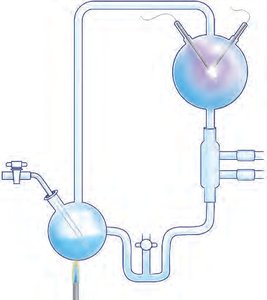
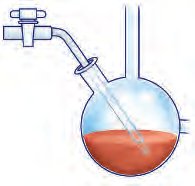
Stanley Miller's 1953 experiment simulated early Earth conditions to test whether simple molecules could form complex organic compounds. By exposing a mixture of methane, ammonia, hydrogen, and water vapor to electrical sparks (simulating lightning), Miller demonstrated the formation of amino acids and other organic molecules, supporting the theory of chemical evolution.
Life Is Carbon-Based: Organic Molecules and Functional Groups
Carbon's ability to form four covalent bonds makes it the backbone of organic molecules. The diversity of organic molecules arises from different arrangements of carbon atoms and the presence of functional groups, which determine chemical reactivity and properties.
Functional Groups: Specific groups of atoms (e.g., amino, carboxyl, hydroxyl, phosphate, sulfhydryl, carbonyl) that confer distinct chemical properties.
Macromolecules: Large molecules (proteins, nucleic acids, carbohydrates) formed by polymerization of smaller subunits (monomers).
Condensation (Dehydration) Reaction: Joins monomers by removing water.
Hydrolysis: Breaks polymers into monomers by adding water.
Example: Amino acids (monomers) link to form proteins (polymers) via condensation reactions.
Functional Group | Family of Molecules | Properties | Example |
|---|---|---|---|
Amino | Amines | Acts as a base, attracts protons | Glycine |
Carboxyl | Carboxylic acids | Acts as an acid, loses protons | Acetic acid |
Carbonyl | Aldehydes, Ketones | Site for reactions that link molecules | Acetaldehyde, Acetone |
Hydroxyl | Alcohols | Highly polar, forms hydrogen bonds | Ethanol |
Phosphate | Organic phosphates | Stores chemical energy, affects structure | 3-Phosphoglyceric acid |
Sulfhydryl | Thiols | Forms disulfide bonds in proteins | Cysteine |
Additional info: The study of water and carbon chemistry is foundational for understanding the origin of life, the structure and function of biological macromolecules, and the chemical processes that sustain living organisms.
