 Back
Water and Carbon: The Chemical Basis of Life – Study Notes
Study Guide - Smart Notes
 Tailored notes based on your materials, expanded with key definitions, examples, and context.
Chapter 2: Water and Carbon – The Chemical Basis of Life
Introduction
This chapter explores the atomic and molecular foundations of life, focusing on the structure of atoms, the nature of chemical bonds, and the unique properties of water and carbon that make life possible. Understanding these concepts is essential for grasping how biological molecules form and interact.
Basic Atomic Structure
Atoms: The Building Blocks of Matter
Atoms are the smallest units of matter that retain the properties of an element.
Composed of protons (positively charged), neutrons (neutral), and electrons (negatively charged).
Protons and neutrons are located in the nucleus; electrons occupy orbitals surrounding the nucleus.
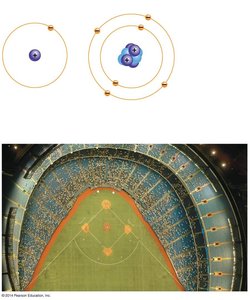
Example: If an atom were the size of a stadium, the nucleus would be the size of a pea, illustrating how most of an atom's volume is empty space.
Elements and Atomic Number
An element is defined by its atomic number, which is the number of protons in its nucleus.
Atoms with the same atomic number have the same chemical properties and belong to the same element.
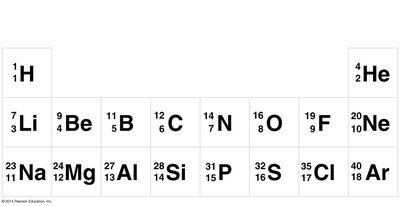
Example: Carbon (C) always has 6 protons; oxygen (O) always has 8.
Electron Arrangement
Electrons occupy orbitals, which are grouped into electron shells (energy levels).
Each shell has a specific number of orbitals and can hold a set number of electrons (first shell: 2, second shell: 8, etc.).
Electrons fill the innermost shells first.
The number of unpaired electrons in the outermost shell (valence shell) determines an atom's chemical reactivity.
Chemical Bonds and Interactions
Covalent Bonds
Formed when atoms share pairs of electrons to fill their valence shells.
Nonpolar covalent bonds: Electrons are shared equally (e.g., H2).
Polar covalent bonds: Electrons are shared unequally due to differences in electronegativity (e.g., H2O).
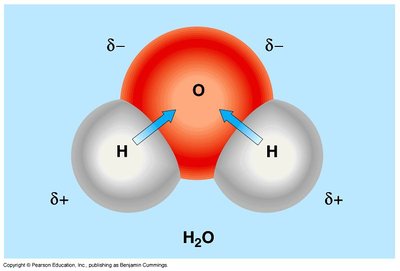
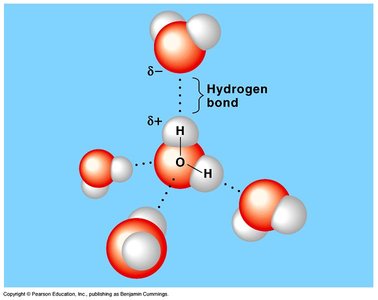
Example: In water, oxygen is more electronegative than hydrogen, resulting in partial charges (δ− on O, δ+ on H).
Ionic Bonds
Occur when one atom transfers an electron to another, forming charged ions.
Cation: Positively charged ion (loses electron).
Anion: Negatively charged ion (gains electron).
The electrostatic attraction between oppositely charged ions forms an ionic bond.
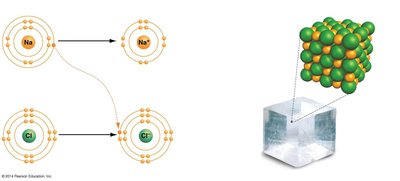
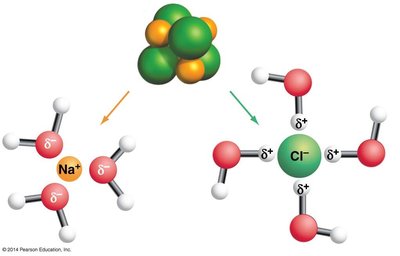
Example: Sodium (Na) loses an electron to become Na+; chlorine (Cl) gains an electron to become Cl−; together they form NaCl (table salt).
The Electron-Sharing Continuum
Chemical bonds exist on a continuum from equal sharing (nonpolar covalent) to unequal sharing (polar covalent) to complete transfer (ionic).
Water: Structure and Properties
Polarity and Hydrogen Bonding
Water is a polar molecule due to the unequal sharing of electrons between oxygen and hydrogen.
The polarity allows water molecules to form hydrogen bonds with each other.
Water as a Solvent
Water's polarity makes it an excellent solvent for ions and polar molecules (hydrophilic substances).
Hydrophobic molecules (nonpolar, uncharged) do not dissolve in water.
Cohesion and Adhesion
Cohesion: Attraction between like molecules (water to water), resulting in high surface tension.
Adhesion: Attraction between unlike molecules (water to other substances).
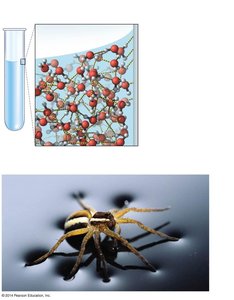
Example: Water forms a meniscus in a glass tube due to adhesion to glass and cohesion among water molecules.
Thermal Properties of Water
Water has a high specific heat (amount of energy required to raise the temperature of 1g by 1°C) and a high heat of vaporization (energy required to convert 1g from liquid to gas).
These properties moderate Earth's climate and help organisms maintain stable internal temperatures.

Density of Water and Ice
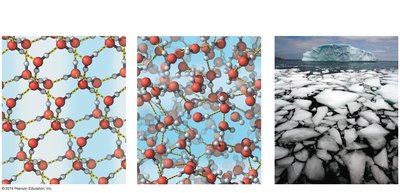
Water is less dense as a solid (ice) than as a liquid because hydrogen bonds form a crystal lattice in ice, spacing molecules farther apart.
This property allows ice to float, insulating aquatic life in cold environments.
Carbon: The Backbone of Life
Importance and Versatility of Carbon
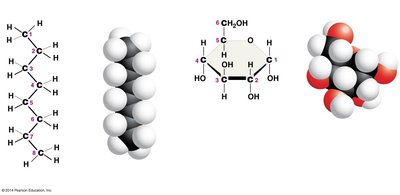
Carbon atoms have four valence electrons, allowing them to form up to four covalent bonds.
This versatility enables the formation of a wide variety of molecular shapes and complex organic molecules.
Carbon is the second most abundant element in the human body and is essential for all life forms.
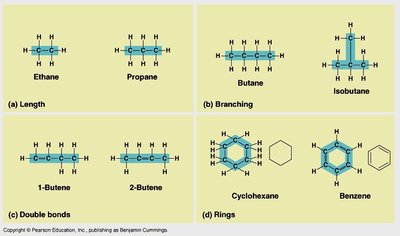
Variations in Carbon Skeletons
Carbon skeletons can vary in length, branching, presence of double bonds, and ring structures.
Functional Groups
Functional groups are specific groups of atoms attached to carbon skeletons that determine the chemical behavior of organic molecules.
Major functional groups include:
Amino (–NH2): Acts as a base, attracts protons.
Carboxyl (–COOH): Acts as an acid, donates protons.
Carbonyl (–C=O): Important in linking molecules into larger compounds.
Hydroxyl (–OH): Acts as a weak acid, forms hydrogen bonds.
Phosphate (–PO42−): Has two negative charges, stores energy.
Sulfhydryl (–SH): Forms disulfide bonds, stabilizing protein structure.
Summary Table: Major Functional Groups
Functional Group | Structure | Properties |
|---|---|---|
Amino | –NH2 | Acts as a base, attracts protons |
Carboxyl | –COOH | Acts as an acid, donates protons |
Carbonyl | –C=O | Links molecules into larger compounds |
Hydroxyl | –OH | Weak acid, forms hydrogen bonds |
Phosphate | –PO42− | Two negative charges, stores energy |
Sulfhydryl | –SH | Forms disulfide bonds |
Conclusion: The unique properties of water and carbon, including their bonding capabilities and interactions, are fundamental to the chemistry of life. Mastery of these concepts is essential for further study in biology.
