 Back
Water and Carbon: The Chemical Basis of Life
Study Guide - Smart Notes
 Tailored notes based on your materials, expanded with key definitions, examples, and context.
Water and Carbon: The Chemical Basis of Life
Atoms, Elements, and Their Abundance in Life
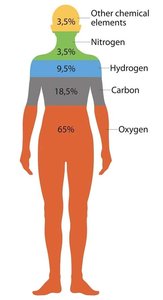
All matter is composed of atoms, which are the smallest units of elements. Although many elements exist, life on Earth is primarily built from a small subset of these elements. The most abundant elements in living organisms are oxygen, carbon, hydrogen, and nitrogen, with smaller contributions from sulfur and phosphorus.
Atom: The basic unit of matter, consisting of protons, neutrons, and electrons.
Element: A substance made entirely of one type of atom.
Major elements in life: Oxygen (O), Carbon (C), Hydrogen (H), Nitrogen (N), Sulfur (S), Phosphorus (P).
Atomic Structure
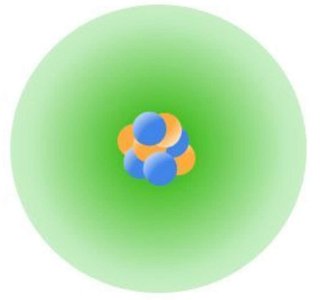
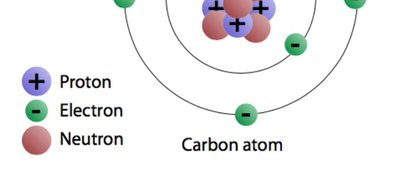
Atoms are composed of a central nucleus containing protons and neutrons, surrounded by electrons in orbitals. The arrangement of these subatomic particles determines the chemical properties of each element.
Protons: Positively charged particles with significant mass.
Neutrons: Neutral particles with similar mass to protons.
Electrons: Negatively charged particles with very little mass, occupying regions called orbitals.
Electron Orbitals and Energy Shells
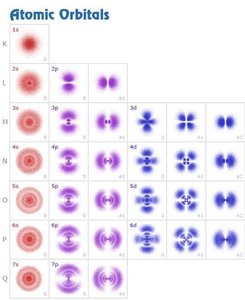
Electrons occupy orbitals, which are regions of space where they are likely to be found. Orbitals are organized into energy shells around the nucleus. The arrangement of electrons in these shells determines how atoms interact and bond with each other.
Schrödinger Wave Equation: Predicts the probability field of an electron in an atom.
Orbitals: Each orbital can hold up to two electrons.
Energy shells: Groups of orbitals with similar energy levels; atoms are most stable when their outermost shell is full.
Electron Configuration and the Aufbau Principle
The arrangement of electrons in an atom follows the Aufbau Principle, which states that electrons fill the lowest energy orbitals first before occupying higher energy levels. This configuration influences the chemical reactivity of elements.
Aufbau Principle: Electrons fill orbitals from lowest to highest energy.
Valence electrons: Electrons in the outermost shell, crucial for chemical bonding.
Chemical Bonds: Covalent, Ionic, and Hydrogen Bonds
Atoms form chemical bonds to achieve stable electron configurations. The type of bond formed depends on the difference in electronegativity between the atoms involved.
Nonpolar Covalent Bonds: Electrons are shared equally between atoms (e.g., H2, O2).
Polar Covalent Bonds: Electrons are shared unequally, resulting in partial charges (e.g., H2O).
Ionic Bonds: Electrons are transferred from one atom to another, creating ions (e.g., NaCl).
Hydrogen Bonds: Weak attractions between a hydrogen atom with a partial positive charge and another atom with a partial negative charge (commonly O or N).
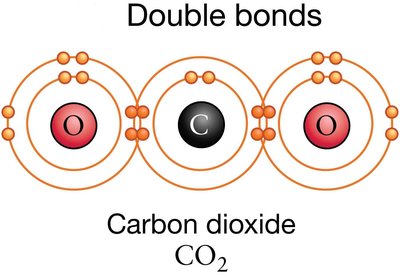
Electronegativity and Bond Polarity
Electronegativity is the tendency of an atom to attract electrons in a bond. Differences in electronegativity between atoms determine whether a bond is nonpolar covalent, polar covalent, or ionic.
High electronegativity: Atoms like oxygen and nitrogen attract electrons strongly.
Bond polarity: Polar bonds have partial charges; nonpolar bonds do not.
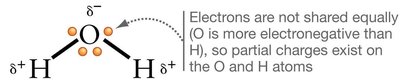
Molecular Shape and Polarity
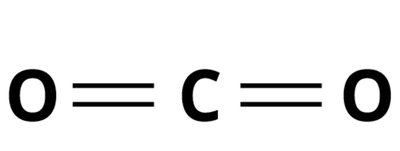
The shape of a molecule affects its overall polarity. For example, carbon dioxide (CO2) has polar bonds, but its linear shape causes the dipoles to cancel, making the molecule nonpolar.
Symmetry: Symmetrical molecules can be nonpolar even if they contain polar bonds.
Example: CO2 is nonpolar due to its linear geometry.
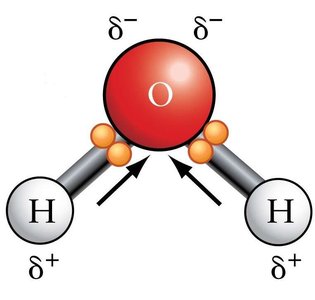
Properties of Water and Hydrogen Bonding
Water is a polar molecule capable of forming hydrogen bonds, which are responsible for many of its unique properties, such as high cohesion, surface tension, and its ability to dissolve many substances.
Hydrogen bonds: Form between the partial positive charge on hydrogen and the partial negative charge on oxygen or nitrogen in another molecule.
Solvent properties: Water dissolves polar and ionic substances but not nonpolar molecules.
Hydrophilic and Hydrophobic Molecules
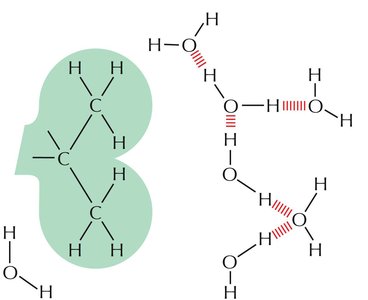
Molecules with polar covalent bonds are hydrophilic (water-loving) and dissolve in water, while molecules with nonpolar covalent bonds are hydrophobic (water-fearing) and do not dissolve in water.
Hydrophilic: Polar molecules that interact with water via hydrogen bonds.
Hydrophobic: Nonpolar molecules that do not interact with water.
Summary Table: Types of Chemical Bonds
Bond Type | Electron Sharing | Polarity | Example |
|---|---|---|---|
Nonpolar Covalent | Equal | None | H2, CH4 |
Polar Covalent | Unequal | Partial | H2O, NH3 |
Ionic | Transferred | Full | NaCl |
Key Equations
Electronegativity difference and bond type:
Water as a solvent: Ion-dipole interactions allow water to dissolve ionic compounds.
Additional info: The notes above expand on the original content by providing definitions, examples, and a summary table for clarity and completeness.
