 Back
Water and Carbon: The Chemical Basis of Life
Study Guide - Smart Notes
 Tailored notes based on your materials, expanded with key definitions, examples, and context.
Water and Carbon: The Chemical Basis of Life
Introduction
This chapter explores the chemical foundations of life, focusing on the unique properties of water and carbon. Understanding these molecules is essential for grasping how life evolved and functions at the molecular level.
The Unique Properties of Water
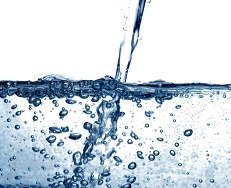
Water Supports Life
Water is fundamental to all known forms of life. Its ability to exist in all three physical states (solid, liquid, gas) and act as an excellent solvent makes Earth habitable and supports biological processes.
Key Point: Life on Earth began in water and evolved there for billions of years before spreading to land.
Key Point: Water's fitness for life is due to its chemical and physical properties.
Example: Water is used to transport nutrients and wastes in organisms.

Polar Molecule and Hydrogen Bonding
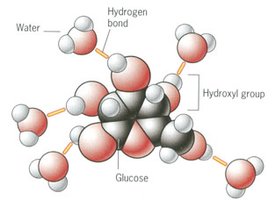
Water is a polar molecule, meaning it has a partial positive charge on one side and a partial negative charge on the other. This polarity allows water molecules to form hydrogen bonds, which are weak individually but strong collectively.
Key Point: Hydrogen bonds are not true bonds but are biologically significant due to their collective strength.
Key Point: The bent shape of water molecules is crucial for hydrogen bonding.
Example: If water were linear, hydrogen bonding would decrease in strength.
Water as an Efficient Solvent
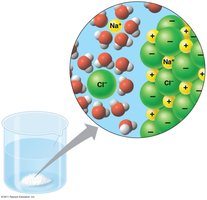
Water's polarity enables it to dissolve a wide range of substances, making it an efficient solvent. Hydrophilic substances (polar or ionic) dissolve easily, while hydrophobic substances (nonpolar) do not.
Key Point: Nonionic polar solutes, such as glucose, dissolve in water due to hydrogen bonding.
Key Point: Ionic compounds dissolve in water, forming hydration shells around ions.
Key Point: Nonpolar molecules, like octane, do not dissolve in water.
Cohesion, Adhesion, and Surface Tension
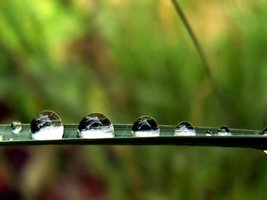
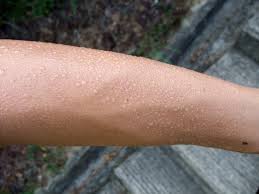
Water molecules exhibit cohesion (attraction to each other), adhesion (attraction to other substances), and high surface tension. Surface tension results from the cohesion of water molecules at the surface, allowing certain organisms to walk on water.
Key Point: Surface tension minimizes the total surface area of water.
Example: Water droplets on a leaf demonstrate surface tension.

Density and States of Water
Water is denser as a liquid than as a solid. Ice floats because its molecules are more spread apart, forming a lattice structure. This property is crucial for aquatic life.
Key Point: If ice did not float, aquatic ecosystems would be threatened.
High Capacity for Absorbing Energy
Water has a high specific heat, meaning it can absorb a large amount of heat without a significant change in temperature. This property moderates Earth's climate and helps organisms maintain stable internal temperatures.
Key Point: Specific heat is the energy required to raise the temperature of 1 g of a substance by 1°C.
Key Point: Heat of vaporization is high for water, enabling evaporative cooling in organisms.
Example: Sweating and transpiration dissipate heat and produce a cooling effect.
Dissociation of Water and pH
Dissociation of Water
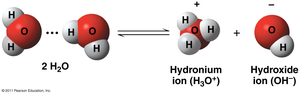
Water can dissociate into hydronium (H3O+) and hydroxide (OH-) ions. This process is rare but biologically relevant, as it affects the pH of solutions.
Key Point: In pure water, [H+] is 1 × 10⁻⁷ M.
Equation:
Acids, Bases, and the pH Scale
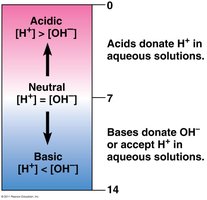
The pH scale measures the concentration of hydrogen ions in a solution. Acids increase [H+], bases decrease it. The scale ranges from 0 (acidic) to 14 (basic), with 7 being neutral.
Key Point: pH is calculated as
Key Point: Each pH unit represents a tenfold difference in ion concentration.
Example: Biological fluids typically have pH values between 6 and 8.
Buffers and Biological Importance
Buffers
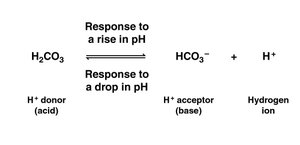
Buffers are substances that minimize changes in pH by accepting or donating H+ ions. They are crucial for maintaining homeostasis in living organisms.
Key Point: Most buffers consist of weak acids and their corresponding bases.
Example: Carbonic acid acts as a buffer in human blood.
Carbon: The Element of Life
Organic Molecules and Carbon's Properties
Carbon is the backbone of biological macromolecules. It forms stable covalent bonds with up to four different atoms, allowing for a diversity of organic compounds.
Key Point: Carbon's ability to form C-C bonds was crucial in chemical evolution.
Key Point: Organic molecules contain carbon bonded to other elements.
Functional Groups in Organic Molecules
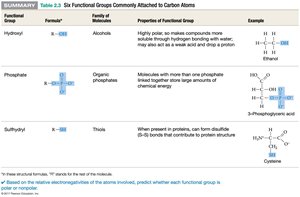
Functional groups are specific groups of atoms within molecules that determine their chemical properties and reactivity. Common functional groups include hydroxyl, phosphate, and sulfhydryl.
Key Point: Functional groups influence the solubility, reactivity, and biological activity of organic molecules.
Example: Alcohols contain hydroxyl groups, which make them highly polar.
Functional Group | Formula | Family of Molecules | Properties | Example |
|---|---|---|---|---|
Hydroxyl | –OH | Alcohols | Highly polar; forms hydrogen bonds; increases solubility | Ethanol |
Phosphate | –PO4 | Organic phosphates | Contributes negative charge; stores chemical energy | 3-Phosphoglyceric acid |
Sulfhydryl | –SH | Thiols | Can form disulfide bonds; important for protein structure | Cysteine |
Learning Outcomes
Describe the structure of an atom and the role of electrons in forming bonds and interactions between atoms that form molecules.
Explain how the structure of water molecules relates to water's unusual properties and to its importance to life.
List the properties of water that make it a good solvent, and distinguish between hydrophilic and hydrophobic substances.
Explain how the molarity of a solution is used to measure the concentration of solutes in solution.
Explain how H2O can ionize into hydroxide ions (OH-) and hydrogen ions (H+), and how the H+ concentration is expressed as a solution’s pH.
Give examples of how buffers maintain a stable environment in an organism’s body fluids.
Explain the properties of carbon that make it the chemical basis of all life.
Describe the variety and chemical characteristics of common functional groups of organic compounds.
