 Back
Water and Carbon: The Chemical Basis of Life (General Biology Study Notes)
Study Guide - Smart Notes
 Tailored notes based on your materials, expanded with key definitions, examples, and context.
Water & Carbon – The Chemical Basis of Life
Introduction to Chemical Evolution
The origin of life is a central question in biology. The leading explanation is chemical evolution, where simple molecules present on early Earth underwent reactions to form more complex molecules, eventually leading to life. This process involved the acquisition of membranes, metabolic activity, and the onset of natural selection, bridging chemical and biological evolution.
Atoms, Ions, and Molecules
Basic Atomic Structure
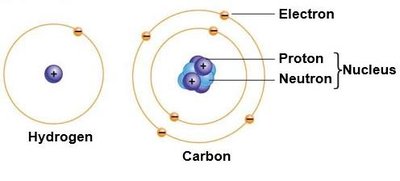
Atoms are the fundamental units of matter. Four types—hydrogen, carbon, nitrogen, and oxygen—make up 96% of living organisms. Understanding their structure is essential for grasping chemical evolution.
Protons: Positively charged particles in the nucleus
Neutrons: Neutral particles in the nucleus
Electrons: Negatively charged particles in orbitals around the nucleus
Atoms are electrically neutral when protons = electrons
Atomic Number, Mass Number, and Atomic Weight
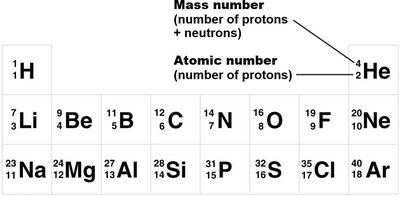
Atomic Number: Number of protons in the nucleus; defines the element
Mass Number: Total number of protons and neutrons
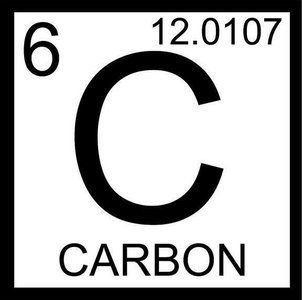
Atomic Weight: Average mass of all naturally occurring isotopes, weighted by abundance
Isotopes and Radioactivity
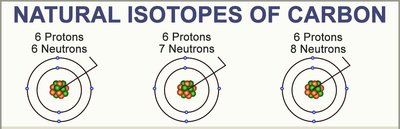
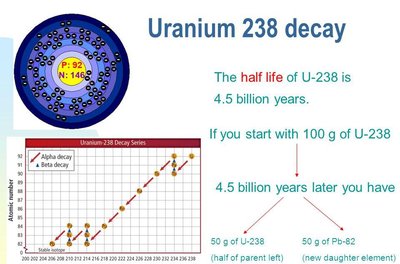
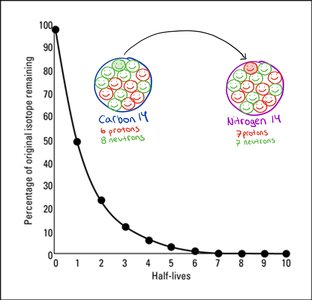
Isotopes are forms of an element with different numbers of neutrons. Most are stable, but some are radioactive and decay over time, which is useful for dating materials (e.g., radiocarbon dating, uranium-lead dating).
The Mole Concept
The mole is a standard unit for counting atoms and molecules. One mole contains particles (Avogadro's number). The mass of one mole of an element (in grams) equals its atomic weight.
Molecular Weight: Sum of atomic weights of all atoms in a molecule
Molarity (M): Concentration of a substance in solution, expressed as moles per liter
Chemical Bonds and Molecular Structure
Electron Shells and Valence
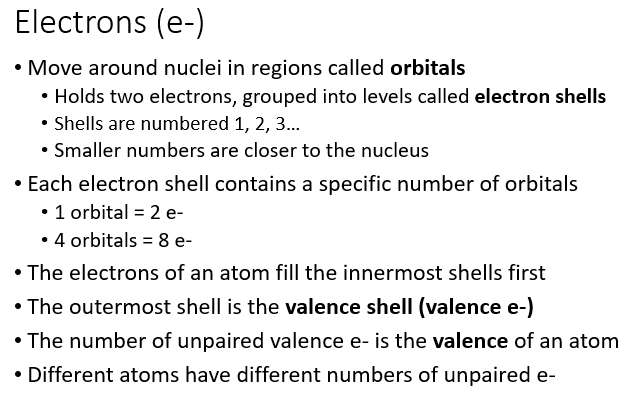
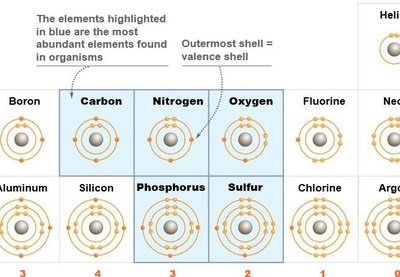
Electrons occupy regions called orbitals, grouped into electron shells. The outermost shell is the valence shell, and the number of unpaired electrons in this shell determines an atom's valence (bonding capacity).
Covalent Bonds
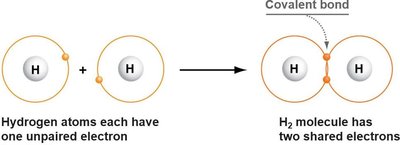
Covalent bonds form when atoms share pairs of electrons to fill their valence shells, resulting in stable molecules. If the atoms are of different elements, the molecule is called a compound.
Electronegativity and Bond Polarity
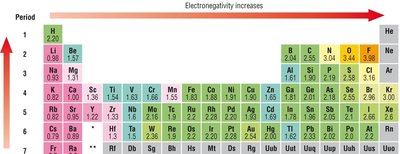
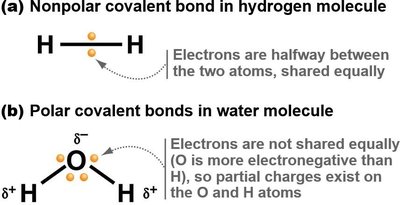
Atoms differ in electronegativity, the ability to attract electrons. When electrons are shared equally, the bond is nonpolar covalent. When shared unequally, the bond is polar covalent, creating partial charges.
Ionic Bonds
Ionic bonds form when electrons are transferred from one atom to another, resulting in charged ions (cations and anions) that attract each other.

The Electron-Sharing Continuum
Bonds exist on a continuum from equal sharing (nonpolar covalent) to unequal sharing (polar covalent) to complete transfer (ionic).
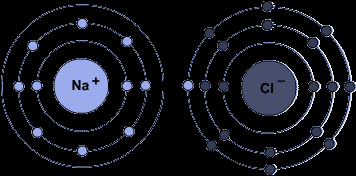
Properties of Water
Water as a Universal Solvent
Water is essential for life due to its ability to dissolve a wide range of substances, facilitating chemical reactions. Its polarity allows it to interact with ions and polar molecules (hydrophilic), but not with nonpolar molecules (hydrophobic).

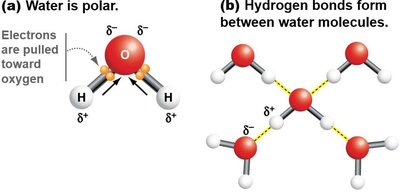
Hydrogen Bonds and Water's Unique Properties
Hydrogen bonds are weak attractions between the partial positive charge of hydrogen in one molecule and the partial negative charge of another atom (often oxygen or nitrogen). These bonds give water its remarkable properties:
Cohesion: Water molecules stick to each other
Adhesion: Water molecules stick to other surfaces
Surface Tension: Water forms a 'skin' at its surface
Density: Water is denser as a liquid than as a solid (ice floats)
High Specific Heat: Water absorbs a lot of energy before changing temperature
High Heat of Vaporization: Water requires much energy to evaporate
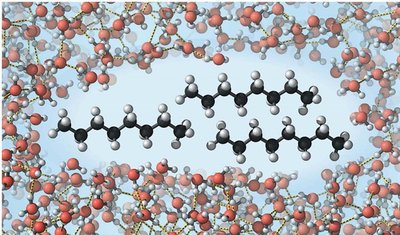
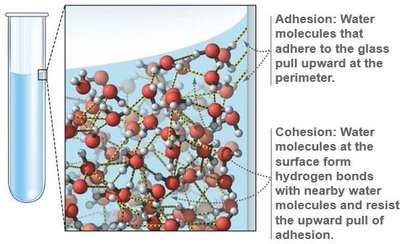
Biological Consequences of Water's Properties
Facilitates transport in plants and animals
Moderates Earth's climate
Ice insulates aquatic environments

Water in Acid–Base Chemical Reactions
Water can dissociate into hydrogen ions (H+) and hydroxide ions (OH-), establishing a chemical equilibrium. The concentration of H+ ions determines the pH of a solution.
Acids: Donate protons (increase H+ concentration)
Bases: Accept protons (decrease H+ concentration)
Buffers: Maintain stable pH in biological systems
The pH scale is logarithmic:
Chemical Reactions, Energy, and Chemical Evolution
Energy in Chemical Reactions
Energy is the capacity to do work or supply heat. It exists as potential energy (stored) and kinetic energy (movement). In molecules, potential energy is stored in chemical bonds.
Exothermic reactions: Release energy; products have lower potential energy
Endothermic reactions: Absorb energy; products have higher potential energy
The first law of thermodynamics states that energy cannot be created or destroyed, only transformed.
Spontaneity and Entropy
A chemical reaction is spontaneous if it proceeds without added energy. Spontaneity is favored when:
Products are less ordered (entropy increases)
Products have lower potential energy than reactants
The second law of thermodynamics states that entropy (disorder) always increases in spontaneous processes.
Models for the Origin of Life
Prebiotic Soup Model: Life began in a 'soup' of molecules in the early oceans, energized by lightning and UV radiation.
Surface Metabolism Model: Life began on mineral surfaces, where molecules were concentrated and reacted.
Polymerization and Organic Molecules
Polymerization Reactions
Polymerization is the process of linking monomers to form polymers. Two key reactions:
Condensation (Dehydration Synthesis): Monomers join, releasing water; decreases entropy, requires energy (endergonic)
Hydrolysis: Polymers break apart by adding water; increases entropy, releases energy (exergonic)
These reactions are reversible and reach chemical equilibrium.
Importance of Carbon and Functional Groups
Carbon's four valence electrons allow it to form diverse and complex molecules, making it the backbone of organic chemistry. Organic molecules often contain functional groups that determine their chemical behavior:
Functional Group | Properties |
|---|---|
Amino | Acts as a base, attracts protons |
Carboxyl | Acts as an acid, donates protons |
Carbonyl | Sites for linking molecules |
Hydroxyl | Acts as a weak acid |
Phosphate | Has two negative charges |
Sulfhydryl | Forms disulfide bonds |
Summary: The chemical properties of water and carbon are foundational to life, enabling the formation of complex molecules and the emergence of biological systems through chemical evolution.
