 Back
Water and Carbon: The Chemical Basis of Life (Chapter 2 Study Notes)
Study Guide - Smart Notes
 Tailored notes based on your materials, expanded with key definitions, examples, and context.
Water and Carbon: The Chemical Basis of Life
Overview
This chapter explores the fundamental chemical principles that underlie biological systems, focusing on atomic structure, chemical bonding, the properties of water, and the importance of carbon in organic molecules. Understanding these concepts is essential for grasping how life is possible at the molecular level.
Basic Atomic Structure
Atoms and Subatomic Particles
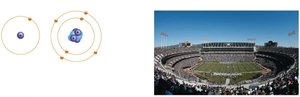
Atoms are the basic units of matter, composed of three types of subatomic particles:
Protons: Positively charged particles located in the nucleus.
Neutrons: Neutral particles also found in the nucleus.
Electrons: Negatively charged particles that orbit the nucleus in electron shells.
Atoms are electrically neutral when they have equal numbers of protons and electrons.
Atomic Number, Mass Number, and Isotopes
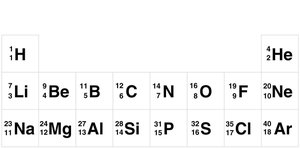
Atomic Number: The number of protons in an atom, which defines the element.
Mass Number: The sum of protons and neutrons in the nucleus.
Isotopes: Atoms of the same element with different numbers of neutrons, resulting in different masses (e.g., Carbon-12, Carbon-13, Carbon-14).
Atomic mass is measured in Daltons (Da).
Chemical Bonds and Valence
Valence and Electron Configuration
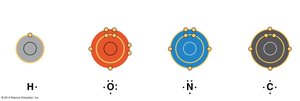
The valence of an atom is the number of unpaired electrons in its outermost shell, determining how many bonds it can form. The major elements in organic molecules have the following valences:
Hydrogen: 1
Oxygen: 2
Nitrogen: 3
Carbon: 4
Covalent Bonds
Covalent bonds form when two atoms share one or more pairs of electrons, allowing each atom to achieve a full outer shell. Molecules are groups of atoms held together by covalent bonds. Compounds are molecules composed of different elements.
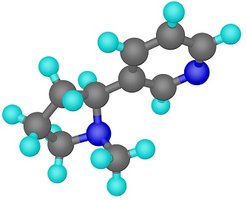
Electronegativity and Bond Polarity
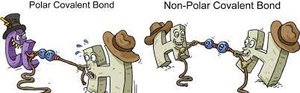
Electronegativity is an atom's ability to attract electrons in a covalent bond. Differences in electronegativity lead to:
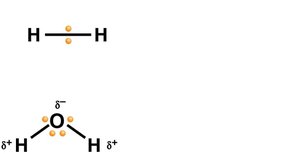
Nonpolar covalent bonds: Electrons are shared equally (e.g., C–H bond).
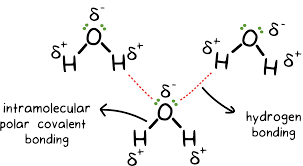
Polar covalent bonds: Electrons are shared unequally, resulting in partial charges (e.g., O–H bond).
Electronegativity increases up and to the right on the periodic table (O > N > S, C, H, P).
Hydrogen Bonds
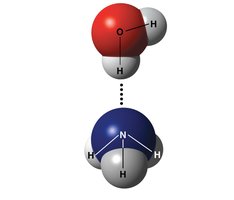
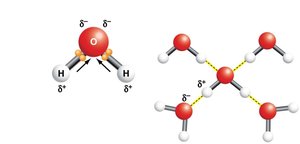
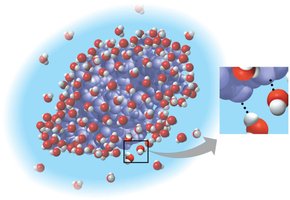
Hydrogen bonds are weak attractions between the partially positive hydrogen atom of one polar molecule and a partially negative atom (often oxygen or nitrogen) of another molecule. These bonds are crucial for the properties of water and the structure of biological macromolecules.
Ionic Bonds and Ions
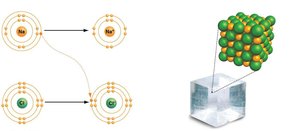
Ionic bonds form when electrons are transferred from one atom to another, resulting in charged particles called ions:
Cation: Positively charged ion (loss of electron).
Anion: Negatively charged ion (gain of electron).
Ionic bonds are the electrostatic attractions between oppositely charged ions (e.g., NaCl).
Electron-Sharing Continuum
Chemical bonds exist on a continuum based on how electrons are distributed:
Nonpolar covalent: Equal sharing, no charge.
Polar covalent: Unequal sharing, partial charges.
Ionic: Complete transfer, full charges.
Single, Double, and Triple Bonds
Atoms can share one, two, or three pairs of electrons, forming single, double, or triple bonds, respectively (e.g., H2O, CO2, N2).
Properties of Water
Water as a Solvent
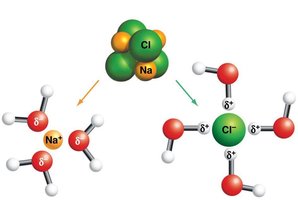
Water is an excellent solvent due to its polarity and ability to form hydrogen bonds. A solution consists of a solute dissolved in a solvent. Most biochemical reactions occur in aqueous solutions.
Polarity and Hydrogen Bonding in Water
Water molecules are polar, with partial negative charge on oxygen and partial positive charges on hydrogens. This allows water molecules to form hydrogen bonds with each other and with other polar or charged substances.
Hydrophilic and Hydrophobic Substances
Hydrophilic ("water-loving"): Ions and polar molecules that dissolve easily in water due to favorable interactions with water's partial charges.
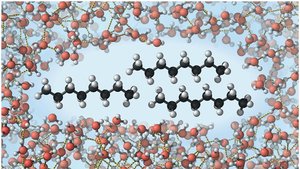
Hydrophobic ("water-fearing"): Nonpolar molecules that do not dissolve in water and tend to aggregate due to hydrophobic interactions.
Unique Properties of Water
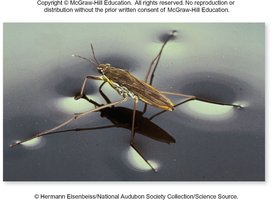
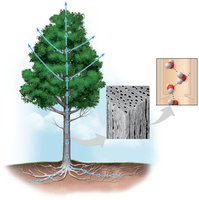
Cohesion: Water molecules stick to each other due to hydrogen bonding, resulting in high surface tension.
Adhesion: Water molecules stick to other polar or charged surfaces.
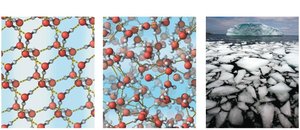
Density: Ice is less dense than liquid water because hydrogen bonds form a crystal lattice in ice, causing it to float.
High Specific Heat: Water can absorb large amounts of energy with only a small change in temperature, stabilizing environments.
Functional Groups in Organic Molecules
Common Functional Groups
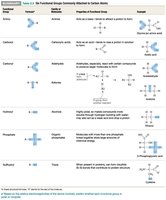
Functional groups are specific groups of atoms within molecules that have characteristic properties and reactivities. The main functional groups in biological molecules include:
Amino (–NH2): Acts as a base, attracts protons.
Carboxyl (–COOH): Acts as an acid, donates protons.
Carbonyl (–C=O): Involved in linking molecules into larger compounds.
Hydroxyl (–OH): Acts as a weak acid, forms hydrogen bonds.
Phosphate (–PO42−): Has two negative charges, important in energy transfer.
Sulfhydryl (–SH): Forms disulfide bonds, stabilizing protein structure.
Functional Group | Structure | Properties |
|---|---|---|
Amino | –NH2 | Acts as a base, attracts protons |
Carboxyl | –COOH | Acts as an acid, donates protons |
Carbonyl | –C=O | Links molecules into larger compounds |
Hydroxyl | –OH | Weak acid, forms hydrogen bonds |
Phosphate | –PO42− | Two negative charges, energy transfer |
Sulfhydryl | –SH | Forms disulfide bonds |
Summary Table: Types of Chemical Bonds
Bond Type | Electron Sharing | Charge Distribution | Example |
|---|---|---|---|
Nonpolar Covalent | Equal | No charge | H2, CH4 |
Polar Covalent | Unequal | Partial charges | H2O, NH3 |
Ionic | Transferred | Full charges | NaCl |
Key Equations
Mass Number:
Atomic Number:
Example: Carbon-14 has 6 protons and 8 neutrons. Its mass number is .
Additional info: Understanding the chemical basis of life is foundational for all biological sciences, as it explains how atoms interact to form the molecules essential for life, and how water's unique properties make life possible on Earth.
