 Back
Water and Carbon: The Chemical Basis of Life (Chapter 2 Study Notes)
Study Guide - Smart Notes
 Tailored notes based on your materials, expanded with key definitions, examples, and context.
Water and Carbon: The Chemical Basis of Life
Introduction to Chemical Evolution
Chemical evolution is the leading explanation for the origin of life on Earth. It describes the process by which simple molecules formed increasingly complex carbon-containing substances, eventually leading to molecules capable of self-replication. This transition marked the shift from chemical to biological evolution, fulfilling the five characteristics of life.
Chemical evolution: Formation of complex molecules from simple substances.
Biological evolution: Driven by natural selection, leading to metabolically active, membrane-bound cells.
Atoms, Ions, and Molecules: The Building Blocks of Chemical Evolution
Basic Atomic Structure
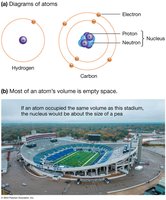
Atoms are the fundamental units of matter, composed of a nucleus (protons and neutrons) surrounded by electrons. The arrangement of these subatomic particles determines the chemical properties of each element.
Protons: Positively charged particles in the nucleus.
Neutrons: Neutral particles in the nucleus.
Electrons: Negatively charged particles orbiting the nucleus.
Atomic number: Number of protons in the nucleus (defines the element).
Mass number: Sum of protons and neutrons.
Isotopes: Atoms of the same element with different numbers of neutrons.
Atomic weight: Average mass of all isotopes, weighted by abundance.
Electron Arrangement and Chemical Bonds
The arrangement of electrons in shells and orbitals determines how atoms interact and bond. The outermost shell, or valence shell, contains valence electrons that participate in chemical bonding.
Orbitals: Regions where electrons are likely to be found; each holds up to two electrons.
Electron shells: Levels of orbitals; filled from the inside out.
Valence electrons: Electrons in the outermost shell; determine bonding behavior.
Chemical bonds: Attractions that bind atoms together, including covalent and ionic bonds.
Covalent Bonding
Covalent bonds form when atoms share pairs of valence electrons, resulting in stable molecules. The number of unpaired valence electrons determines how many bonds an atom can form.
Single, double, and triple bonds: Formed by sharing one, two, or three pairs of electrons, respectively.
Molecule: Two or more atoms held together by covalent bonds.
Nonpolar and Polar Covalent Bonds
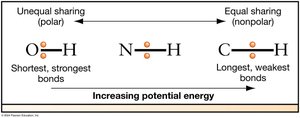
The sharing of electrons in covalent bonds can be equal (nonpolar) or unequal (polar), depending on the electronegativity of the atoms involved.
Electronegativity: The ability of an atom to attract electrons in a bond. Increases up and to the right on the periodic table (O > N > S, C, H, P).
Nonpolar covalent bond: Electrons shared equally (e.g., H2).
Polar covalent bond: Electrons shared unequally, creating partial charges (e.g., H2O).
Ionic Bonding and the Electron-Sharing Continuum
Ionic bonds form when electrons are completely transferred from one atom to another, resulting in charged ions (cations and anions) that attract each other.
Cation: Positively charged ion (loses electron).
Anion: Negatively charged ion (gains electron).
Electron-sharing continuum: Ranges from equal sharing (nonpolar covalent) to complete transfer (ionic).
Properties of Water and the Early Oceans
Structure and Polarity of Water
Water is a small, bent molecule with highly polar covalent bonds, making it an excellent solvent for many substances essential to life.
Polarity: Oxygen has a partial negative charge; hydrogens have partial positive charges.
Hydrogen bonds: Weak attractions between the partial charges of water molecules.
Water as a Solvent
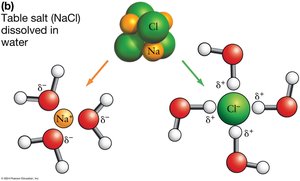
Water dissolves ions and polar molecules (hydrophilic) due to its polarity, but does not dissolve nonpolar molecules (hydrophobic).
Hydrophilic: "Water-loving"; dissolve easily in water (e.g., salts, sugars).
Hydrophobic: "Water-fearing"; do not dissolve in water (e.g., oils).
Cohesion, Adhesion, and Surface Tension
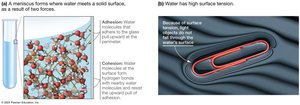
Water molecules exhibit cohesion (attraction to each other) and adhesion (attraction to other substances), leading to high surface tension and capillary action.
Cohesion: Water molecules stick together via hydrogen bonds.
Adhesion: Water molecules stick to other polar or charged surfaces.
Surface tension: The elastic "skin" on the water's surface due to cohesive forces.
Density and Phase Changes of Water
Water is unique in that it is denser as a liquid than as a solid. Ice floats because its molecules form an open crystal structure, which insulates aquatic environments.
Ice: Less dense than liquid water due to hydrogen-bonded lattice.
Liquid water: Molecules are closer together, making it denser.
Water's Heat Capacity
Water has a high specific heat and heat of vaporization, meaning it can absorb or release large amounts of energy with little temperature change. This property helps regulate temperature in organisms and environments.
Specific heat: Energy required to raise the temperature of 1 gram of a substance by 1°C.
Heat of vaporization: Energy required to convert 1 gram of liquid to gas.
Acid–Base Chemistry in Water
Water can dissociate into hydrogen ions (H+) and hydroxide ions (OH−), playing a central role in acid–base chemistry. The pH scale measures the concentration of hydrogen ions in solution.
Acid: Substance that donates protons (increases [H+]).
Base: Substance that accepts protons (decreases [H+]).
pH scale: Ranges from 0 (acidic) to 14 (basic); pH 7 is neutral.
Buffers: Substances that minimize changes in pH, maintaining homeostasis.

Chemical Reactions, Energy, and Chemical Evolution
Chemical Reactions and Energy
Chemical reactions involve the breaking and forming of bonds, often accompanied by energy changes. Energy can be stored (potential) or in motion (kinetic).
Potential energy: Stored energy due to position or arrangement (e.g., chemical bonds).
Kinetic energy: Energy of motion (e.g., thermal energy).
First law of thermodynamics: Energy cannot be created or destroyed, only transformed.
Spontaneity and Entropy
A chemical reaction is spontaneous if it proceeds without continuous external input. Spontaneity is favored when products have lower potential energy and greater disorder (entropy) than reactants.
Entropy: Measure of disorder in a system; increases in spontaneous processes.
Second law of thermodynamics: Entropy always increases in isolated systems.
Investigating Chemical Evolution
Experiments such as Stanley Miller's spark-discharge experiment demonstrated that complex organic molecules could form from simple precursors under early Earth conditions, supporting the theory of chemical evolution.
Stanley Miller's experiment: Simulated early Earth atmosphere, producing amino acids and other organic molecules.
Life is Carbon Based
Carbon's Versatility
Carbon atoms form the backbone of organic molecules due to their ability to make four covalent bonds, resulting in a vast diversity of molecular structures.
Organic compounds: Molecules containing carbon bonded to other elements (H, N, O, P, S).
Functional groups: Specific groups of atoms that confer characteristic chemical behaviors (e.g., amino, carboxyl, hydroxyl, phosphate, sulfhydryl).
Macromolecules and Polymerization
Small organic molecules (monomers) can join to form large macromolecules (polymers) through condensation (dehydration) reactions, while hydrolysis breaks polymers into monomers. This process is fundamental to the formation of proteins, nucleic acids, and carbohydrates.
Condensation reaction: Joins monomers, releasing water.
Hydrolysis: Breaks polymers, consuming water.
Macromolecules: Large molecules essential for life, assembled from smaller subunits.
Additional info: The study of water and carbon chemistry is foundational for understanding the molecular basis of life, including the structure and function of biological macromolecules, cellular processes, and the evolution of living systems.
