 Back
Water and Carbon: The Chemical Basis of Life – Study Notes
Study Guide - Smart Notes
 Tailored notes based on your materials, expanded with key definitions, examples, and context.
Chapter 2: Water and Carbon – The Chemical Basis of Life
Learning Objectives
Explain how atomic structure and electron arrangement determine how atoms interact to form molecules.
Distinguish between ionic and covalent bonds, including polar and nonpolar covalent bonds.
Describe why water is a polar molecule and how hydrogen bonding occurs.
Explain the importance of hydrogen bonds in giving water properties essential for life.
List the key properties of water important to life: cohesion, adhesion, surface tension, high specific heat, solvent ability, density of ice vs liquid water.
Explain how water’s properties support temperature regulation, transport, and homeostasis.
Distinguish between acids and bases based on their effects on hydrogen ion (H⁺) concentration.
Interpret the logarithmic pH scale and relate pH values to acidity and basicity.
Explain why organisms require a narrow pH range for normal enzyme and cellular function.
Define a buffer and explain its purpose in resisting pH changes.
Identify and describe the major biological buffer systems, including the ammonia buffer system in the kidneys.
Explain the importance of buffers in maintaining physiological pH balance and homeostasis.
Chemical Elements
Definition and Importance
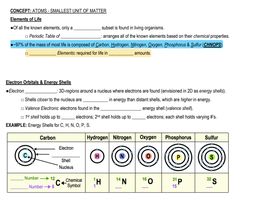
All matter, living and nonliving, is composed of basic substances called elements. An element is a substance that cannot be broken down into substances with different properties and is composed of one type of atom. Ninety-two elements are naturally occurring, but only six—carbon, hydrogen, nitrogen, oxygen, phosphorus, and sulfur (CHNOPS)—are basic to life and make up about 95% of the body weight of organisms.
Carbon (C): Backbone of organic molecules.
Hydrogen (H): Found in water and organic compounds.
Nitrogen (N): Component of proteins and nucleic acids.
Oxygen (O): Essential for cellular respiration and water.
Phosphorus (P): Found in nucleic acids and ATP.
Sulfur (S): Present in some amino acids and vitamins.
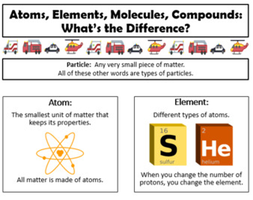

Atoms, Ions, and Molecules: The Building Blocks of Chemical Evolution
Atomic Structure
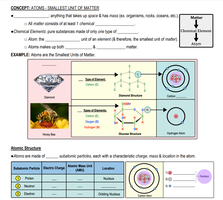
An atom consists of a nucleus made up of protons (positive charge) and neutrons (neutral charge), surrounded by orbiting electrons (negative charge). Atoms are electrically neutral when the number of protons equals the number of electrons.
Atomic number: Number of protons in the nucleus, written as a subscript to the lower left of the atomic symbol.
Mass number: Sum of protons and neutrons, written as a superscript to the upper left of the atomic symbol.

Electron Arrangement and Energy
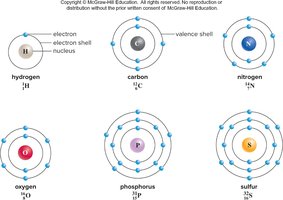
Electrons occupy specific regions called orbitals, grouped into electron shells. The arrangement of electrons determines chemical behavior. The first shell holds up to 2 electrons; subsequent shells hold up to 8. The outermost shell is the valence shell, and electrons here are called valence electrons. The octet rule states that atoms are most stable with eight electrons in their valence shell (except hydrogen, which is stable with two).
Molecules and Compounds
Chemical Bonding
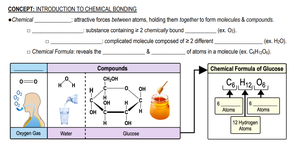
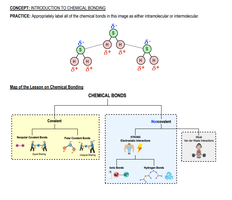
Chemical bonds are attractive forces between atoms, holding them together to form molecules and compounds. The process of bond formation is called a chemical reaction.
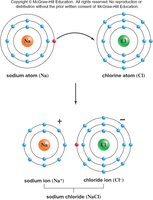
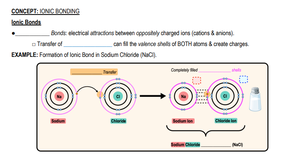
Ionic bonds: Formed when electrons are transferred from one atom to another, resulting in charged ions (cations and anions).
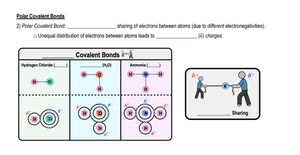
Covalent bonds: Formed when atoms share electrons. Can be nonpolar (equal sharing) or polar (unequal sharing).
Ionic Bonding
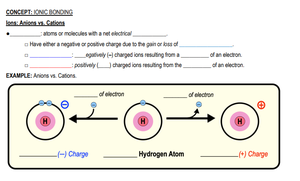
An ion is an atom that has lost or gained an electron and carries a charge. Cations are positively charged (lost electron), and anions are negatively charged (gained electron). Ionic bonds are electrical attractions between oppositely charged ions.
Covalent Bonding
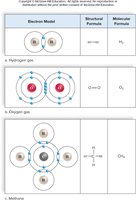
Covalent bonds result when two atoms share electrons so each atom has a complete outer shell. In nonpolar covalent bonds, electrons are shared equally (e.g., hydrogen gas, oxygen gas, methane). In polar covalent bonds, electrons are shared unequally due to differences in electronegativity (e.g., water).
Electronegativity: The ability of an atom to attract electrons towards itself in a chemical bond.
Chemistry of Water
Water as a Polar Molecule
Water is a polar molecule due to the unequal sharing of electrons between oxygen and hydrogen atoms. This polarity allows water molecules to form hydrogen bonds, which are weak attractions between a slightly positive hydrogen atom and a slightly negative atom (often oxygen or nitrogen).
Hydrogen bonds are individually weak but collectively strong, helping maintain the structure and function of proteins and DNA.
Properties of Water Essential for Life
Cohesion: Water molecules cling to each other due to hydrogen bonding.
Adhesion: Water molecules cling to other polar surfaces.
Surface tension: Water resists external force due to cohesive nature.
High specific heat: Water absorbs and retains heat effectively, regulating temperature.
High heat of vaporization: Water requires significant energy to change from liquid to gas.
Universal solvent: Water dissolves many substances due to its polarity.
Density of ice vs liquid water: Ice is less dense than liquid water, allowing it to float and insulate bodies of water.
Biological Importance of Water’s Properties
Temperature regulation: Water’s high specific heat protects organisms from rapid temperature changes.
Transport: Cohesion and adhesion enable water transport in plants and blood vessels.
Homeostasis: Water’s solvent properties support biochemical reactions and nutrient transport.
Acids, Bases, pH, and Buffers
Acids and Bases
Acids release H⁺ ions in water, lowering pH. Bases accept H⁺ ions or release OH⁻ ions, raising pH. The pH scale is logarithmic; a 1-unit change represents a tenfold change in H⁺ concentration.
Strong acids (e.g., HCl) ionize completely.
Weak acids (e.g., H₂CO₃) ionize partially.
Strong bases (e.g., NaOH) release many OH⁻.
Weak bases (e.g., HCO₃⁻) bind fewer H⁺.
Buffers and pH Regulation
A buffer is a chemical system that resists changes in pH by absorbing excess H⁺ or OH⁻ ions. Buffers are essential for maintaining physiological pH balance and homeostasis. The most important biological buffer systems include:
Bicarbonate buffer system: Operates in blood plasma, controlled by lungs and kidneys.
Phosphate buffer system: Functions in cells and kidneys.
Protein buffer system: Proteins donate or accept H⁺ via amino and carboxyl groups.
Ammonia buffer system: Functions in kidneys to excrete excess H⁺.
The bicarbonate buffer system follows the equation:
Normal blood pH is 7.35–7.45. Deviations can cause acidosis or alkalosis, disrupting cellular function.
Summary Table: Properties of Water
Property | Description | Biological Importance |
|---|---|---|
Cohesion | Water molecules stick to each other | Enables transport in plants |
Adhesion | Water molecules stick to other surfaces | Capillary action in plants and blood vessels |
Surface tension | Resists external force | Supports small organisms on water surface |
High specific heat | Absorbs heat with little temperature change | Regulates body and environmental temperature |
High heat of vaporization | Requires energy to evaporate | Cooling via sweating |
Universal solvent | Dissolves many substances | Supports biochemical reactions |
Density of ice | Ice is less dense than liquid water | Insulates aquatic life |
Additional info:
Biological buffer systems are critical for maintaining homeostasis and preventing harmful pH shifts.
Water’s unique properties are due to its molecular structure and hydrogen bonding.
