 Back
Water and Carbon: The Chemical Basis for Life – General Biology Study Notes
Study Guide - Smart Notes
 Tailored notes based on your materials, expanded with key definitions, examples, and context.
Chapter Overview: Chemistry and the Evolution of Life
Introduction
This chapter explores how chemistry underpins the evolution of life, focusing on the structure of atoms, ions, and molecules, the unique properties of water, chemical reactions, and the central role of carbon in biological systems.
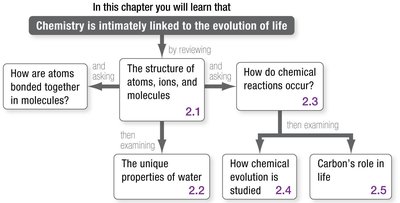
The Structure of Atoms, Ions, and Molecules
Basic Atomic Structure
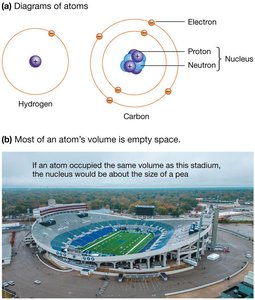
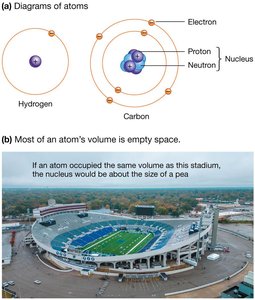
Atoms are the smallest identifiable units of matter. The nucleus contains protons (positive charge) and neutrons (neutral), surrounded by orbiting electrons (negative charge). Atoms are electrically neutral when the number of protons equals the number of electrons.
Protons: Positive charge (+1)
Neutrons: No charge
Electrons: Negative charge (-1)
Atomic Number: Number of protons in the nucleus
Mass Number: Sum of protons and neutrons
Isotopes and Atomic Weight
Isotopes are variants of elements with different numbers of neutrons. Atomic weight is the average mass of all naturally occurring isotopes, weighted by their abundance. Some isotopes are radioactive and decay over time.
Example: Carbon-12, Carbon-13, Carbon-14
Electron Arrangement and Chemical Behavior
Electrons occupy orbitals grouped into shells. The arrangement of electrons determines how elements behave chemically. The outermost shell (valence shell) contains valence electrons, which are key to chemical bonding.
Orbitals: Regions where electrons are likely found
Electron Shells: Levels of orbitals, filled from innermost to outermost
Valence Electrons: Electrons in the outermost shell
Chemical Bonds: Covalent, Polar, and Ionic
Covalent Bonds
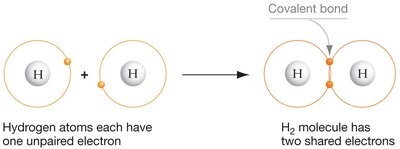
Covalent bonds form when atoms share unpaired valence electrons. Atoms are most stable when their valence shells are full.
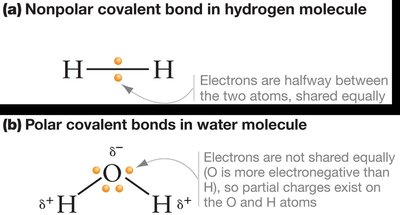
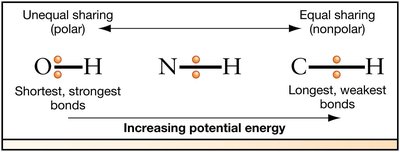
Nonpolar Covalent Bonds: Electrons are shared equally (e.g., C-H bond)
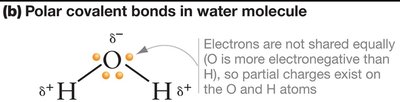
Polar Covalent Bonds: Electrons are shared unequally, creating partial charges (e.g., O-H bond in water)
Ionic Bonds and Ions
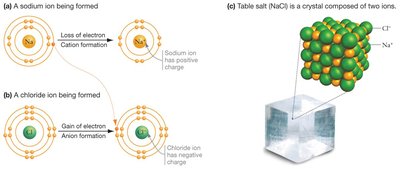
Ionic bonds form when electrons are completely transferred from one atom to another, resulting in charged ions. Cations are positively charged, and anions are negatively charged.
Example: Sodium chloride (NaCl) formation
Electron Sharing Continuum
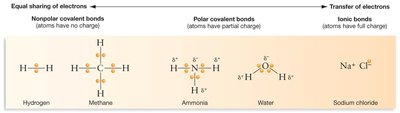
The degree of electron sharing in chemical bonds forms a continuum from equal sharing (nonpolar covalent) to unequal sharing (polar covalent) to complete transfer (ionic).
The Geometry and Representation of Molecules
Molecular Geometry
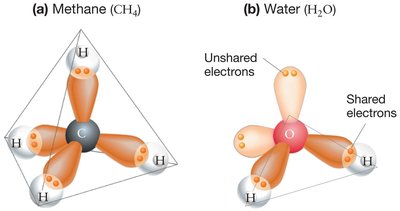
The shape of a molecule is determined by the geometry of its bonds and influences its behavior. For example, methane is tetrahedral, water is bent due to unshared electron pairs.
Representing Molecules
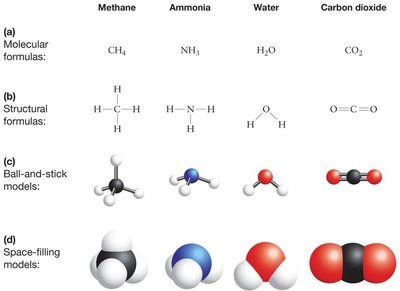
Molecules can be represented by molecular formulas, structural formulas, ball-and-stick models, and space-filling models, each providing different levels of detail about atomic arrangement and bonding.
Properties of Water and the Early Oceans
Water as a Solvent
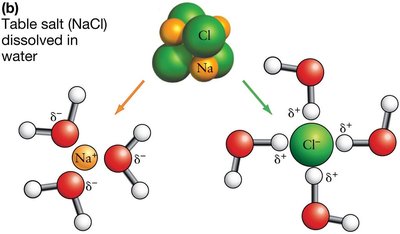
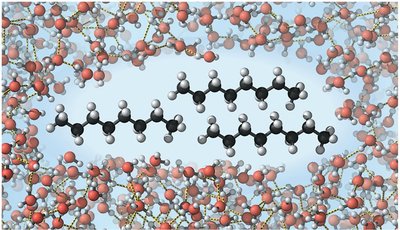
Water is a polar molecule, making it an excellent solvent. Its bent shape and highly polar covalent bonds allow it to dissolve ions and polar molecules (hydrophilic), while nonpolar molecules (hydrophobic) do not dissolve.
Hydrogen Bonds: Weak interactions between partial charges on water molecules
Hydrophilic: Water-loving, dissolves in water
Hydrophobic: Water-fearing, does not dissolve in water
Cohesion, Adhesion, and Surface Tension
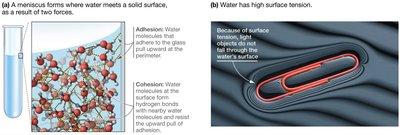
Water molecules exhibit cohesion (attraction to each other) and adhesion (attraction to other surfaces), resulting in surface tension. Surface tension allows water to resist external forces and explains phenomena like the meniscus and floating objects.
Density and Heat Capacity of Water
Water is denser as a liquid than as a solid, which is why ice floats. Water also has a high specific heat and heat of vaporization, meaning it absorbs and retains energy efficiently. This property moderates temperatures in coastal regions.
Substance | Specific Heat (J/g°C) |
|---|---|
Water (H2O) | 4.18 |
Ethanol (C2H6O) | 2.44 |
Glycerol (C3H8O3) | 2.38 |
Benzene (C6H6) | 1.74 |
Xylene (C8H10) | 1.72 |
Chemical Reactions, Energy, and Chemical Evolution
Environments for Chemical Evolution
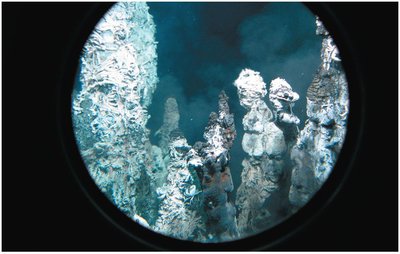
Chemical evolution may have begun in the atmosphere (volcanic gases) or deep-sea hydrothermal vents, where reactive gases and minerals provided energy and materials for the formation of complex molecules.
Types of Chemical Reactions
Chemical reactions involve breaking and forming bonds. They can be endothermic (absorb energy) or exothermic (release energy). The first law of thermodynamics states that energy is conserved, though it can be transferred or transformed.
Potential Energy: Stored energy due to position or arrangement
Kinetic Energy: Energy of motion
Thermal Energy: Kinetic energy of molecular motion
Acid–Base Reactions in Water
Water can dissociate into hydrogen ions (H+) and hydroxide ions (OH−). Acids increase proton concentration, while bases decrease it. Molarity (M) measures the concentration of solute in solution.
Equation for dissociation:
Mole: particles
Life is Carbon-Based
Carbon's Role in Life
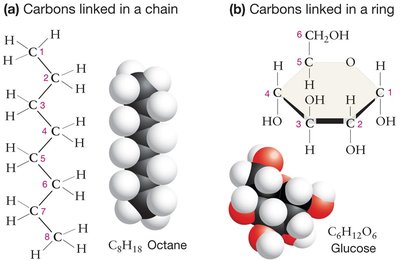
Carbon forms the backbone of most biological molecules, capable of making four covalent bonds. Organic compounds contain carbon bonded to other elements, allowing for a vast diversity of molecular shapes and functions.
Functional Groups
Functional groups are specific clusters of atoms that define the chemical behavior of organic molecules. Common groups include amino, carboxyl, carbonyl, hydroxyl, phosphate, and sulfhydryl.
Amino: Acts as a base
Carboxyl: Acts as an acid
Carbonyl: Links molecules
Hydroxyl: Weak acid
Phosphate: Two negative charges
Sulfhydryl: Forms disulfide bonds
Assembly of Large Molecules
Macromolecules and Polymerization
Macromolecules are large molecules made of smaller subunits (monomers) joined together. Polymerization occurs via condensation (dehydration) reactions, which release water. Hydrolysis is the reverse, breaking polymers into monomers and increasing entropy.


Condensation Reaction: Monomer in, water out
Hydrolysis: Water in, monomer out
Summary Table: Types of Chemical Bonds
Bond Type | Electron Sharing | Example |
|---|---|---|
Nonpolar Covalent | Equal | H2, CH4 |
Polar Covalent | Unequal | H2O, NH3 |
Ionic | Transferred | NaCl |
Key Terms and Concepts
Atom: Smallest unit of matter
Isotope: Atom with varying number of neutrons
Covalent Bond: Shared electrons
Ionic Bond: Transferred electrons
Hydrogen Bond: Weak interaction between partial charges
Macromolecule: Large molecule made of monomers
Polymerization: Process of forming polymers
Additional info: Academic context was added to clarify the role of water in moderating climate, the importance of functional groups, and the energetics of polymerization and hydrolysis.
