 Back
Water and Electrolyte Balance in Animals: Osmoregulation and Excretion
Study Guide - Smart Notes
 Tailored notes based on your materials, expanded with key definitions, examples, and context.
Chapter 40: Water and Electrolyte Balance
Overview and Roadmap
This chapter explores how animals maintain water and electrolyte balance across different habitats, focusing on osmoregulation and excretion. The mechanisms vary among marine, freshwater, and terrestrial environments, and are crucial for survival and homeostasis.
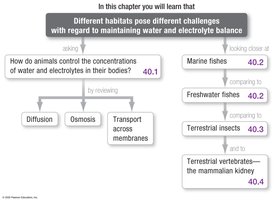
Osmoregulation and Excretion
Osmoregulation is the process by which organisms control the concentration of water and solutes within their bodies. Excretion is the removal of metabolic waste products, including nitrogenous wastes.
Osmosis: Water moves across cell membranes from areas of low solute concentration (hypo-osmotic) to high solute concentration (hyper-osmotic).
Osmolarity: The solute concentration of a solution; determines the direction of water movement.
Iso-osmotic: Equal movement of water in both directions between two solutions.
Osmotic Stress: Occurs when the concentration of dissolved substances in a cell or tissue deviates from the organism's set point.
Osmoregulatory Challenges in Different Environments
Marine Fishes
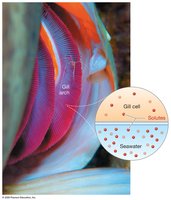
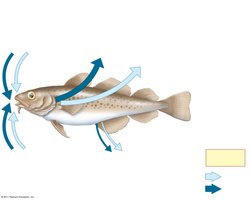
Marine environments are hyperosmotic compared to fish tissues, causing water loss and salt gain. Marine bony fishes must actively regulate their internal osmolarity to survive.
Water loss: Occurs by osmosis through gills and body surface.
Salt gain: Occurs by diffusion and drinking seawater.
Excretion: Salt ions are excreted via gills and kidneys; urine is scanty and concentrated.
Freshwater Fishes
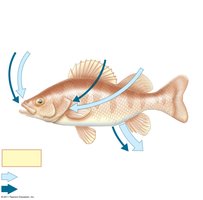
Freshwater environments are hypo-osmotic compared to fish tissues, causing water gain and salt loss. Freshwater fishes must prevent excessive water uptake and loss of electrolytes.
Water gain: Occurs by osmosis through gills and body surface.
Salt loss: Occurs by diffusion.
Excretion: Salt ions are actively taken up by gills; urine is dilute and copious.
Terrestrial Animals
Land animals face the challenge of minimizing water loss. Adaptations include body coverings, waxy layers, shells, and keratinized skin. Nocturnal lifestyles also help reduce water loss.
Transport Epithelia and Countercurrent Exchange
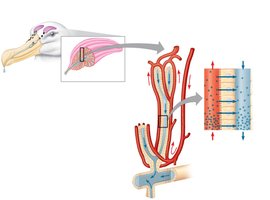
Transport epithelia are specialized tissues that move solutes in specific directions, often arranged in complex networks. Countercurrent exchange mechanisms, such as those in nasal salt glands, help excrete excess salt efficiently.
Nitrogenous Waste and Excretion
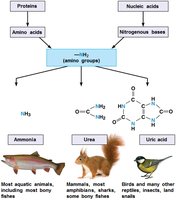
Metabolic waste includes nitrogen, which is excreted in different forms depending on the animal's phylogeny and habitat. Ammonia, urea, and uric acid are the primary forms.
Ammonia (NH3): Highly toxic, excreted by most aquatic animals.
Urea: Less toxic, excreted by mammals, amphibians, sharks, and some bony fishes.
Uric Acid: Least toxic, excreted by birds, reptiles, insects, and land snails.
Osmoconformation vs. Osmoregulation
Marine animals use two main strategies:
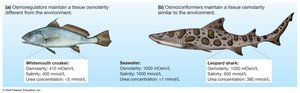
Osmoconformers: Maintain tissue osmolarity similar to the environment (e.g., sharks, rays).
Osmoregulators: Maintain tissue osmolarity different from the environment (e.g., most bony fishes).
Salt Excretion in Sharks
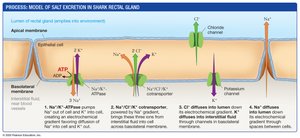
Sharks use a rectal gland to secrete concentrated salt solutions. This process requires ATP and involves specialized ion transporters.
Chloride Cells in Fishes
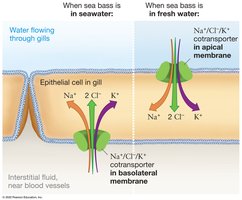
Marine and freshwater fishes use chloride cells in their gills to regulate salt balance. The location and function of key ion cotransporters change depending on the environment.
Water and Electrolyte Balance in Terrestrial Insects
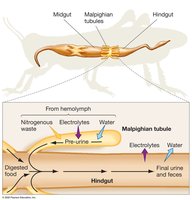
Insects minimize water loss through adaptations such as a waxy cuticle and regulate water and electrolyte excretion using Malpighian tubules and the hindgut.
Malpighian tubules: Form filtrate from hemolymph, which is processed in the hindgut to produce concentrated urine.
Selective reabsorption: Epithelial cells actively transport ions and water, allowing insects to conserve water.
Water and Electrolyte Balance in Terrestrial Vertebrates
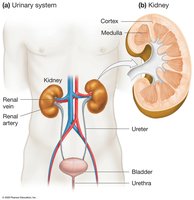
Terrestrial vertebrates rely on the kidney for osmoregulation and excretion. The kidney filters blood, reabsorbs valuable solutes, and excretes waste products.
Structure and Function of the Mammalian Kidney
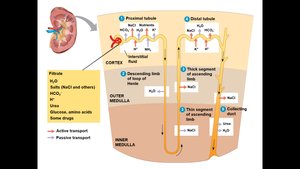
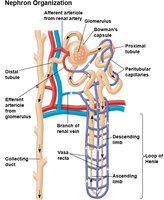
Nephron: Basic functional unit, located in cortex and medulla.
Renal corpuscle: Filters blood to form filtrate.
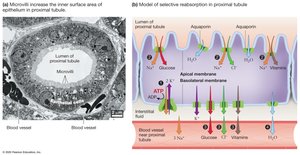
Proximal tubule: Reabsorbs nutrients, ions, and water.
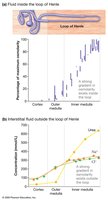
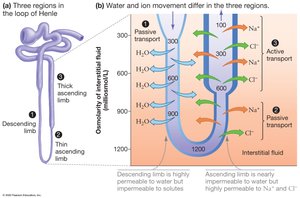
Loop of Henle: Establishes osmotic gradient; descending limb loses water, ascending limb loses salt.
Distal tubule and collecting duct: Regulate water and electrolyte balance; urine concentration varies with hydration.
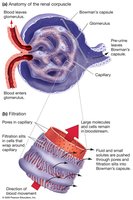
Filtration in the Renal Corpuscle
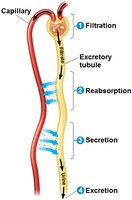
Filtration occurs as water and solutes are forced from blood into Bowman’s capsule through pores.
Reabsorption in the Proximal Tubule
Selective reabsorption is driven by active transport of Na+, creating a gradient for solute and water movement.
Loop of Henle and Osmotic Gradient
The loop of Henle maintains a strong osmotic gradient, essential for water conservation. Water leaves the descending limb, while salt leaves the ascending limb.
Nephron Types and Water Conservation
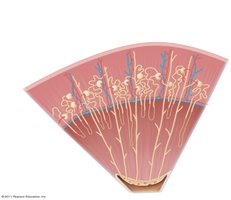
Juxtamedullary nephrons are key to water conservation in mammals, especially those in dry environments.
Vasa Recta and Blood Vessel Association
Vasa recta returns reabsorbed water and solutes to the bloodstream, maintaining the osmotic gradient.
Hormonal Regulation of Urine Formation
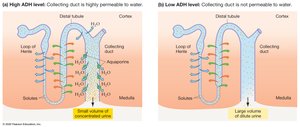
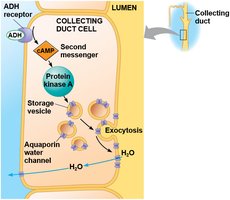
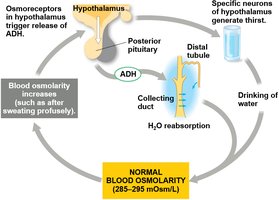
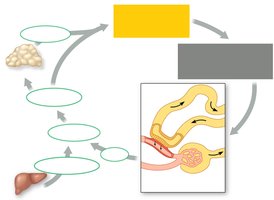
Urine concentration is regulated by hormones such as antidiuretic hormone (ADH), renin-angiotensin-aldosterone system (RAAS), and atrial natriuretic peptide (ANP).
ADH: Increases water reabsorption in the collecting duct.
RAAS: Responds to decreased blood volume, increases water and Na+ reabsorption.
ANP: Opposes RAAS, inhibits renin release.
Summary Table: Attributes of Three Forms of Nitrogenous Waste
Form | Energy Cost | Toxicity | Water Required | Typical Animals |
|---|---|---|---|---|
Ammonia | Low | High | High | Most aquatic animals |
Urea | Moderate | Moderate | Moderate | Mammals, amphibians, sharks |
Uric Acid | High | Low | Low | Birds, reptiles, insects |
Additional info: Table entries inferred from standard biology textbooks.
