 Back
Water and Its Chemical Context: Structure, Properties, and Biological Importance
Study Guide - Smart Notes
 Tailored notes based on your materials, expanded with key definitions, examples, and context.
Molecular Shape and Function
Molecular Mimicry and Biological Effects
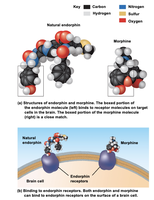
The three-dimensional shape of a molecule is crucial for its biological function. Molecules with similar shapes can interact with the same biological targets, leading to similar physiological effects. For example, both natural endorphins and opiates (such as morphine) can bind to the same receptors in the brain due to their similar molecular shapes, resulting in similar pain-relieving effects.
Molecular mimicry: When different molecules share similar shapes, they can mimic each other's biological activity.
Example: Endorphins (natural painkillers) and morphine (an opiate drug) both bind to endorphin receptors in the brain, producing pain relief.
Chemical Reactions and Bonds
Making and Breaking Chemical Bonds
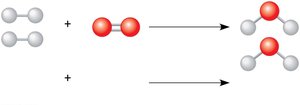
Chemical reactions involve the rearrangement of atoms by making and breaking chemical bonds. The substances present at the start of a reaction are called reactants, and those formed at the end are products. All chemical reactions are theoretically reversible, and equilibrium is reached when the rates of the forward and reverse reactions are equal.
Reactants: Starting molecules in a chemical reaction.
Products: Final molecules produced by the reaction.
Chemical equilibrium: The state where the concentrations of reactants and products remain constant over time.
Water: Structure and Hydrogen Bonding
Polarity and Hydrogen Bonds
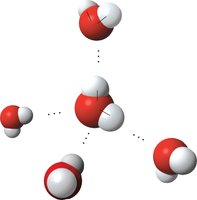
Water is a polar molecule, meaning it has regions of partial positive and negative charge due to unequal sharing of electrons between hydrogen and oxygen atoms. This polarity allows water molecules to form hydrogen bonds with each other, which are weak attractions between the partially positive hydrogen of one molecule and the partially negative oxygen of another.
Polarity: Oxygen is more electronegative than hydrogen, creating partial charges (δ− on oxygen, δ+ on hydrogen).
Hydrogen bonds: Weak bonds that form between water molecules, giving water many of its unique properties.
Emergent Properties of Water
1. Cohesion and Adhesion
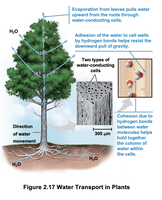
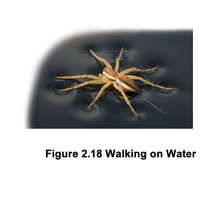
Cohesion refers to the attraction between water molecules due to hydrogen bonding, which helps transport water against gravity in plants. Adhesion is the attraction between water molecules and other substances, aiding in water movement through plant tissues. Surface tension, a result of cohesion, allows some organisms to move on water surfaces without sinking.
Cohesion: Water molecules stick together, supporting water transport in plants.
Adhesion: Water molecules stick to other substances, such as cell walls.
Surface tension: The difficulty of breaking the surface of a liquid, important for small organisms.
2. Moderation of Temperature
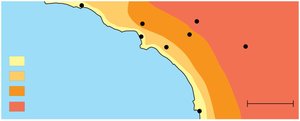
Water moderates Earth's temperature by absorbing heat from warmer air and releasing it to cooler air. It has a high specific heat, meaning it can absorb or release a large amount of heat with only a slight change in temperature. This property is due to hydrogen bonding, which buffers temperature changes and helps maintain stable environments for life.
Specific heat: The amount of heat required to change the temperature of 1 g of a substance by 1°C.
Heat absorption and release: Heat is absorbed when hydrogen bonds break and released when they form.
Importance: Stabilizes ocean and atmospheric temperatures, supporting life.
3. Floating of Ice on Liquid Water
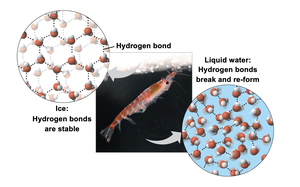
Ice is less dense than liquid water because hydrogen bonds in ice are more ordered, creating a crystalline structure with more open space. As a result, ice floats, insulating the water below and allowing aquatic life to survive in cold climates.
Density anomaly: Water is most dense at 4°C; ice is less dense and floats.
Biological significance: Floating ice insulates water, protecting aquatic ecosystems.
4. Water as the Solvent of Life
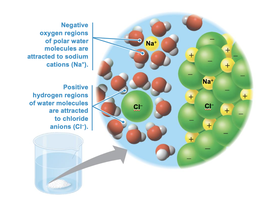
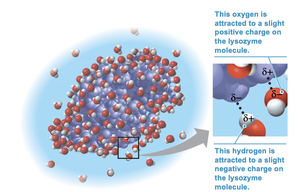
Water is an excellent solvent due to its polarity, which allows it to dissolve many substances. In aqueous solutions, water molecules surround ions or polar molecules, forming hydration shells. This property is essential for biochemical reactions in cells.
Solution: Homogeneous mixture of two or more substances.
Solvent: The dissolving agent (water in biological systems).
Solute: The substance dissolved in the solvent.
Hydration shell: Sphere of water molecules surrounding dissolved ions.
Dissolving Nonionic and Large Polar Molecules
Water can also dissolve nonionic polar molecules and large molecules like proteins if they have ionic or polar regions. This ability is crucial for the function of biological macromolecules in cells.
Example: Proteins with polar and charged regions can dissolve in water, facilitating cellular processes.
Hydrophilic and Hydrophobic Substances
Substances that have an affinity for water are called hydrophilic, while those that repel water are hydrophobic. Hydrophobic molecules, such as oils, have nonpolar covalent bonds and do not dissolve in water.
Hydrophilic: Water-loving; interacts well with water (e.g., salts, sugars).
Hydrophobic: Water-fearing; does not interact with water (e.g., oils, fats).
Acids, Bases, and pH
Water Dissociation and Ion Formation
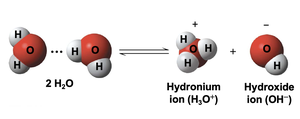
Water molecules can dissociate into hydrogen ions (H+) and hydroxide ions (OH−). The hydrogen ion does not exist alone but associates with another water molecule to form a hydronium ion (H3O+).
Equation:
Acids, Bases, and the pH Scale
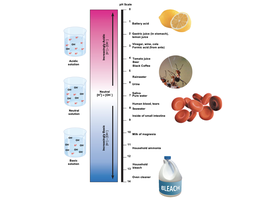
An acid increases the concentration of H+ in a solution, while a base reduces it, often by accepting H+ or releasing OH−. The pH scale measures the concentration of hydrogen ions in a solution, ranging from 0 (most acidic) to 14 (most basic), with 7 being neutral.
pH definition:
Neutral solution: [H+] = [OH−] = M, pH = 7
Acidic solution: pH < 7
Basic solution: pH > 7
Buffers and pH Stability
Buffers are substances that minimize changes in pH by accepting or donating H+ ions. Most biological fluids contain buffers to maintain a stable internal environment. For example, carbonic acid acts as a buffer in human blood, helping to maintain pH near 7.4.
Buffer system: Typically consists of a weak acid and its conjugate base.
Importance: Prevents harmful changes in cellular and blood pH.
