Back
Water and Its Importance in Biology
Study Guide - Smart Notes
 Tailored notes based on your materials, expanded with key definitions, examples, and context.
Water: Structure, Properties, and Biological Importance
Polar Covalent Bonds and Hydrogen Bonding
Water’s unique properties arise from its molecular structure and the interactions between its molecules. The electrons in water’s polar covalent bonds spend more time near the oxygen atom, making water a polar molecule with an uneven charge distribution. This polarity allows water molecules to form hydrogen bonds with each other, which are crucial for many of water’s properties.
Emergent Properties of Water
Cohesion and Surface Tension
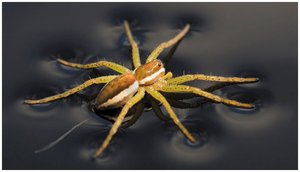
Cohesion refers to the attraction between water molecules due to hydrogen bonding. This property results in high surface tension, making it difficult to break the surface of water. Surface tension allows certain organisms, such as some insects and spiders, to move across water surfaces without sinking.
Adhesion
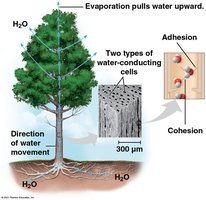
Adhesion is the attraction between water molecules and other substances. In plants, adhesion helps water move upward against gravity by clinging to the walls of water-conducting cells, working together with cohesion to enable the transport of water from roots to leaves.
Moderation of Temperature
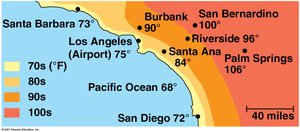
Water moderates temperature by absorbing heat from warmer air and releasing it to cooler air. It can absorb or release large amounts of heat with only slight changes in its own temperature, due to its high specific heat. This property helps stabilize environmental and organismal temperatures.
Water’s High Specific Heat
The specific heat of water is 1 cal/(g·ºC), which is much higher than most substances. This means water resists temperature changes, helping to moderate climate and maintain stable conditions for life, especially in coastal regions.
Evaporative Cooling
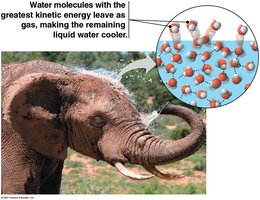
As water evaporates, the molecules with the highest kinetic energy leave as gas, cooling the remaining liquid. This evaporative cooling helps organisms regulate temperature and stabilizes temperatures in bodies of water.
Expansion Upon Freezing
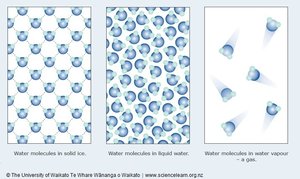
Water is less dense as a solid than as a liquid because, at 0ºC, water molecules form a crystalline lattice that keeps them further apart. This property allows ice to float, insulating aquatic life in winter and preventing bodies of water from freezing solid.
Versatility as a Solvent
Water is known as the universal solvent because its polarity allows it to dissolve many substances. Water dissolves ionic compounds, polar molecules, and large molecules with ionic or polar regions. Non-polar or hydrophobic compounds, such as oils, do not dissolve in water.
How Water Dissolves Substances
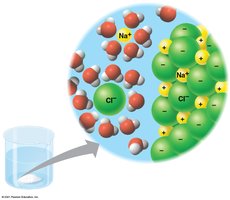
When an ionic compound dissolves in water, each ion is surrounded by a hydration shell of water molecules, separating and dispersing the ions throughout the solution.
Hydrophilic and Hydrophobic Substances
Hydrophilic substances have an affinity for water and dissolve easily, while hydrophobic substances, such as oils, do not mix with water due to their non-polar bonds. Hydrophobic molecules are important in biological membranes.
Solute Concentration and Solution Calculations
Moles and Molarity
The mole is a standard unit for counting molecules (1 mole = molecules, Avogadro’s number). Molarity (M) is the number of moles of solute per liter of solution.
Molecular mass is the sum of atomic masses in a molecule (g/mol).
To calculate molarity:
Acids, Bases, and pH
Acid-Base Chemistry in Water
Water molecules can dissociate into hydrogen ions (H+) and hydroxide ions (OH–). The concentration of these ions determines the solution’s acidity or basicity. Acids increase H+ concentration, while bases decrease it.
pH is defined as
In pure water at 25ºC:
Acidic solutions: pH < 7; Basic solutions: pH > 7; Neutral: pH = 7
Buffers
Buffers are substances that minimize changes in pH by reversibly binding H+ ions. Most buffers consist of a weak acid and its conjugate base, helping maintain stable pH in biological systems.
Ocean Acidification
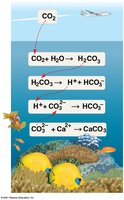
Excess atmospheric CO2 dissolves in oceans, forming carbonic acid and lowering pH—a process called ocean acidification. This reduces carbonate ion availability, threatening organisms that rely on carbonate for shells and skeletons.