 Back
Water and Its Importance in Biology
Study Guide - Smart Notes
 Tailored notes based on your materials, expanded with key definitions, examples, and context.
Water: Structure, Properties, and Biological Importance
Polar Covalent Bonds and Hydrogen Bonding
Water’s unique properties arise from its molecular structure and the interactions between its molecules. The electrons in water’s polar covalent bonds spend more time near the oxygen atom, making water a polar molecule with an uneven charge distribution. This polarity allows water molecules to form hydrogen bonds with each other, which are crucial for many of water’s properties.
Electronegativity: Oxygen is more electronegative than hydrogen, pulling shared electrons closer.
Polarity: Water is not charged overall, but has partial positive and negative regions.
Hydrogen Bonds: Weak attractions between the hydrogen of one water molecule and the oxygen of another.
Emergent Properties of Water
Cohesion and Surface Tension
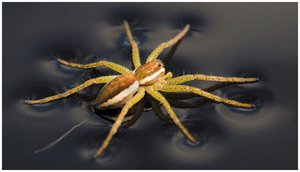
Cohesion refers to the attraction between water molecules due to hydrogen bonding. This property results in high surface tension, allowing water to resist external force and enabling certain organisms to move across its surface.
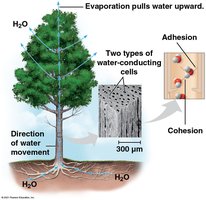
Cohesion: Holds water molecules together, supporting processes like water transport in plants.
Surface Tension: The difficulty of stretching or breaking the surface of water.
Example: Some insects and spiders can walk on water due to surface tension.
Adhesion
Adhesion is the attraction between water molecules and other substances, such as the walls of plant vessels. This property helps counteract gravity and assists in the upward movement of water in plants.
Adhesion: Water molecules stick to other materials, aiding in capillary action.
Example: Water moves up plant stems due to adhesion and cohesion.
Moderation of Temperature
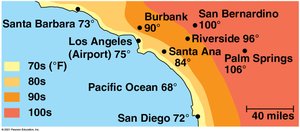
Water moderates temperature by absorbing heat from warmer air and releasing it to cooler air. It can absorb or release large amounts of heat with only slight changes in its own temperature, due to its high specific heat.
Kinetic Energy: The energy of motion; in molecules, this is called thermal energy.
Specific Heat: The amount of heat needed to change 1 g of a substance by 1ºC. For water, this is 1 cal/(g·ºC), which is very high.
Importance: Stabilizes temperatures in organisms and environments, especially near large bodies of water.
Example: Coastal areas experience milder climates due to water’s high specific heat.
Evaporative Cooling
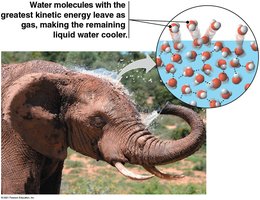
When water evaporates, the molecules with the highest kinetic energy leave as gas, cooling the remaining liquid. This evaporative cooling helps regulate temperature in organisms and environments.
Heat of Vaporization: The heat required to convert 1 g of liquid to gas.
Evaporative Cooling: Maintains stable temperatures in lakes, ponds, and organisms (e.g., sweating, panting).
Example: Elephants spray water on themselves to cool down as the water evaporates.
Expansion Upon Freezing
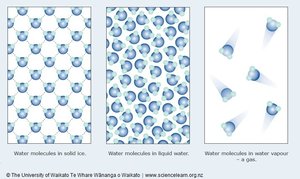
Water is less dense as a solid than as a liquid because its molecules form a crystalline lattice at 0ºC. This causes ice to float, insulating bodies of water and making life possible beneath the surface.
Crystalline Lattice: Water molecules are locked in a fixed structure in ice.
Biological Importance: If ice sank, aquatic life would not survive in cold climates.
Water as a Solvent
Versatility as a Solvent
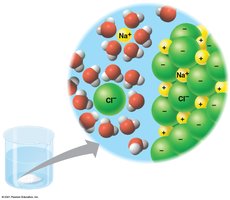
Water is known as the universal solvent because it can dissolve many substances, especially ionic and polar compounds. This property is essential for biological reactions and transport of materials in living organisms.
Solution: Homogeneous mixture of two or more substances.
Solvent: The dissolving agent (water in aqueous solutions).
Solute: The substance dissolved.
Hydration Shell: Sphere of water molecules surrounding each ion in solution.
Limitation: Water does not dissolve non-polar or hydrophobic substances (e.g., oils).
Hydrophilic and Hydrophobic Substances
Hydrophilic substances have an affinity for water and dissolve easily, while hydrophobic substances do not mix with water due to their non-polar nature. Hydrophobic molecules, such as oils, are important components of cell membranes.
Hydrophilic: Water-loving; dissolves in water (e.g., salts, sugars).
Hydrophobic: Water-fearing; does not dissolve in water (e.g., oils, fats).
Solute Concentration and Calculations
Moles, Molecular Mass, and Molarity
Chemical reactions in biology often occur in aqueous solutions. Understanding concentration is essential for preparing and analyzing these solutions.
Mole (mol): 6.02 × 10²³ molecules (Avogadro’s number).
Molecular Mass: Sum of atomic masses in a molecule (g/mol).
Molarity (M): Number of moles of solute per liter of solution.
Example Calculation:
To make 1.00 L of 1.00 M NaOH solution, weigh out 40 g of NaOH (molecular mass: 40 g/mol).
To find molarity: Moles of solute / Liters of solution.
Acids, Bases, and pH
Acidic and Basic Conditions
Water can dissociate into hydrogen ions (H+) and hydroxide ions (OH–). The concentrations of these ions determine the acidity or basicity of a solution, measured by the pH scale.
Acid: Increases H+ concentration (pH < 7).
Base: Reduces H+ concentration (pH > 7).
pH Calculation:
Relationship: at 25ºC
Example: For [H+] = 0.0235 M, pH = 1.629
Buffers
Buffers are substances that minimize changes in pH by accepting or donating H+ ions. Most biological fluids are buffered to maintain a stable internal environment, usually near pH 7.
Composition: Typically a weak acid and its conjugate base.
Function: Prevents harmful shifts in pH in cells and tissues.
Ocean Acidification
Impact of CO2 on Ocean Chemistry
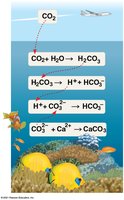
Excess atmospheric CO2 dissolves in oceans, forming carbonic acid and lowering pH—a process known as ocean acidification. This reduces carbonate ion availability, threatening organisms that rely on carbonate for shells and skeletons.
CO2 + H2O → H2CO3 (carbonic acid)
H2CO3 → H+ + HCO3– (bicarbonate)
H+ + CO32– → HCO3–
CO32– + Ca2+ → CaCO3 (calcium carbonate, used by marine organisms)
Additional info: Understanding water’s properties is fundamental to biology, as these characteristics underpin many physiological and ecological processes essential for life.
