 Back
Water and Life: Chemical Bonds, Properties of Water, and Solutions
Study Guide - Smart Notes
 Tailored notes based on your materials, expanded with key definitions, examples, and context.
Water and Life
Introduction
Water is essential for all known forms of life. Its unique chemical and physical properties are critical for supporting biological processes. Understanding the molecular structure of water and the types of chemical bonds that form between atoms is foundational for studying biology.
Chemical Bonds Important for Life
Covalent Bonds
Covalent bonds are formed when two atoms share one or more pairs of valence electrons. These bonds are strong and help form the backbone of biological molecules.
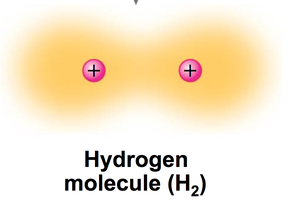
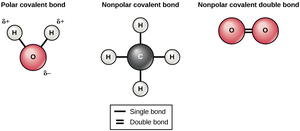
Nonpolar covalent bonds: Electrons are shared equally between atoms (e.g., H2 molecule).
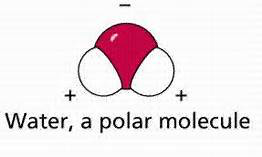
Polar covalent bonds: Electrons are shared unequally, resulting in partial charges (e.g., water molecule).
Valence electrons: Electrons in the outermost shell that are involved in bonding.
Ionic Bonds
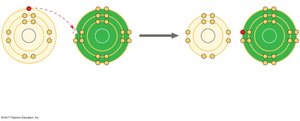
Ionic bonds are formed when one atom transfers electrons to another, resulting in the formation of oppositely charged ions (cations and anions) that attract each other. Ionic compounds are often called salts.
Cation: Positively charged ion (e.g., Na+).
Anion: Negatively charged ion (e.g., Cl−).
Weak Chemical Interactions
Weak interactions, such as hydrogen bonds and van der Waals forces, play crucial roles in the structure and function of biological molecules. Most strong bonds in living organisms are covalent, but weak bonds are essential for dynamic processes.
Hydrogen Bonds
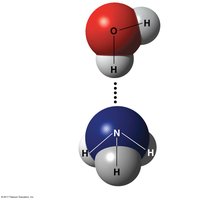
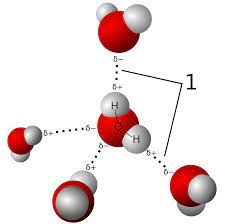
Hydrogen bonds form when a hydrogen atom covalently bonded to an electronegative atom (like oxygen or nitrogen) is attracted to another electronegative atom. These bonds are weaker than covalent or ionic bonds but are vital for the properties of water and the structure of DNA and proteins.
Valence and Valence Electrons
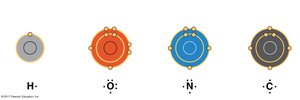
The valence of an atom is the number of bonds it can form, determined by the number of unpaired electrons in its outer shell.
Hydrogen: Valence = 1
Oxygen: Valence = 2
Nitrogen: Valence = 3
Carbon: Valence = 4
Properties of Water That Support Life
Cohesion and Adhesion
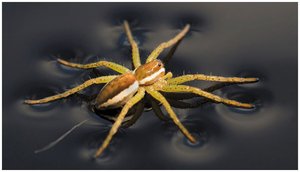
Water molecules stick together (cohesion) due to hydrogen bonding, which also explains surface tension. Adhesion is the attraction between water molecules and other substances.
Cohesion: Responsible for water transport in plants and surface tension.
Adhesion: Helps water climb up plant vessels.
Moderation of Temperature
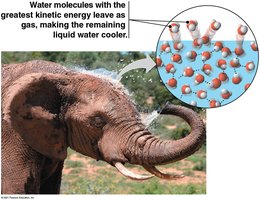
Water has a high specific heat, meaning it can absorb or release a large amount of heat with only a slight change in its own temperature. This property helps moderate Earth's climate and organisms' internal temperatures.
Specific heat of water: 1 cal/(g·°C)
Heat of vaporization: The amount of heat required to convert 1 g of liquid water to gas.

Expansion Upon Freezing
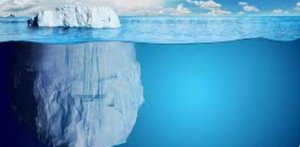
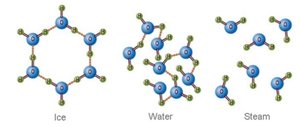
Water is less dense as a solid than as a liquid because hydrogen bonds keep water molecules further apart in ice. This property allows ice to float, insulating aquatic life in winter.
Water as a Versatile Solvent
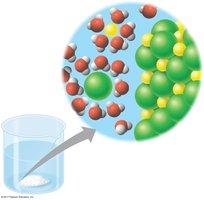
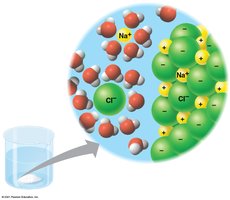
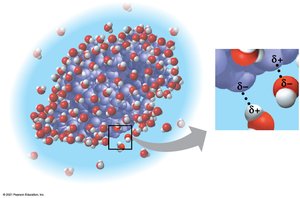
Water's polarity allows it to dissolve many ionic and polar substances, making it an excellent solvent for biological reactions. When ionic compounds dissolve, each ion is surrounded by a hydration shell of water molecules.
Hydrophilic substances: Water-loving; dissolve easily in water (e.g., salts, sugars).
Hydrophobic substances: Water-fearing; do not dissolve well in water (e.g., oils, lipids).
Solute Concentration in Aqueous Solutions
Mole and Molarity
Most chemical reactions in organisms occur in aqueous solutions. The concentration of solutes is measured in moles and molarity.
Mole (mol): 6.022 × 10²³ particles (Avogadro's number).
Molarity (M): Moles of solute per liter of solution.
Molar mass: The mass of one mole of a substance, calculated by adding the atomic masses of its elements.
Example calculation for NaCl:
Na: 22.99 g/mol
Cl: 35.45 g/mol
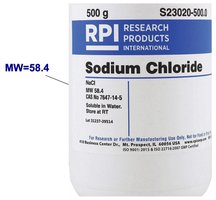
Molar mass of NaCl = 22.99 + 35.45 = 58.44 g/mol
Preparing Solutions
To prepare a solution of a given molarity, dissolve the calculated mass of solute in enough water to make the desired volume.
1 L of 2 M NaCl: 116.8 g NaCl in 1 L H2O
1 L of 1 mM NaCl: 58.4 mg in 1 L H2O
0.5 L of 0.5 mM NaCl: 14.6 mg in 0.5 L H2O
Acids, Bases, and pH
Acids and Bases
Acids increase the concentration of H+ ions in a solution, while bases decrease it. The pH scale measures the concentration of hydrogen ions.
Acid: H+ donor
Base: H+ acceptor
The pH Scale
The pH of a solution is defined as the negative logarithm of the hydrogen ion concentration:
pH 7: [H+] = 10−7 M (neutral)
pH 3: [H+] = 10−3 M (acidic)
Summary Table: Properties of Water
Property | Biological Importance |
|---|---|
Cohesion/Adhesion | Transport of water in plants, surface tension |
High Specific Heat | Moderates temperature changes |
Expansion upon Freezing | Ice floats, insulates aquatic life |
Versatile Solvent | Dissolves many substances, supports metabolism |
