 Back
BackWater and Life: Properties, Acidity, and Biological Importance
Study Guide - Smart Notes
 Tailored notes based on your materials, expanded with key definitions, examples, and context.
Water and Life
Polar Covalent Bonds and Hydrogen Bonding in Water
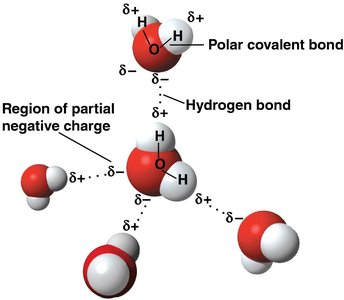
Water’s unique chemical properties arise from its molecular structure and the interactions between its molecules. The electrons in water’s polar covalent bonds spend more time near the oxygen atom, making water a polar molecule with an uneven charge distribution. This polarity enables water molecules to form hydrogen bonds with each other, which are critical for many of water’s life-supporting properties.
Polar molecule: A molecule with an uneven distribution of charges (e.g., water).
Hydrogen bond: A weak bond between the slightly positive hydrogen atom of one water molecule and the slightly negative oxygen atom of another.
Example: The partial negative charge on oxygen and partial positive charge on hydrogen allow water molecules to attract each other.
Four Emergent Properties of Water That Support Life
Water’s structure and hydrogen bonding give rise to four key properties that make Earth suitable for life:
Cohesive behavior: Water molecules stick together, aiding in transport in plants.
Ability to moderate temperature: Water absorbs and releases heat slowly, stabilizing environments.
Expansion upon freezing: Ice is less dense than liquid water, allowing it to float and insulate aquatic life.
Versatility as a solvent: Water dissolves many substances, facilitating chemical reactions in cells.
Water as the Solvent of Life
Water’s polarity makes it an excellent solvent, especially for ionic and polar substances. Most biochemical reactions occur in aqueous solutions, where water acts as the dissolving agent (solvent).
Solution: A homogeneous mixture of two or more substances.
Solvent: The substance that dissolves another (e.g., water).
Solute: The substance being dissolved (e.g., salt).
Aqueous solution: A solution where water is the solvent.
Hydrophilic and Hydrophobic Substances
Substances interact with water differently based on their polarity:
Hydrophilic: Substances with an affinity for water (ionic or polar), such as salt or coffee.
Hydrophobic: Substances that repel water (nonionic or nonpolar), such as oil.
Acidic and Basic Conditions in Biological Systems
Dissociation of Water Molecules
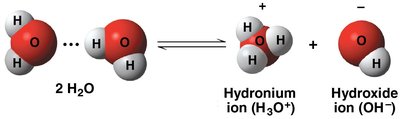
Water molecules can dissociate, forming ions that are crucial for biological processes. A hydrogen atom may shift from one water molecule to another, resulting in a hydronium ion (H3O+) and a hydroxide ion (OH−).
Hydronium ion (H3O+): Water molecule with an extra proton.
Hydroxide ion (OH−): Water molecule that lost a proton.
Dynamic equilibrium: Water molecules dissociate and reform at equal rates.
Acids, Bases, and the pH Scale
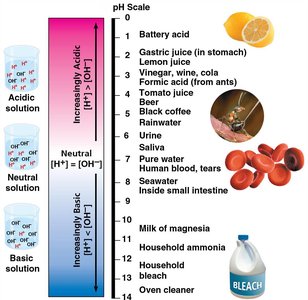
The concentration of hydrogen ions (H+) and hydroxide ions (OH−) determines whether a solution is acidic or basic. Acids increase H+ concentration, while bases reduce it. The pH scale quantifies acidity and basicity:
Acid: Substance that increases H+ concentration.
Base: Substance that decreases H+ concentration.
pH scale: Ranges from 0 (most acidic) to 14 (most basic); pH 7 is neutral.
Equation:
pH definition:
Relationship:
Example: If pH = 4, then pOH = 10 and M.
Biological Importance of pH and Buffers
Most biological fluids have pH values between 6 and 8. Even slight changes in pH can be harmful to cells. Buffers are crucial for maintaining stable pH in biological systems by accepting or donating H+ as needed. Most buffers consist of an acid-base pair that can reversibly combine with H+.
Buffer: Substance that minimizes changes in H+ and OH− concentrations.
Mechanism: Buffers accept H+ when in excess and donate H+ when depleted.
Example: The bicarbonate buffer system in blood helps maintain pH homeostasis.
