 Back
Water and Life: Properties, Acids, Bases, and Buffers
Study Guide - Smart Notes
 Tailored notes based on your materials, expanded with key definitions, examples, and context.
Water and Life
Introduction
Water is essential for all known forms of life. Its unique chemical and physical properties are fundamental to biological processes, making it a central topic in biology. This chapter explores the molecular structure of water, its major properties, and its role in biological systems.
Properties of Water
Molecular Structure and Hydrogen Bonding
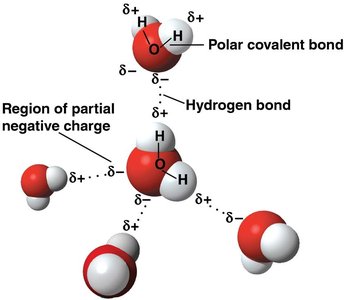
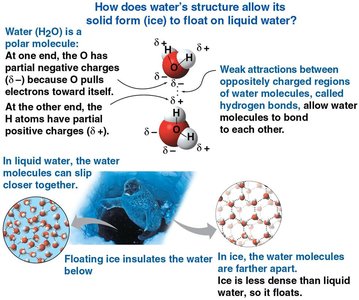
Water (H2O) is a polar molecule, meaning it has regions of partial positive and negative charge due to the unequal sharing of electrons (polar covalent bonds) between hydrogen and oxygen atoms. The polarity of water allows molecules to form hydrogen bonds with each other, which are weak attractions between the partially positive hydrogen of one molecule and the partially negative oxygen of another.
Polar Covalent Bond: Electrons are shared unequally between atoms, resulting in partial charges.
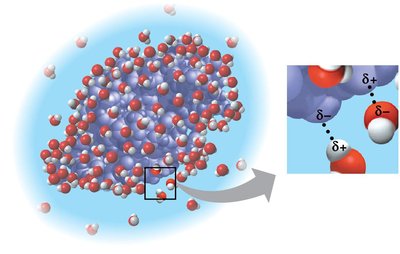
Hydrogen Bond: Weak attraction between a hydrogen atom (δ+) and an electronegative atom (δ−), such as oxygen.
Four Major Properties of Water
Cohesive and Adhesive Behavior: Water molecules stick to each other (cohesion) and to other substances (adhesion).
Ability to Moderate Temperature: Water can absorb or release large amounts of heat with only slight changes in its own temperature.
Expansion Upon Freezing: Ice is less dense than liquid water, causing it to float.
Versatility as a Solvent: Water dissolves many substances, especially polar and ionic compounds.
Cohesion and Adhesion
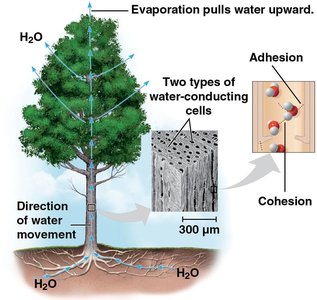
Cohesion refers to the attraction between water molecules, resulting in high surface tension. Adhesion is the attraction between water molecules and other substances. Both properties are crucial for the transport of water and nutrients in plants, allowing movement against gravity through capillary action.
Example: Water transport in plants relies on cohesion and adhesion to move water from roots to leaves.
High Specific Heat and Temperature Moderation
Specific heat is the amount of heat required to change the temperature of 1 gram of a substance by 1°C. Water's high specific heat means it resists temperature changes, helping to stabilize environmental and biological temperatures.
Formula: (where q is heat, m is mass, c is specific heat, and ΔT is temperature change)
Example: Large bodies of water moderate climate by absorbing heat during the day and releasing it at night.

Evaporative Cooling
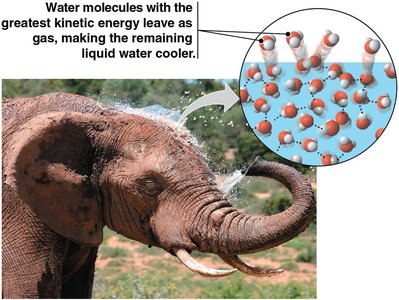
Evaporation is the process by which molecules transition from liquid to gas. As water evaporates, the molecules with the highest kinetic energy leave, cooling the remaining liquid. This evaporative cooling helps organisms regulate temperature (e.g., sweating in mammals).
Expansion Upon Freezing
When water freezes, its molecules form a crystalline structure maintained by hydrogen bonds, making ice less dense than liquid water. This property allows ice to float, insulating aquatic environments and protecting life during cold periods.
Example: Floating ice insulates lakes and oceans, preventing them from freezing solid.
Environmental Impact: Climate Change and Ice
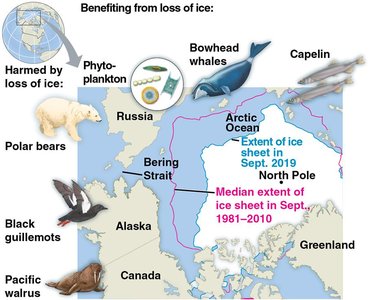
Loss of ice due to climate change affects ecosystems, especially in the Arctic. Species dependent on ice for survival are threatened, while others may benefit from the changing environment.
Water as a Solvent
Solutions, Solvents, and Solutes
A solution is a homogeneous mixture of two or more substances. The solvent is the dissolving agent, and the solute is the substance dissolved. An aqueous solution uses water as the solvent. Water's polarity allows it to dissolve many ionic and polar substances, making it a versatile solvent.
Example: Table salt (NaCl) dissolving in water.
Hydrophilic vs. Hydrophobic Substances
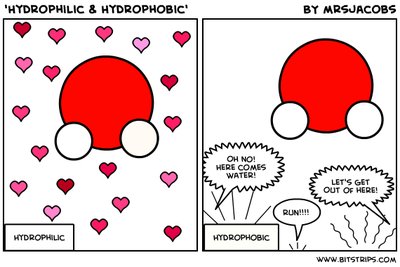
Hydrophilic substances have an affinity for water and dissolve easily (e.g., salts, sugars). Hydrophobic substances do not interact well with water and do not dissolve (e.g., oils, fats).
Acids, Bases, and the pH Scale
Acids and Bases
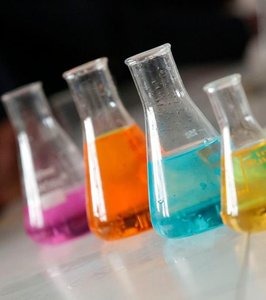
An acid increases the concentration of hydrogen ions (H+) in a solution, while a base decreases it (often by increasing OH−). Strong acids and bases dissociate completely in water.
The pH Scale
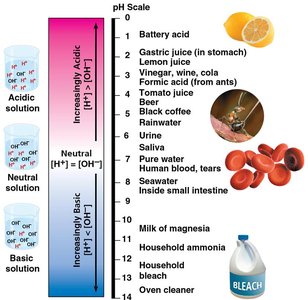
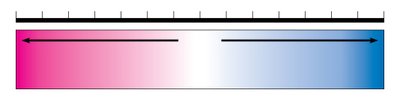
The pH scale measures the concentration of H+ ions in a solution, ranging from 0 (most acidic) to 14 (most basic), with 7 being neutral. Most biological fluids have pH values between 6 and 8.
Formula:
At 25°C,
Using the pH Scale
Each unit change on the pH scale represents a tenfold difference in H+ concentration. For example, a solution with pH 3 is 1,000 times more acidic than one with pH 6.
Buffers and Biological Importance
Buffers
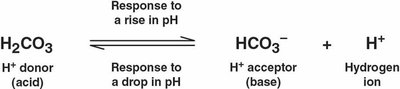
Buffers are substances that minimize changes in pH by accepting or donating H+ ions. Most buffers consist of a weak acid and its conjugate base. They are essential for maintaining stable pH in biological systems, such as blood.
Example: The carbonic acid-bicarbonate buffer system in blood:
Acidification of the Oceans
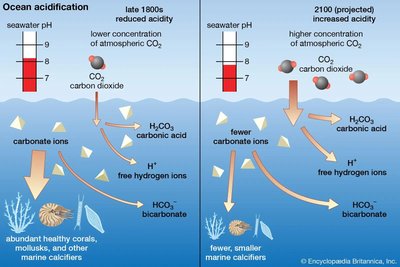
Human activities increase atmospheric CO2, which dissolves in oceans to form carbonic acid. This lowers ocean pH (ocean acidification), reducing carbonate ions needed by marine organisms to build shells and coral reefs.
Review Questions
Give one benefit of each of the following properties of water:
Adhesive: Enables water to move up plant vessels against gravity.
Less dense as a solid: Ice floats, insulating aquatic life in winter.
High specific heat: Stabilizes temperatures in organisms and environments.
Cohesive: Allows for surface tension and water transport in plants.
What type of chemical bond is responsible for the unique properties of water?
Hydrogen bonds
What is the difference between an acid and a base?
Acid: Increases H+ concentration; Base: Decreases H+ concentration.
In the human body, where would you find neutral, acidic, and basic conditions?
Neutral: Blood (pH ~7.4)
Acidic: Stomach (gastric juice, pH 1-2)
Basic: Small intestine (pH 8)
