 Back
Water and Life: Properties and Biological Importance
Study Guide - Smart Notes
 Tailored notes based on your materials, expanded with key definitions, examples, and context.
Water and Life
Polarity of Water and Hydrogen Bonds
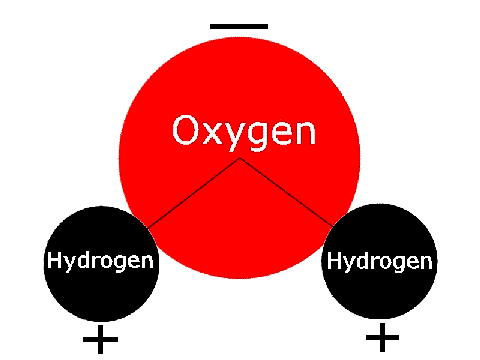
Water is a polar molecule, meaning it has a partial positive charge on one end and a partial negative charge on the other. This polarity allows water molecules to form hydrogen bonds with each other, which is essential for many of water's unique properties that support life.
Polarity: The oxygen atom in water is more electronegative, pulling electrons closer and creating a partial negative charge, while the hydrogen atoms are partially positive.
Hydrogen Bonds: Weak attractions between the hydrogen atom of one water molecule and the oxygen atom of another.
Biological Importance: Hydrogen bonding is responsible for water's high cohesion, surface tension, and its role as a universal solvent.
Cohesion and Adhesion
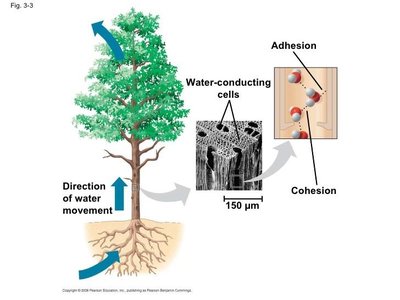
Cohesion refers to the attraction between molecules of the same type, while adhesion is the attraction between different types of molecules. In water, cohesion is primarily due to hydrogen bonding, which allows water molecules to stick together. This property is crucial for processes such as water transport in plants.
Cohesion: Water molecules stick together, enabling surface tension and the upward movement of water in plants.
Adhesion: Water molecules stick to other substances, such as the walls of plant vessels.
Example: Water travels from roots to the top of trees due to cohesion and adhesion.
Surface Tension
Surface tension is the result of cohesion among water molecules at the surface. It allows water to resist external force and is why small objects can float on water if they do not break the surface.
Surface Tension: The tightness at the surface of water due to hydrogen bonding.
Example: Insects such as water striders can walk on water due to surface tension.
Moderation of Temperature
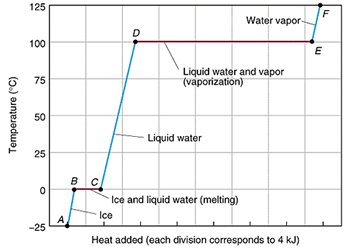
Water has a high specific heat capacity, meaning it can absorb or release large amounts of heat with only a slight change in its own temperature. This property is due to the energy required to break hydrogen bonds before water molecules can move faster.
Specific Heat: The amount of heat needed to raise the temperature of 1 gram of water by 1°C.
Phase Changes: Water requires significant energy to change from solid to liquid (melting) and from liquid to gas (vaporization).
Biological Importance: Helps moderate climate and maintain stable temperatures in organisms and environments.
Hydrogen Bonding in Action
Hydrogen bonds allow water to hold a large amount of heat, even at low temperatures. This property is important for moderating temperatures in coastal areas and maintaining stable environments for life.
Heat Storage: Water absorbs heat without rapid temperature increase.
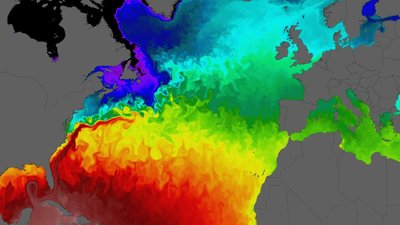
Moderation of Climate: Coastal regions experience milder temperatures due to water's heat capacity.
Evaporative Cooling
Evaporative cooling occurs when the fastest-moving (highest energy) water molecules escape as vapor, leaving behind cooler molecules. This process helps organisms dissipate excess heat.
Temperature: Average kinetic energy of molecules.
Evaporation: Loss of high-energy molecules lowers the temperature of the remaining liquid.
Example: Sweating and panting are biological mechanisms for evaporative cooling.
Ice Floating
When water freezes, hydrogen bonds form a crystalline structure that spaces molecules farther apart, decreasing density. As a result, ice floats on liquid water, insulating the water below and allowing aquatic life to survive in cold climates.
Open Lattice: Hydrogen bonds create a less dense structure in ice.
Biological Importance: Ice acts as a blanket, keeping water beneath in liquid form.
Universal Solvent
Water is known as the universal solvent because it can dissolve a wide variety of substances due to its polarity. This property is essential for biological processes, as most chemical reactions in organisms occur in aqueous solutions.
Solution: Homogeneous mixture of two or more substances.
Solute: Substance that is dissolved.
Solvent: Dissolving agent (water in aqueous solutions).
Aqueous Solution: Solution where water is the solvent.
Biological Importance: Provides a medium for chemical reactions and transport of substances.
Acids, Bases, and pH
Water can dissociate into hydrogen ions (H+) and hydroxide ions (OH-). The concentration of H+ determines the pH of a solution, which is a logarithmic scale from 1 to 14. Buffers help maintain stable pH in organisms.
Acid: Substance that increases H+ concentration.
Base: Substance that decreases H+ concentration (or accepts H+).
pH: Measure of H+ concentration; each unit is 10 times the previous.
Neutral: pH 7, where H+ = OH-.
Buffer: Chemical that can add or remove H+ or OH- to maintain pH.
Equation:
Biological Importance: Buffers are vital for maintaining pH in organisms; ocean acidification can overwhelm natural buffers, affecting coral reefs and enzyme activity.
Summary Table: Water Properties and Biological Importance
Property | Biological Importance |
|---|---|
Cohesion | Enables water transport in plants |
Adhesion | Helps water stick to plant vessels |
Surface Tension | Allows small organisms to move on water |
High Specific Heat | Moderates climate and organism temperature |
Evaporative Cooling | Regulates body temperature |
Ice Floating | Insulates aquatic environments |
Universal Solvent | Facilitates chemical reactions and transport |
Buffering | Maintains stable pH in organisms |
