 Back
Water and Life: Properties and Biological Importance
Study Guide - Smart Notes
 Tailored notes based on your materials, expanded with key definitions, examples, and context.
Water and Life
Introduction to Water in Biology
Water is essential for all known forms of life and is the most abundant molecule in living cells. Its unique chemical and physical properties arise from its molecular structure and the interactions between water molecules. These properties make Earth suitable for life and enable the complex chemistry of living organisms.
Water exists naturally on Earth in all three states: solid, liquid, and gas.
Living cells are aqueous environments; most biochemical reactions occur in water.
Emergent properties of water arise from the collective behavior of many water molecules, not just individual H2O molecules.
The Structure and Polarity of Water
Polarity of Water Molecules
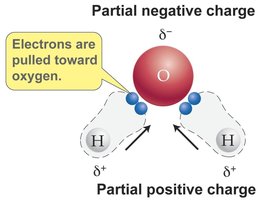
The water molecule (H2O) is polar because oxygen is more electronegative than hydrogen, causing an unequal sharing of electrons. This results in a partial negative charge (δ−) near the oxygen atom and partial positive charges (δ+) near the hydrogen atoms.
Polar covalent bonds form between oxygen and hydrogen.
The bent shape of the molecule and unequal electron sharing create a dipole moment.
Hydrogen Bonding Between Water Molecules
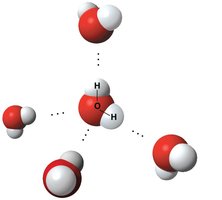
Water molecules interact through hydrogen bonds, which are weak attractions between the partially negative oxygen of one molecule and the partially positive hydrogen of another. These bonds are responsible for many of water's unique properties.
Hydrogen bonds are individually weak but collectively strong in large numbers.
Water can also form hydrogen bonds with other polar molecules.
Emergent Properties of Water
Overview of Water's Four Key Properties
Four emergent properties of water are critical for supporting life on Earth:
Cohesion and adhesion
Ability to moderate temperature
Expansion upon freezing
Versatility as a solvent
Property #1: Cohesion and Adhesion
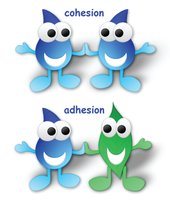
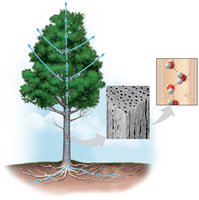
Cohesion is the attraction between molecules of the same substance, while adhesion is the attraction between different substances. In water, hydrogen bonds cause strong cohesion, resulting in high surface tension. Adhesion allows water to interact with other materials, such as plant cell walls.
Surface tension is the resistance of a liquid's surface to breaking, due to cohesion.
Adhesion helps water move against gravity in plants (capillary action).
Property #2: Moderation of Temperature
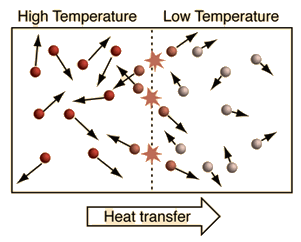
Water can absorb or release large amounts of heat with only slight changes in its own temperature, due to its high specific heat. This property helps stabilize environmental and organismal temperatures.
Specific heat is the amount of heat needed to raise 1 gram of a substance by 1°C.
Hydrogen bonds must be broken for water to increase in temperature, so much energy is absorbed before temperature rises.
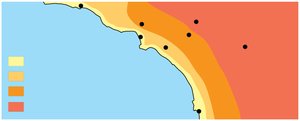
Water moderates climate near large bodies of water and stabilizes internal temperatures in organisms.
Evaporative Cooling
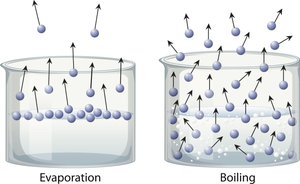
Evaporation is the transformation of a liquid to a gas. As water evaporates, the fastest-moving molecules leave, cooling the remaining liquid. This process helps organisms regulate temperature (e.g., sweating, panting).
Evaporative cooling stabilizes temperatures in organisms and environments.
Property #3: Expansion Upon Freezing
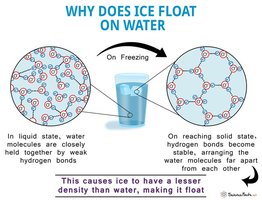
When water freezes, hydrogen bonds stabilize into a hexagonal lattice, holding molecules farther apart than in liquid water. This makes ice less dense than liquid water, causing it to float. Floating ice insulates water below, protecting aquatic life in cold climates.
Ice is less dense than liquid water due to the open hexagonal structure formed by hydrogen bonds.
Property #4: Water as the Solvent of Life
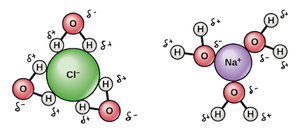
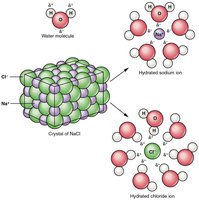
Water is an excellent solvent for ionic and polar substances due to its polarity. In aqueous solutions, water surrounds ions and polar molecules, allowing them to dissolve and participate in chemical reactions.
Solution: Homogeneous mixture of solute dissolved in solvent.
Aqueous solution: Water is the solvent.
Water forms hydration shells around ions and polar molecules.
Hydrophilic and Hydrophobic Substances
Hydrophilic substances (ions, polar molecules) interact favorably with water and dissolve easily. Hydrophobic substances (nonpolar molecules) do not interact well with water and do not dissolve.
Examples of hydrophilic: alcohols, ammonia, DNA
Examples of hydrophobic: oils, fats
Dissociation of Water and pH
Water Dissociation
Water molecules can dissociate into ions: a hydrogen ion (H+) and a hydroxide ion (OH−). The hydrogen ion often associates with another water molecule to form a hydronium ion (H3O+), but is commonly represented as H+ for simplicity.
Water is in a dynamic equilibrium between dissociation and recombination.

Acids, Bases, and Buffers
Acids increase the concentration of H+ in solution, while bases decrease it. Buffers help maintain stable pH by absorbing excess H+ or OH−.
Acid example: HCl → H+ + Cl−
Base example: NH3 + H+ → NH4+
pH Scale
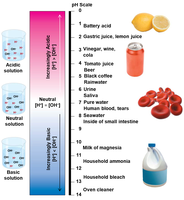
The pH scale measures the concentration of hydrogen ions in a solution. At neutral pH (7), [H+] = [OH−]. Lower pH values indicate higher acidity (more H+), while higher pH values indicate higher basicity (less H+).
Acidic: pH < 7, [H+] > [OH−]
Neutral: pH = 7, [H+] = [OH−]
Basic: pH > 7, [H+] < [OH−]
Summary Table: Properties of Water and Their Biological Importance
Property | Description | Biological Importance |
|---|---|---|
Cohesion & Adhesion | Hydrogen bonds hold water molecules together and allow them to stick to other substances | Enables water transport in plants, high surface tension |
High Specific Heat | Water absorbs/release heat with little temperature change | Stabilizes climate and organismal temperature |
Expansion Upon Freezing | Ice is less dense than liquid water | Insulates aquatic life in cold environments |
Versatility as a Solvent | Dissolves ionic and polar substances | Facilitates biochemical reactions in cells |
Practice Questions
List the four major properties of water. For each, explain how hydrogen bonding contributes to that property.
Give a specific example of how each property of water impacts life on Earth.
Diagram how water molecules would interact with: a polar NH3 molecule, a Ca2+ cation, and a nonpolar CH4 molecule.
Write the chemical equation for water dissociation. What ions are produced by a single dissociation event?
Compare the relative concentrations of H+ and OH− in acidic (pH < 7), neutral (pH = 7), and basic (pH > 7) solutions.
