 Back
Water and Life: Properties and Biological Importance
Study Guide - Smart Notes
 Tailored notes based on your materials, expanded with key definitions, examples, and context.
Water and Life
Water as a Polar Molecule
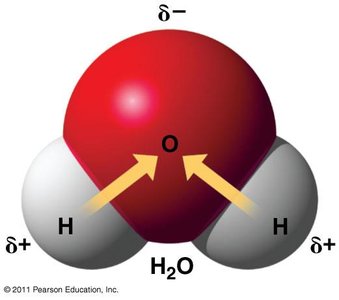
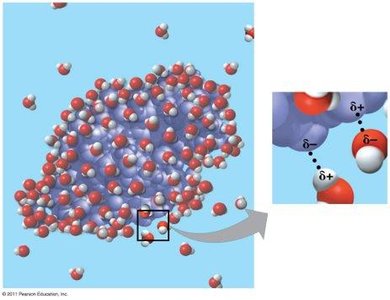
Water (H2O) is a polar molecule, meaning it has regions of partial positive and negative charge due to the unequal sharing of electrons between oxygen and hydrogen atoms. The oxygen atom is more electronegative, carrying a partial negative charge (δ-), while the hydrogen atoms carry partial positive charges (δ+). This polarity is fundamental to water's unique properties.
Polarity: The oxygen atom attracts electrons more strongly than hydrogen, creating a dipole moment.
Hydrogen Bonds: The slightly positive hydrogen of one water molecule is attracted to the slightly negative oxygen of another, forming hydrogen bonds.
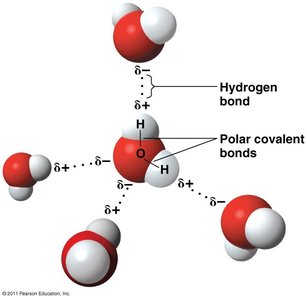
Hydrogen Bonding and Structural Organization
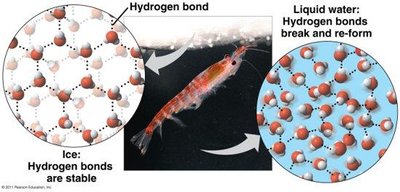
Hydrogen bonds in water form and break rapidly, leading to a dynamic network. This high frequency of hydrogen bond formation and disruption gives rise to a high level of structural organization, which is responsible for water's emergent properties critical for life.
Emergent Properties: Cohesion/adhesion, temperature moderation, ice floating, and solvent abilities.
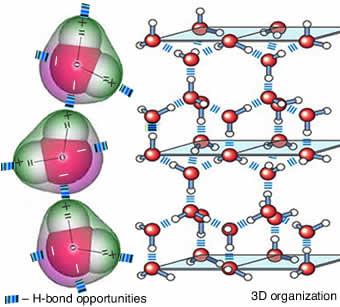
Emergent Properties of Water
Cohesion and Adhesion
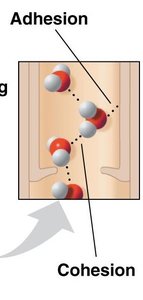
Cohesion refers to the attraction between like molecules, while adhesion is the attraction between different substances. In water, cohesion is due to hydrogen bonding between water molecules, and adhesion occurs when water forms hydrogen bonds with other substances. These properties are essential for processes such as water transport in plants.
Cohesion: Responsible for surface tension and the upward movement of water in plants.
Adhesion: Helps water molecules cling to cell walls, counteracting gravity in plant vessels.
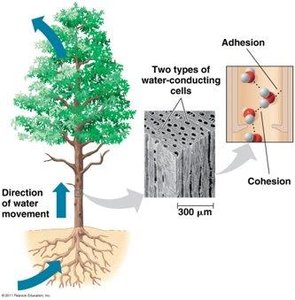
Surface Tension
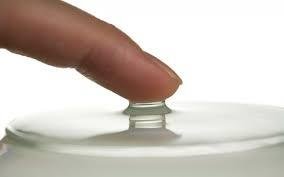
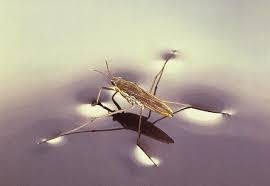
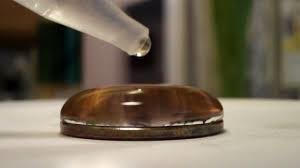
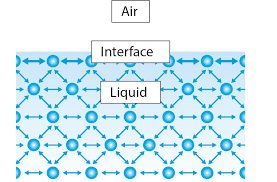
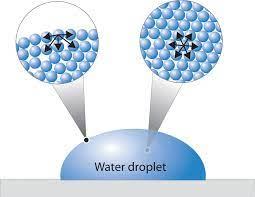
Surface tension is a measure of how difficult it is to stretch or break the surface of a liquid. Water's high surface tension is due to the cohesive forces between water molecules at the surface, which are hydrogen-bonded to each other and to molecules below.
Examples: Water droplets forming beads, insects walking on water, and the meniscus in a glass.

Moderation of Temperature
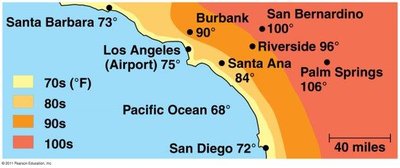
Water moderates temperature by absorbing heat from warmer air and releasing heat to cooler air. This property is due to water's high specific heat, which is the amount of heat required to change the temperature of 1 gram of a substance by 1°C. Water's specific heat is much higher than that of most other substances, primarily due to hydrogen bonding.
Heat: Total kinetic energy of molecules (depends on volume).
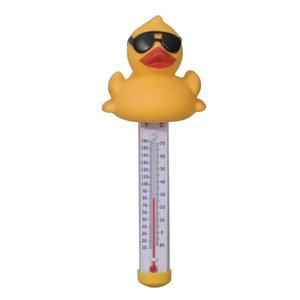
Temperature: Average kinetic energy of molecules (independent of volume).
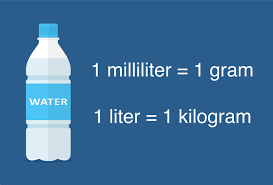
Calorie: 1 calorie is the heat needed to raise 1 g of water by 1°C.
High Specific Heat: Water = 1 cal/g°C; Alcohol = 0.6 cal/g°C; Glass = 0.2 cal/g°C; Aluminum = 0.2 cal/g°C; Iron = 0.1 cal/g°C; Gold = 0.03 cal/g°C.
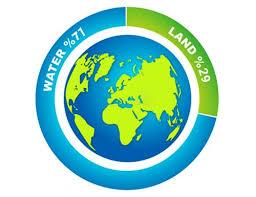
Biological Importance: Oceans moderate coastal climates, and water's high specific heat stabilizes temperatures in organisms and environments.


Evaporative Cooling
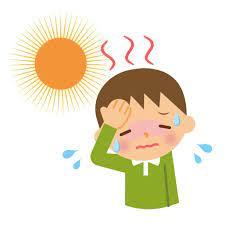
Evaporative cooling occurs when the hottest water molecules (those with the most kinetic energy) evaporate, leaving the remaining liquid cooler. This process helps organisms regulate temperature through sweating or panting.
Example: Humans sweat and dogs pant to cool down.


Floating of Ice on Liquid Water
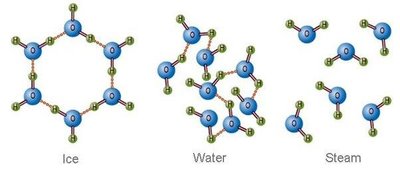
Unlike most substances, water is less dense as a solid (ice) than as a liquid. This is because hydrogen bonds in ice are stable and hold water molecules in a lattice, keeping them further apart than in liquid water, where bonds constantly break and reform. As a result, ice floats, insulating the water below and providing a habitat for aquatic life.
Importance: Floating ice prevents bodies of water from freezing solid, protecting aquatic ecosystems.
Water as an Excellent Solvent
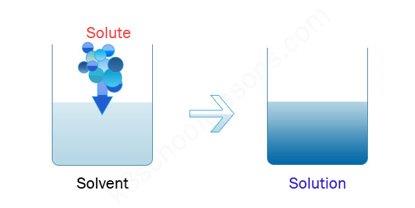
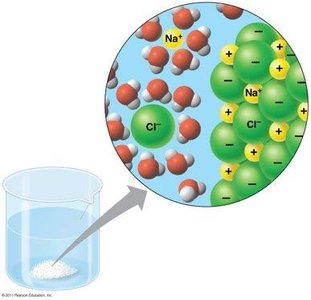
Water's polarity makes it an excellent solvent, especially for ionic and polar substances. In a solution, the solvent (water) dissolves the solute (e.g., salt), forming a homogeneous mixture. Water molecules surround ions or polar molecules, forming hydration shells that keep them dissolved.
Solution: Homogeneous mixture of two or more substances.
Solvent: The dissolving agent (water).
Solute: The substance dissolved (e.g., NaCl).
Hydration Shell: Water molecules surround and isolate ions or polar molecules.
Hydrophilic vs. Hydrophobic Substances
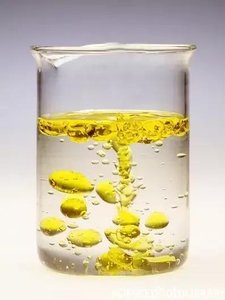
Substances that dissolve in water are called hydrophilic ('water loving'), including salts, charged molecules, and polar molecules. Hydrophobic ('water fearing') substances, such as oils and nonpolar molecules, do not dissolve in water because they cannot form hydrogen bonds with water molecules.
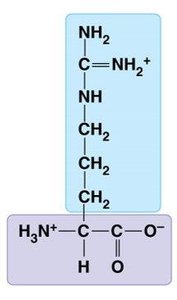
Hydrophilic: Salts, polar amino acids, and other polar molecules.
Hydrophobic: Oils, nonpolar amino acids, and nonionic molecules.

Summary Table: Emergent Properties of Water
Property | Description | Biological Importance |
|---|---|---|
Cohesion/Adhesion | Hydrogen bonds hold water molecules together and to other substances | Enables water transport in plants, surface tension |
Temperature Moderation | High specific heat buffers temperature changes | Stabilizes climates and organismal temperatures |
Floating Ice | Solid water is less dense than liquid water | Insulates aquatic habitats, prevents freezing |
Solvent Abilities | Polarity allows dissolution of many substances | Facilitates chemical reactions in cells |
