 Back
Water and Life: Properties and Biological Importance
Study Guide - Smart Notes
 Tailored notes based on your materials, expanded with key definitions, examples, and context.
Water and Life
Introduction
Water is an essential molecule for all known forms of life. Its unique chemical and physical properties make it indispensable for biological processes, from cellular metabolism to ecosystem regulation.
Polar Covalent Bonds and Hydrogen Bonding in Water
The Water Molecule
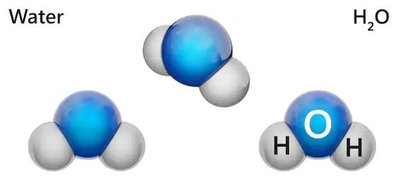
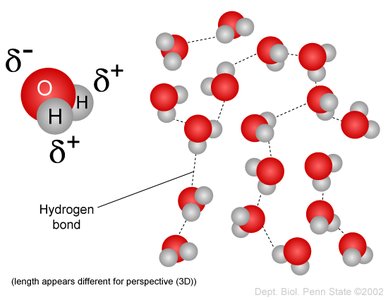
The structure and properties of water are determined by the arrangement and characteristics of its atoms. Water (H2O) consists of two hydrogen atoms covalently bonded to one oxygen atom. The oxygen atom is more electronegative, resulting in an unequal sharing of electrons—a polar covalent bond. This polarity gives rise to partial charges: the oxygen atom carries a partial negative charge (δ−), while the hydrogens carry partial positive charges (δ+).
Electronegativity: The tendency of an atom to attract electrons in a covalent bond. Oxygen is more electronegative than hydrogen.
Hydrogen Bond: A weak bond formed between the slightly positive hydrogen atom of one water molecule and the slightly negative oxygen atom of another.
Emergent Properties of Water
Cohesion and Adhesion
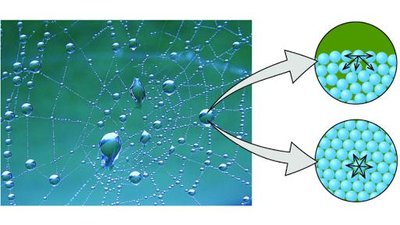
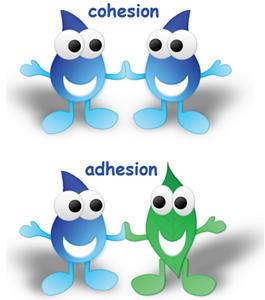
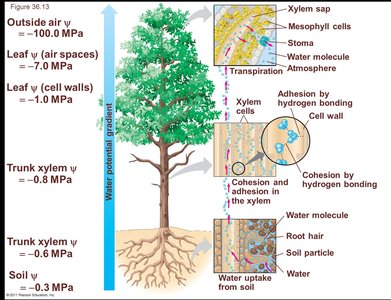
Water molecules exhibit cohesion (attraction to each other) due to hydrogen bonding, and adhesion (attraction to other substances). These properties enable unique phenomena such as surface tension and capillary action, which are vital for processes like water transport in plants.
Cohesion: Responsible for surface tension, allowing small objects or insects to rest on water surfaces.
Adhesion: Enables water to cling to other materials, aiding in capillary action.
Example: Transpiration in trees relies on both cohesion and adhesion to move water from roots to leaves.
High Specific Heat
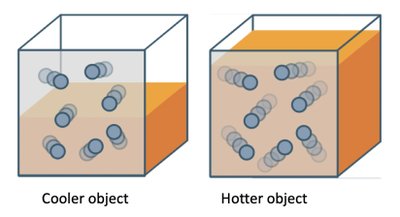
Water has a high specific heat, meaning it can absorb or release large amounts of heat with only a slight change in its own temperature. This property helps stabilize temperatures in organisms and environments, moderating climate and supporting life.
Specific Heat: The amount of heat required to raise the temperature of 1 gram of a substance by 1°C.
Biological Importance: Maintains stable internal and external environments for living organisms.
Example: Large bodies of water buffer temperature fluctuations, and sweating cools the body via evaporative cooling.
Heat Transfer and Ocean Currents
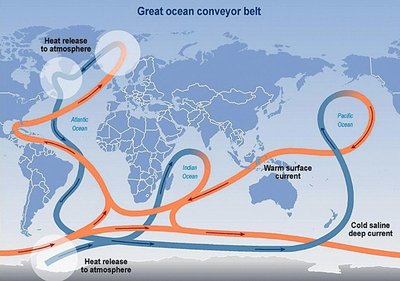
Water's thermal properties drive large-scale processes such as ocean currents, which redistribute heat around the globe. The Great Ocean Conveyor Belt is a system of deep and surface currents that regulate climate by moving warm and cold water between the equator and the poles.
Convection: The movement of water due to differences in temperature and density.
Impact: Influences weather patterns, nutrient cycling, and marine life distribution.
Ice Floats
Unlike most substances, water is less dense as a solid (ice) than as a liquid. This is due to the hydrogen-bonded lattice structure formed at low temperatures, which spaces molecules farther apart. Floating ice insulates aquatic environments, allowing life to persist beneath the surface during cold periods.
Ecological Ramifications: Aquatic organisms survive winter under the ice; ice cover affects global climate and sea levels.
Universal Solvent
Water is known as the "universal solvent" because its polarity allows it to dissolve many polar and ionic substances. This property is crucial for biological systems, enabling the transport of nutrients, waste, and gases in solution.
Solution: A homogeneous mixture of two or more substances.
Solvent: The dissolving agent (water in biological systems).
Hydrophilic: Water-attracting (polar) molecules.
Hydrophobic: Water-repelling (non-polar) molecules.
Acidic and Basic Conditions Affect Living Organisms
Dissociation of Water and pH
Water can dissociate into hydrogen ions (H+) and hydroxide ions (OH−). The concentration of these ions determines the pH of a solution, which is a measure of its acidity or alkalinity.
pH Scale: Ranges from 0 (most acidic) to 14 (most basic), with 7 being neutral.
Equation:
Acids: Substances that increase H+ concentration (pH < 7).
Bases: Substances that decrease H+ concentration (pH > 7).
Buffers: Compounds that minimize changes in pH by accepting or donating H+ ions.
Biological Importance of pH
Maintaining a stable pH is vital for cellular function and organismal health. Enzyme activity, metabolic processes, and the structure of biomolecules are all pH-dependent. Buffers, such as bicarbonate in blood, help organisms resist drastic pH changes.
Summary Table: Properties of Water
Property | Definition | Biological Example |
|---|---|---|
Cohesion | Attraction between water molecules | Surface tension, water transport in plants |
Adhesion | Attraction between water and other substances | Capillary action in plant xylem |
High Specific Heat | High energy required to change temperature | Temperature regulation in organisms and environments |
Ice Floats | Solid water is less dense than liquid | Insulation of aquatic habitats |
Universal Solvent | Dissolves many polar/ionic substances | Transport of nutrients and waste in cells |
