 Back
Water and Life: Properties, Functions, and Biological Importance
Study Guide - Smart Notes
 Tailored notes based on your materials, expanded with key definitions, examples, and context.
Chapter 3: Water and Life
Introduction to Water in Biology
Water is essential for all known forms of life. Its unique chemical and physical properties make it indispensable for biological processes, from cellular metabolism to ecosystem dynamics. The structure of the water molecule and its interactions with other molecules underlie its critical roles in biology.
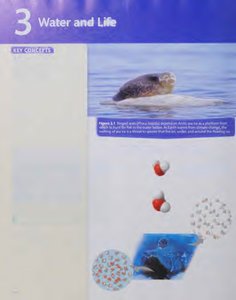
Properties of Water
Polarity and Hydrogen Bonding
Polarity: Water (H2O) is a polar molecule, meaning it has a partial positive charge on the hydrogen atoms and a partial negative charge on the oxygen atom.
Hydrogen Bonds: The polarity allows water molecules to form hydrogen bonds with each other and with other polar substances. These bonds are responsible for many of water's unique properties.
Cohesion and Adhesion: Cohesion is the attraction between water molecules, while adhesion is the attraction between water molecules and other substances. These properties are crucial for processes like water transport in plants.
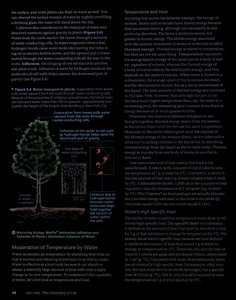
Moderation of Temperature by Water
Water moderates temperature on Earth by absorbing heat from warmer air and releasing stored heat to cooler air. This property is due to water's high specific heat, which is the amount of heat required to change its temperature by 1°C.
High Specific Heat: Water can absorb or release a large amount of heat with only a slight change in its own temperature. This helps stabilize ocean and atmospheric temperatures, creating a favorable environment for life.
Evaporative Cooling: As water evaporates, it removes heat from surfaces, cooling organisms and environments. This is the principle behind sweating and transpiration in plants.

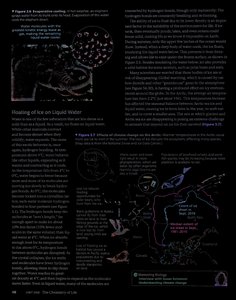
Floating of Ice on Liquid Water
Unlike most substances, water is less dense as a solid than as a liquid. This is because hydrogen bonds stabilize and keep the molecules of ice farther apart than in liquid water.
Biological Importance: Ice floats on water, insulating aquatic environments and protecting life during cold periods.
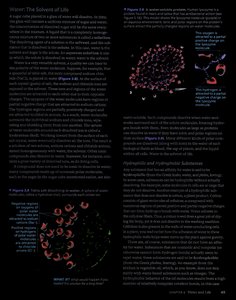
Water as the Solvent of Life
Solvent Properties
Water is often called the "universal solvent" because it dissolves more substances than any other liquid. This property is due to its polarity, which allows it to surround and separate ions and polar molecules.
Hydrophilic Substances: Substances that dissolve in water (e.g., salts, sugars) are called hydrophilic.
Hydrophobic Substances: Nonpolar molecules (e.g., oils, fats) do not dissolve in water and are termed hydrophobic.
Acids, Bases, and pH
Water can dissociate into hydrogen ions (H+) and hydroxide ions (OH-), which is the basis for acids and bases in aqueous solutions.
Acid: A substance that increases the H+ concentration of a solution.
Base: A substance that reduces the H+ concentration, often by increasing OH-.
pH Scale: Measures the concentration of H+ in a solution. It is calculated as .
Buffers
Buffers are substances that minimize changes in pH by accepting or donating H+ ions. They are crucial for maintaining stable pH in biological systems, such as blood.
Acidification: A Threat to Our Oceans
Ocean Acidification
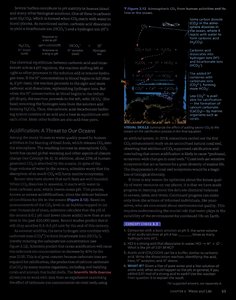
Increased atmospheric CO2 dissolves in oceans, forming carbonic acid and lowering pH. This process, known as ocean acidification, threatens marine life, especially organisms that build shells or skeletons from calcium carbonate.
Possible Evolution of Life on Other Planets
Water and Extraterrestrial Life
The search for life beyond Earth often focuses on the presence of water, as its unique properties are considered essential for life as we know it. Scientists study planets and moons for evidence of liquid water as a key indicator of potential habitability.

Summary Table: Properties of Water and Their Biological Importance
Property | Description | Biological Importance |
|---|---|---|
Cohesion/Adhesion | Hydrogen bonding holds water molecules together and to other surfaces | Enables transport in plants, surface tension |
High Specific Heat | Absorbs/releases heat with little temperature change | Stabilizes climate and organismal temperature |
Ice Floats | Solid water is less dense than liquid | Insulates aquatic life in winter |
Versatile Solvent | Dissolves many ionic and polar substances | Facilitates chemical reactions in cells |
pH Buffering | Minimizes changes in pH | Maintains homeostasis in organisms |
Additional info: The notes above expand on the textbook content by providing definitions, examples, and a summary table for clarity and exam preparation.
