 Back
BackWater and Life: Properties, Functions, and Biological Importance
Study Guide - Smart Notes
 Tailored notes based on your materials, expanded with key definitions, examples, and context.
Water and Life
Overview: The Molecule That Supports All Life
Water is the essential biological medium on Earth, making up 70–95% of most cells and surrounding all living organisms. Its abundance is a key factor in Earth's habitability, supporting cellular processes and life itself.
Key Point 1: All living organisms require water more than any other substance.
Key Point 2: Water's unique properties make it indispensable for life.
Example: Cells are mostly water, and many biochemical reactions occur in aqueous environments.
Polar Covalent Bonds and Hydrogen Bonding
Structure and Polarity of Water Molecules
Water molecules have polar covalent bonds, with electrons spending more time near the oxygen atom than the hydrogen atoms. This uneven charge distribution makes water a polar molecule, enabling the formation of hydrogen bonds between molecules.
Key Point 1: Polarity allows water molecules to form hydrogen bonds with each other.
Key Point 2: Hydrogen bonds are responsible for many of water's unique properties.
Example: Hydrogen bonding leads to cohesion and high surface tension.
Emergent Properties of Water
Four Properties That Facilitate Life
Water exhibits four emergent properties that contribute to Earth's suitability for life: cohesive behavior, ability to moderate temperature, expansion upon freezing, and versatility as a solvent.
Cohesive Behavior: Hydrogen bonds hold water molecules together, resulting in high surface tension and aiding the transport of water in plants.
Ability to Moderate Temperature: Water absorbs and releases heat with minimal temperature change due to its high specific heat.
Expansion Upon Freezing: Water is less dense as a solid than as a liquid, allowing ice to float and insulate aquatic life.
Versatility as a Solvent: Water dissolves a wide variety of substances, facilitating chemical reactions in cells.
Cohesion and Adhesion
Cohesion refers to the attraction between water molecules, while adhesion is the attraction between water and other substances, such as plant cell walls. These properties enable water transport against gravity in plants.
Key Point: Cohesion and adhesion help move water and nutrients through plant tissues.
Example: Water transport in xylem vessels of plants.
Moderation of Temperature
Water moderates temperature by absorbing heat from warmer air and releasing it to cooler air. Its high specific heat means it resists temperature changes, stabilizing environments for organisms.
Key Point: Water's high specific heat is due to hydrogen bonding.
Example: Coastal areas experience milder climates due to large bodies of water.
Evaporative Cooling
Evaporation transforms liquid water into gas, and the heat of vaporization is the energy required for this process. Evaporative cooling helps regulate temperatures in organisms and bodies of water.
Key Point: As water evaporates, the surface cools, stabilizing temperatures.
Example: Sweating in humans helps cool the body.
Expansion Upon Freezing
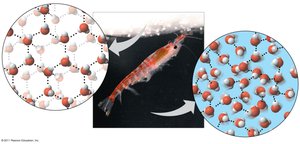
Water becomes less dense as it freezes because hydrogen bonds form a crystalline lattice, keeping molecules apart. This property allows ice to float, insulating aquatic ecosystems.
Key Point: Ice floats on liquid water, protecting aquatic life in cold climates.
Example: Lakes and ponds do not freeze solid, allowing organisms to survive beneath the ice.
Water: The Solvent of Life
Solutions, Solvents, and Solutes
A solution is a homogeneous mixture of substances. The solvent is the dissolving agent, and the solute is the substance dissolved. An aqueous solution uses water as the solvent.
Key Point: Water's polarity makes it a versatile solvent.
Example: Table salt (NaCl) dissolves in water, forming hydration shells around ions.
Hydrophilic and Hydrophobic Substances
Hydrophilic substances have an affinity for water, while hydrophobic substances do not. Hydrophobic molecules, such as oils, are major components of cell membranes.
Key Point: Hydrophilic molecules dissolve easily in water; hydrophobic molecules do not.
Example: Proteins with polar regions can dissolve in water.
Solute Concentration in Aqueous Solutions
Chemical reactions in organisms depend on the concentration of solutes in water. Molecular mass is the sum of the masses of all atoms in a molecule. Moles and molarity are used to measure solute amounts.
Key Point: Molarity (M) is the number of moles of solute per liter of solution.
Formula:
Example: Preparing a 1 M NaCl solution involves dissolving 1 mole of NaCl in 1 liter of water.
Acidic and Basic Conditions
Dissociation of Water Molecules
Water molecules can dissociate, forming hydronium ions (H3O+) and hydroxide ions (OH-). This process is rare but has significant effects on biological systems.
Key Point: Changes in ion concentrations can drastically affect cell chemistry.
Example: Cellular processes are sensitive to pH changes.
Acids, Bases, and the pH Scale
Acids increase the concentration of H+ ions, while bases reduce it. The pH scale measures the acidity or basicity of a solution, defined by the negative logarithm of H+ concentration.
Formula:
Key Point: Acidic solutions have pH < 7; basic solutions have pH > 7.
Example: Most biological fluids have pH values between 6 and 8.
Buffers
Buffers are substances that minimize changes in pH by accepting or donating H+ ions. Most buffers consist of a weak acid and its corresponding base, maintaining pH stability in cells.
Key Point: Buffers help maintain the internal pH of cells close to neutrality.
Example: Blood contains bicarbonate buffer to regulate pH.
