 Back
Water and Life: Properties, Importance, and Biological Implications
Study Guide - Smart Notes
 Tailored notes based on your materials, expanded with key definitions, examples, and context.
Water and Life
Introduction
Water is the essential biological medium on Earth, supporting all known forms of life. Its unique chemical and physical properties, arising from its molecular structure, make Earth habitable and influence biological processes at every level.
Polar Covalent Bonds and Hydrogen Bonding
Structure of Water Molecules
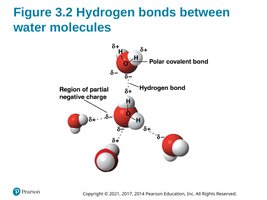
Polar covalent bonds in water result from the unequal sharing of electrons between oxygen and hydrogen atoms.
This polarity creates regions of partial positive (hydrogen) and partial negative (oxygen) charge.
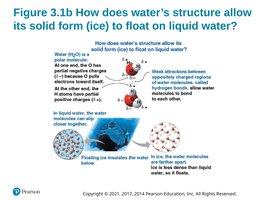
Water molecules form hydrogen bonds with each other due to these charges, leading to many of water’s unique properties.
Emergent Properties of Water
Cohesion, Adhesion, and Surface Tension
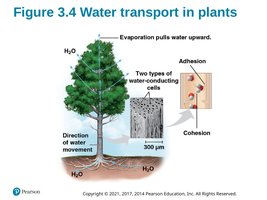
Cohesion: Hydrogen bonds hold water molecules together, allowing for the transport of water against gravity in plants.
Adhesion: Water molecules are attracted to other substances, such as plant cell walls, aiding in water movement.
Surface tension: Water has a high surface tension, making it difficult to break the surface; this allows small organisms to walk on water.

Water Transport in Plants
Cohesion and adhesion work together to move water from roots to leaves in plants, a process essential for nutrient transport and photosynthesis.
Moderation of Temperature by Water
Temperature, Heat, and Specific Heat
Kinetic energy is the energy of motion; thermal energy is the total kinetic energy of molecules.
Temperature measures the average kinetic energy of molecules.
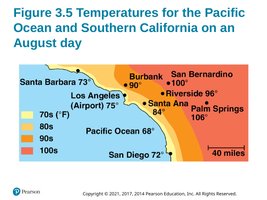
Specific heat is the amount of heat needed to change 1 g of a substance by 1°C. Water’s high specific heat (1 cal/g/°C) allows it to resist temperature changes, stabilizing environments.
Heat is absorbed when hydrogen bonds break and released when they form, minimizing temperature fluctuations.
Evaporative Cooling
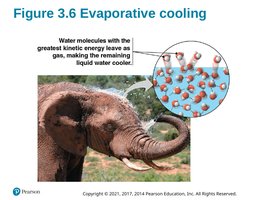
Evaporation is the transformation from liquid to gas. The heat of vaporization is the energy required for this process.
As the fastest-moving molecules leave as gas, the remaining liquid cools, helping organisms and environments regulate temperature.
Floating of Ice on Liquid Water
Density and Insulation
Ice is less dense than liquid water because hydrogen bonds form a stable lattice, spacing molecules apart.
This property allows ice to float, insulating water below and protecting aquatic life during cold periods.
Biological Importance of Floating Ice
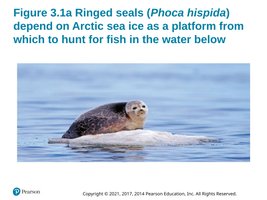
Floating ice provides a habitat for organisms such as ringed seals (Phoca hispida), which rely on sea ice for hunting and survival.
Effects of Climate Change on Arctic Ice
Climate change is reducing Arctic sea ice, impacting species that depend on it and altering ecosystem dynamics.

Water: The Solvent of Life
Solutions and Solubility
A solution is a homogeneous mixture of substances; the solvent dissolves the solute.
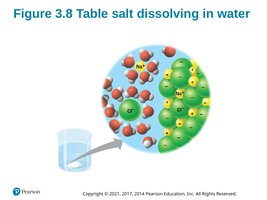
An aqueous solution uses water as the solvent. Water’s polarity makes it a versatile solvent, able to dissolve ionic and polar substances.
Hydration Shells and Polar Solutes
When ionic compounds dissolve, water forms hydration shells around ions, separating and surrounding them.
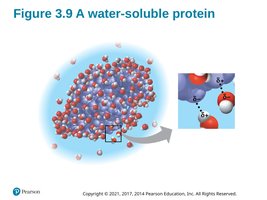
Large polar molecules, such as proteins, can dissolve if they have ionic or polar regions.
Hydrophilic vs. Hydrophobic Substances
Hydrophilic substances have an affinity for water and dissolve easily.
Hydrophobic substances, such as oils, do not mix with water due to nonpolar bonds.
Solute Concentration in Aqueous Solutions
Molecular Mass, Moles, and Molarity
Molecular mass is the sum of the masses of all atoms in a molecule.
1 mole (mol) = molecules (Avogadro’s number).
Molarity (M) is moles of solute per liter of solution.
Example: 1 mole of sucrose (C12H22O11) weighs 342 g. A 1.0 M solution contains 342 g per liter.
Water Dissociation and Dynamic Equilibrium
Dissociation of Water
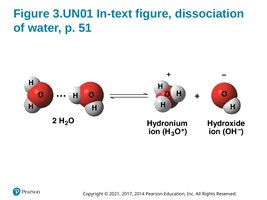
A hydrogen atom can shift between water molecules, forming hydronium (H3O+) and hydroxide (OH−) ions.
Water is in dynamic equilibrium, with dissociation and reformation occurring at equal rates.
Importance of H+ and OH−
Even small changes in H+ and OH− concentrations can drastically affect cell chemistry.
Acids and bases alter these concentrations, impacting biological processes.
Acids, Bases, and pH
Definitions and Properties
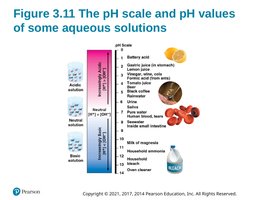
Acid: Increases H+ concentration in solution.
Base: Reduces H+ concentration, either by accepting H+ or releasing OH−.
Strong acids/bases dissociate completely; weak acids/bases do so partially and reversibly.
pH Scale
pH is defined as the negative logarithm of H+ concentration:
At 25°C,
Neutral solution: M, so pH = 7.
Acidic solutions: pH < 7; Basic solutions: pH > 7.
Buffers
Maintaining pH Stability
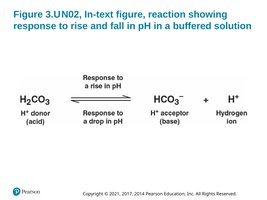
Buffers minimize changes in H+ and OH− concentrations, maintaining pH stability in biological systems.
Most buffers consist of a weak acid and its corresponding base, which reversibly bind or release H+.
Ocean Acidification
Impact of Human Activities
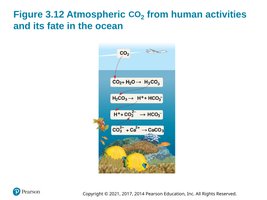
Burning fossil fuels increases atmospheric CO2, about 25% of which is absorbed by oceans.
Dissolved CO2 forms carbonic acid, which lowers seawater pH and reduces carbonate ion availability.
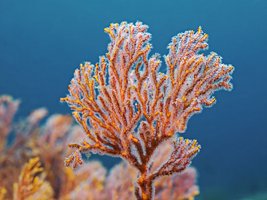
This threatens organisms that rely on carbonate for calcium carbonate structures, such as corals.
Biological Effects of Ocean Acidification
Reduced carbonate availability interferes with calcification in marine organisms, impacting coral reefs and marine ecosystems.
Water and the Search for Life
Extraterrestrial Implications
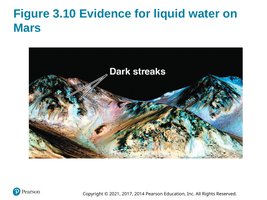
Biologists search for water as a key indicator of potential life beyond Earth.
Evidence of water or water vapor has been found on other planets, such as Mars, suggesting the possibility of life-supporting environments.
Key Takeaways
Water’s polarity and hydrogen bonding explain its unique properties: cohesion, temperature moderation, expansion upon freezing, and solvent versatility.
These properties are essential for life, supporting cellular reactions and ecosystem stability.
Acid–base balance and buffers are crucial for maintaining biological function.
Changes in water chemistry, such as ocean acidification, can have profound effects on organisms and ecosystems.
