Back
Water and Life: Properties, Importance, and Biological Implications
Study Guide - Smart Notes
 Tailored notes based on your materials, expanded with key definitions, examples, and context.
Water and Life
Polar Covalent Bonds and Hydrogen Bonding in Water
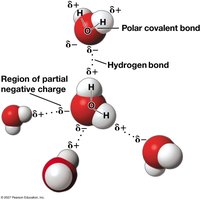
Water's unique properties arise from its molecular structure and the interactions between its molecules. The electrons in water's polar covalent bonds spend more time near the oxygen atom, making water a polar molecule with an uneven charge distribution. This polarity enables water molecules to form hydrogen bonds with each other, which are crucial for many of water's life-supporting properties.
Polar molecule: A molecule with an uneven distribution of charge, such as water (H2O).
Hydrogen bond: A weak bond between a hydrogen atom in one molecule and an electronegative atom (like oxygen) in another.
Example: The partial negative charge on oxygen and partial positive charges on hydrogen allow water molecules to attract each other.
Emergent Properties of Water
Water exhibits four key properties that make Earth suitable for life: cohesion, temperature moderation, expansion upon freezing, and versatility as a solvent.
Cohesion: Hydrogen bonds hold water molecules together, resulting in high surface tension.
Temperature moderation: Water can absorb or release large amounts of heat with little temperature change.
Expansion upon freezing: Ice is less dense than liquid water, allowing it to float.
Versatility as a solvent: Water dissolves many substances due to its polarity.
Cohesion and Adhesion
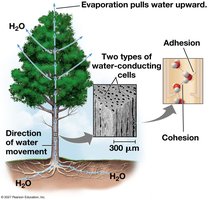
Cohesion refers to the attraction between water molecules, while adhesion is the attraction between water and other substances. These properties are essential for processes like water transport in plants and the high surface tension of water.
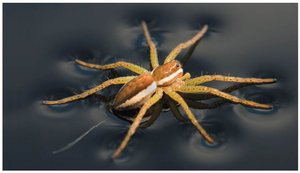
Cohesion: Responsible for water's high surface tension, allowing small organisms to walk on water.
Adhesion: Helps water move against gravity in plant vessels by sticking to cell walls.
Example: Water transport in plants relies on both cohesion and adhesion.
Moderation of Temperature by Water
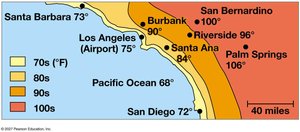
Water moderates temperature by absorbing heat from warmer air and releasing it to cooler air. Its high specific heat means it resists temperature changes, which stabilizes environments and organisms.
Kinetic energy: The energy of motion; thermal energy is the kinetic energy of molecules.
Specific heat: The amount of heat needed to change 1 g of a substance by 1°C. For water, this is 1 cal/(g·°C).
Example: Coastal areas experience milder climates due to water's high specific heat.
Evaporative Cooling
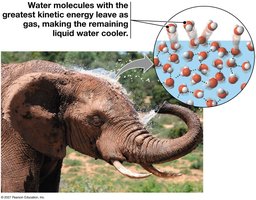
Evaporation is the transformation of a liquid to a gas. As water evaporates, it cools the surface left behind, a process called evaporative cooling. This helps regulate temperatures in organisms and environments.
Heat of vaporization: The amount of heat needed to convert 1 g of liquid to gas.
Evaporative cooling: Removes heat from surfaces, stabilizing temperatures.
Example: Sweating in mammals cools the body through evaporative cooling.
Floating of Ice on Liquid Water
Water is less dense as a solid than as a liquid because hydrogen bonds form a crystalline lattice that spaces molecules farther apart. This property ensures that ice floats, insulating bodies of water and protecting aquatic life in cold climates.
Density anomaly: Ice is about 10% less dense than liquid water.
Biological importance: Floating ice prevents entire bodies of water from freezing solid.
Water: The Solvent of Life
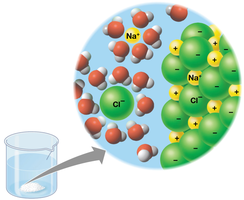
Water's polarity makes it an excellent solvent, capable of dissolving a wide range of substances. Solutions consist of a solvent (dissolving agent) and solute (substance dissolved). An aqueous solution is one where water is the solvent.
Hydration shell: Sphere of water molecules surrounding each ion in a solution.
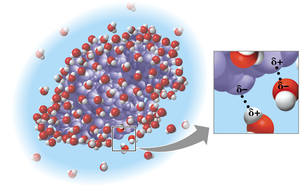
Versatility: Water dissolves ionic and polar molecules, including large biological molecules like proteins.
Example: Table salt (NaCl) dissolves in water as Na+ and Cl- ions are surrounded by water molecules.
Hydrophilic and Hydrophobic Substances
Substances that interact well with water are called hydrophilic, while those that do not are hydrophobic. Hydrophobic molecules, such as oils, are major components of cell membranes.
Hydrophilic: Affinity for water (e.g., salts, sugars).
Hydrophobic: Repel water (e.g., oils, fats).
Solute Concentration in Aqueous Solutions
Chemical reactions in organisms often occur in aqueous solutions. The concentration of solutes is measured in moles per liter (molarity, M). The molecular mass is the sum of the masses of all atoms in a molecule, and Avogadro's number (6.02 × 10²³) defines the number of molecules in a mole.
Molarity (M): Number of moles of solute per liter of solution.
Avogadro's number: molecules/mol.
Acidic and Basic Conditions Affect Living Organisms
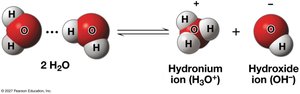
Water molecules can dissociate into hydronium (H3O+) and hydroxide (OH-) ions. The concentrations of these ions are crucial for cellular processes, and even small changes can have significant effects.
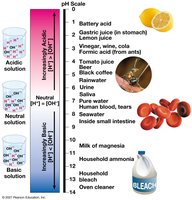
Acid: Increases H+ concentration in solution.
Base: Reduces H+ concentration, often by increasing OH-.
pH scale: Measures acidity or basicity; pH = -log[H+].
Neutral solution: [H+] = [OH-] = M at 25°C, pH = 7.
Buffers
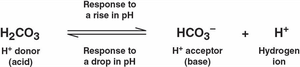
Buffers are substances that minimize changes in pH by accepting or donating H+ ions. Most biological buffers consist of a weak acid and its corresponding base, maintaining pH stability in living organisms.
Example: Carbonic acid (H2CO3) and bicarbonate (HCO3-) buffer blood pH.
Acidification: A Threat to Our Oceans
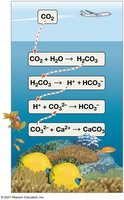
Human activities, such as burning fossil fuels, increase atmospheric CO2, which dissolves in oceans and forms carbonic acid. This process, called ocean acidification, lowers ocean pH and threatens marine life, especially organisms that rely on calcium carbonate for their shells and skeletons.
Ocean acidification: CO2 + H2O → H2CO3 (carbonic acid).
Impact: Reduces carbonate ion concentration, affecting shell-forming organisms.