 Back
BackWater and Life: Properties, Solutions, and pH in Biological Systems
Study Guide - Smart Notes
 Tailored notes based on your materials, expanded with key definitions, examples, and context.
Water and Life
The Importance of Water in Biology
Water is fundamental to life on Earth, existing naturally in all three physical states: solid, liquid, and gas. Its unique molecular structure and emergent properties make it indispensable for biological processes and the maintenance of life.
Universal presence: Water is the most abundant molecule in living organisms and the environment.
Emergent properties: Water’s structure enables it to support life through cohesion, temperature moderation, expansion upon freezing, and its role as a versatile solvent.
Structure and Polarity of Water Molecules
Polar Covalent Bonds and Hydrogen Bonding
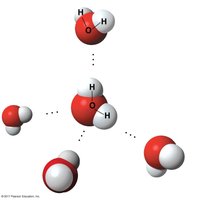
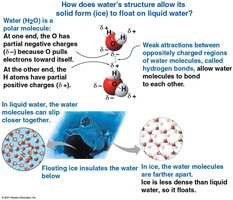
The water molecule (H2O) consists of two hydrogen atoms covalently bonded to an oxygen atom. The electrons are shared unequally, making water a polar molecule with a partial negative charge near the oxygen and partial positive charges near the hydrogens. This polarity allows water molecules to form hydrogen bonds with each other, which are weak attractions between the partially positive hydrogen of one molecule and the partially negative oxygen of another.
Polarity: Uneven distribution of charge within the molecule.
Hydrogen bonds: Responsible for many of water’s unique properties.
Emergent Properties of Water
Cohesion and Adhesion
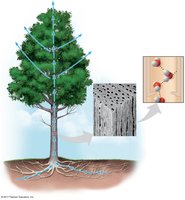
Cohesion refers to the attraction between water molecules due to hydrogen bonding, which helps transport water against gravity in plants. Adhesion is the attraction between water molecules and other substances, such as plant cell walls.
Cohesion: Enables water to form droplets and move as a column in plant vessels.
Adhesion: Helps water stick to other surfaces, aiding in capillary action.
Surface Tension
Surface tension is the measure of how difficult it is to break the surface of a liquid. Water’s high surface tension is due to hydrogen bonding at the air-water interface, allowing certain organisms to walk on water.
Example: Some insects can walk on water due to surface tension.

Moderation of Temperature
Water can absorb or release large amounts of heat with only slight changes in its own temperature, due to its high specific heat. This property stabilizes temperatures in organisms and environments.
Specific heat: The amount of heat required to raise the temperature of 1 gram of a substance by 1°C.
Hydrogen bonds: Heat is absorbed to break bonds and released when bonds form.
Expansion Upon Freezing
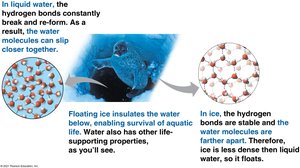
Unlike most substances, water expands when it freezes. Hydrogen bonds in ice are more ordered, causing molecules to be farther apart, making ice less dense than liquid water. This allows ice to float, insulating aquatic life below.
Density: Water is densest at 4°C; ice floats on liquid water.
Biological significance: Floating ice insulates water below, protecting aquatic ecosystems.
Water as a Solvent
Solution, Solvent, and Solute
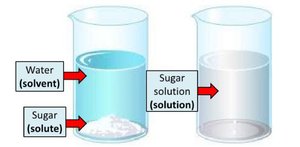
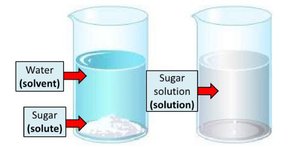
Water is known as the "solvent of life" because it can dissolve a wide variety of substances. A solution is a homogeneous mixture of two or more substances. The solvent is the dissolving agent (water), and the solute is the substance being dissolved.
Aqueous solution: A solution in which water is the solvent.
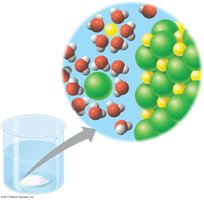
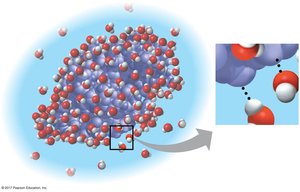
Versatility: Water dissolves ionic and polar substances due to its polarity.
Hydrophilic and Hydrophobic Substances
Substances that have an affinity for water (ionic and polar) are called hydrophilic and dissolve easily in water. Hydrophobic substances (nonpolar) do not dissolve in water.
Hydrophilic: Salts, acids, bases, carbohydrates.
Hydrophobic: Lipids, hydrocarbons.
Solute Concentration in Aqueous Solutions
Molecular Mass and Molarity
Molecular mass is the sum of the masses of all atoms in a molecule, measured in daltons. Molarity (M) is the number of moles of solute per liter of solution, a key concept in preparing solutions for biological experiments.
Avogadro’s number: 1 mole = molecules.
Molarity formula:
Example Calculations
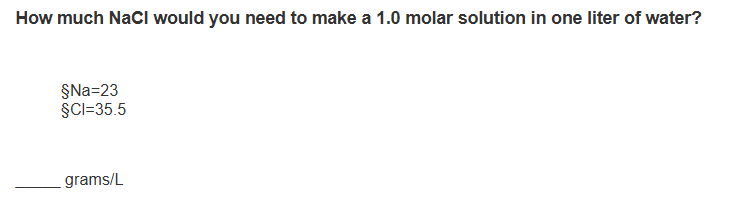
NaCl (Sodium chloride): Na = 23, Cl = 35.5, so molecular mass = 58.5 g/mol. To make a 1.0 M solution: dissolve 58.5 g NaCl in 1 L water.
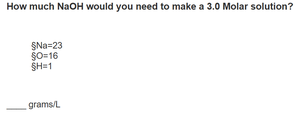
NaOH (Sodium hydroxide): Na = 23, O = 16, H = 1, so molecular mass = 40 g/mol. For a 3.0 M solution: dissolve 120 g NaOH in 1 L water.
Acids, Bases, and pH
Acid-Base Chemistry in Water
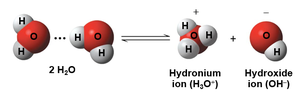
Water can dissociate into hydronium (H3O+) and hydroxide (OH–) ions. Acids increase the concentration of H+ in solution, while bases decrease it. The pH scale measures the concentration of H+ ions, ranging from 0 (most acidic) to 14 (most basic).
pH formula:
Neutral solution: [H+] = [OH–] = M, pH = 7.
Acidic solution: [H+] > [OH–], pH < 7.
Basic solution: [H+] < [OH–], pH > 7.
The pH Scale and Biological Relevance
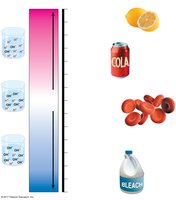
The pH scale is logarithmic, so each unit change represents a tenfold change in H+ concentration. Biological systems are sensitive to pH changes, which can affect enzyme activity and cellular processes.
Example: Human blood has a pH around 7.4; even small deviations can be harmful.
Example pH Calculations
Increasing [H+] by 1,000 times from pH 8: , so new pH = 5.
Decreasing [H+] by 100 times from pH 7: , so new pH = 9.
Summary Table: Properties of Water and Their Biological Importance
Property | Description | Biological Importance |
|---|---|---|
Cohesion | Hydrogen bonds hold water molecules together | Enables water transport in plants |
Adhesion | Attraction between water and other substances | Helps water move up plant vessels |
Surface Tension | Difficulty of breaking water’s surface | Allows small organisms to walk on water |
High Specific Heat | Water resists temperature change | Stabilizes climate and organism temperature |
Expansion Upon Freezing | Ice is less dense than liquid water | Ice floats, insulating aquatic life |
Versatile Solvent | Dissolves many substances | Facilitates chemical reactions in cells |
