 Back
BackWater and Life: Properties, Structure, and Biological Importance
Study Guide - Smart Notes
 Tailored notes based on your materials, expanded with key definitions, examples, and context.
Water and Life
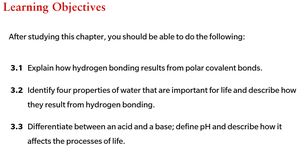
Key Concepts and Learning Objectives
This chapter explores the unique chemical and physical properties of water that make it essential for life. Students will learn about hydrogen bonding, the four emergent properties of water, and the impact of acidic and basic conditions on living organisms.
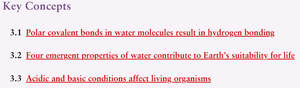
Polar covalent bonds in water molecules result in hydrogen bonding.
Four emergent properties of water contribute to Earth's suitability for life.
Acidic and basic conditions affect living organisms.
Structure and Bonding in Water
Polar Covalent Bonds and Hydrogen Bonding
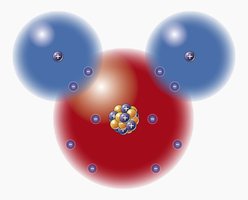
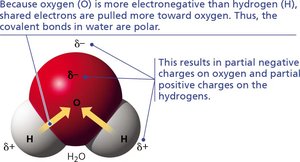
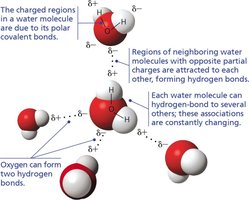
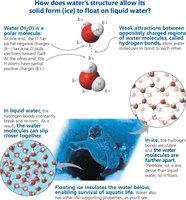
Water (H2O) is a polar molecule, meaning it has uneven charge distribution due to differences in electronegativity between oxygen and hydrogen. This polarity leads to hydrogen bonding, a weak attraction between the slightly positive hydrogen atom of one water molecule and the slightly negative oxygen atom of another.
Polar covalent bond: A bond where electrons are shared unequally, resulting in partial charges.
Hydrogen bond: An intermolecular force between the hydrogen atom of one molecule and the electronegative atom (oxygen) of another.
Each water molecule can form up to four hydrogen bonds.
Emergent Properties of Water
Cohesive Behavior
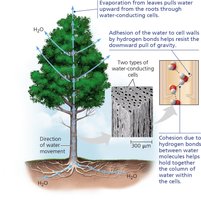
Cohesion refers to the attraction between water molecules due to hydrogen bonding. This property gives water a high surface tension, allowing certain organisms to walk on water and enabling the transport of water and nutrients against gravity in plants.
Surface tension: The measure of how difficult it is to stretch or break the surface of a liquid.
Adhesion: The clinging of water molecules to other substances, such as plant cell walls.

Temperature Moderation
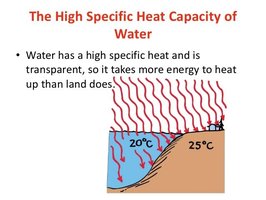
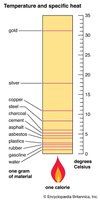
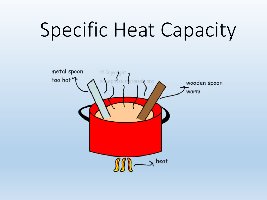
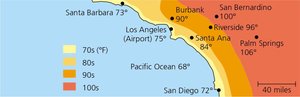
Water moderates temperature by absorbing and releasing heat slowly. This is due to its high specific heat, which is the amount of heat required to change the temperature of 1 gram of water by 1°C. Most of the heat is used to disrupt hydrogen bonds before increasing molecular motion.
Specific heat: where is heat energy, is mass, and is temperature change.
Water's high specific heat stabilizes environmental temperatures, benefiting marine and terrestrial life.
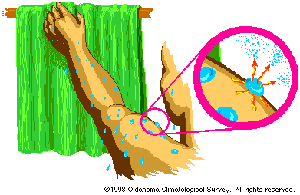
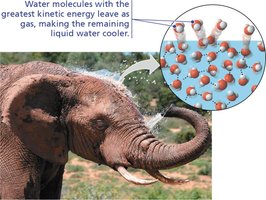
Evaporative cooling occurs when the hottest molecules leave as vapor, cooling the remaining liquid.


Evaporative Cooling
Evaporation removes heat from surfaces, helping organisms regulate temperature (e.g., sweating).
Heat of vaporization: The amount of heat required to convert 1 g of liquid into vapor.
Expansion Upon Freezing
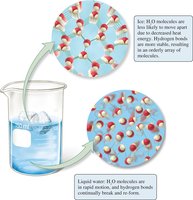
Water is less dense as a solid than as a liquid, so ice floats. At 0°C, water molecules form a crystalline structure with hydrogen bonds, creating gaps that make ice less dense. This property insulates aquatic life during winter.
Density: (mass per unit volume).
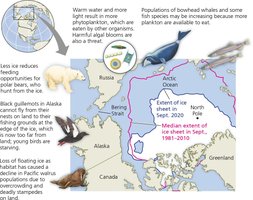
Ice formation protects organisms in lakes and ponds.

Versatility as a Solvent
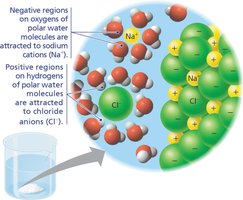
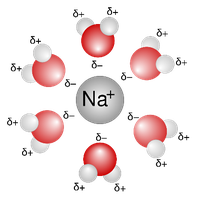
Water is known as the "universal solvent" because it can dissolve many substances. Its polarity allows it to surround and separate ions and polar molecules, forming hydration shells.
Solution: A homogeneous mixture of solvent and solute.
Aqueous solution: Water is the solvent.
Hydrophilic: Substances that dissolve in water (e.g., salts, sugars).
Hydrophobic: Substances that do not dissolve in water (e.g., oils).
Acidic and Basic Conditions
pH and Its Biological Importance
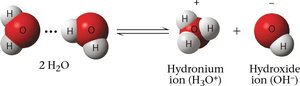
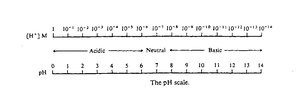
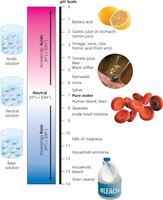
Acids and bases alter the concentration of hydrogen ions (H+) in solution. The pH scale measures the acidity or basicity of a solution, which is crucial for biological processes.
Acid: Increases H+ concentration (pH < 7).
Base: Decreases H+ concentration (pH > 7).
Neutral: pH = 7.
pH formula:
Ocean Acidification
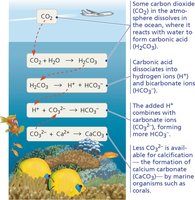
Human activities increase atmospheric CO2, some of which dissolves in oceans, forming carbonic acid and lowering ocean pH. This process, called ocean acidification, threatens marine life by disrupting the balance needed for organisms like corals to form calcium carbonate shells.
Carbonic acid formation:
Lower pH affects marine organisms and ecosystem stability.
Summary Table: Properties of Water
Property | Description | Biological Importance |
|---|---|---|
Cohesion | Hydrogen bonds hold water molecules together | Surface tension, water transport in plants |
Temperature Moderation | High specific heat and heat of vaporization | Stabilizes climate, regulates organism temperature |
Expansion Upon Freezing | Ice is less dense than liquid water | Insulates aquatic life, prevents freezing from bottom up |
Solvent Versatility | Polar nature dissolves many substances | Supports biochemical reactions, nutrient transport |
Conclusion
Water's unique properties, arising from its molecular structure and hydrogen bonding, are fundamental to life on Earth. Understanding these properties helps explain many biological phenomena and environmental processes.
