 Back
BackWater and Life: Properties, Structure, and Biological Importance
Study Guide - Smart Notes
 Tailored notes based on your materials, expanded with key definitions, examples, and context.
Chapter 3: Water and Life
3.1 The Properties of Water
Water is essential for life due to its unique chemical and physical properties, which arise from its molecular structure and ability to form hydrogen bonds. These properties enable water to support biological processes and maintain environmental stability.
Polarity of Water: Water (H2O) is a polar molecule because the oxygen atom attracts electrons more strongly than hydrogen, resulting in partial negative (δ-) and positive (δ+) charges. This uneven charge distribution allows water molecules to form hydrogen bonds with up to four neighboring water molecules.
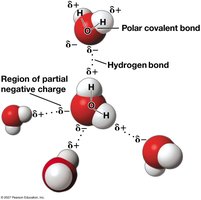
Hydrogen Bonding: Weak attractions between the partial charges of water molecules (hydrogen bonds) are responsible for many of water's emergent properties.
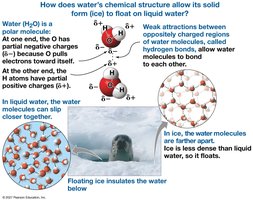
Emergent Properties of Water: Four key characteristics resulting from hydrogen bonding:
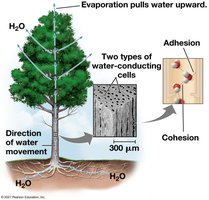
Cohesion: Water molecules stick together, creating high surface tension.
Adhesion: Water molecules are attracted to other substances, such as plant cell walls.
Moderation of Temperature: Water absorbs and releases heat slowly, stabilizing environmental and organismal temperatures.
Expansion Upon Freezing: Ice is less dense than liquid water, allowing it to float and insulate aquatic environments.

Cohesion and Adhesion in Plants: Cohesion and adhesion enable water to move upward from roots to leaves against gravity, supporting nutrient transport.
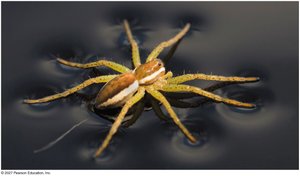
Surface Tension: High surface tension allows insects like water striders to walk on water without breaking the surface.
Heat vs. Temperature:
Heat: Total kinetic energy in a substance.
Temperature: Average kinetic energy of molecules.
Example: Ocean temperatures fluctuate less than land due to water's high specific heat.
Evaporative Cooling: As water evaporates, the surface cools, helping organisms regulate temperature.
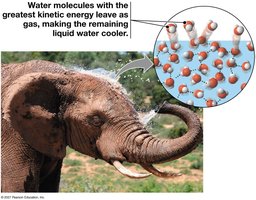
Floating Ice: Ice floats because its hydrogen bonds form a crystalline lattice, making it less dense than liquid water. This property is crucial for aquatic life in cold climates.
3.2 The Solvent of Life
Water's polarity makes it an excellent solvent, capable of dissolving a wide range of substances, which is vital for biological reactions and transport.
Definitions:
Solute: The substance dissolved in a solution.
Solvent: The dissolving agent (water in aqueous solutions).
Solution: A homogeneous mixture of solute and solvent.
Versatility as a Solvent: Water dissolves ionic compounds (e.g., NaCl) by surrounding ions with hydration shells.
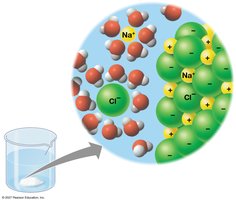
Hydrophilic vs. Hydrophobic Substances:
Hydrophilic: Substances with affinity for water (e.g., salts, sugars).
Hydrophobic: Substances that repel water (e.g., oils, cell membrane components).
Water-Soluble Proteins: Large polar molecules, such as proteins, can dissolve in water if they have ionic and polar regions.
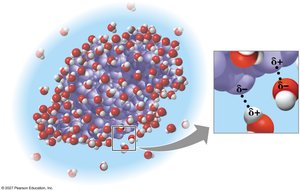
Astrobiology: The search for extraterrestrial life focuses on planets with water, as its solvent properties are essential for life-supporting chemistry.
3.3 The Dissociation of Water Molecules
Water molecules can dissociate into ions, affecting pH and the chemical environment of cells. Understanding acids, bases, and buffers is crucial for maintaining biological homeostasis.
Dissociation of Water: Water molecules can split into hydronium (H3O+) and hydroxide (OH-) ions.
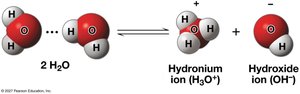
Acid, Base, and pH:
Acid: Increases H+ concentration.
Base: Reduces H+ concentration.
pH: Measures H+ concentration; acidic solutions have pH < 7, basic solutions have pH > 7.
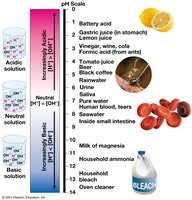
Acids and Bases in Biology: Strong acids/bases dissociate completely; weak acids/bases partially dissociate, affecting pH balance.
Buffers: Buffers minimize pH changes by reversibly binding H+ ions. The bicarbonate buffer system is a key example in blood:
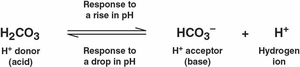
Environmental Impact: Burning fossil fuels increases acid precipitation and ocean acidification, affecting ecosystems and organism health.
Summary Table: Water's Properties and Biological Importance
Property | Description | Biological Importance |
|---|---|---|
Cohesion | Water molecules stick together | Enables water transport in plants |
Adhesion | Water molecules stick to other substances | Supports capillary action in plants |
High Specific Heat | Resists temperature changes | Stabilizes climate and organismal temperature |
Expansion Upon Freezing | Ice is less dense than liquid water | Insulates aquatic life in cold environments |
Versatile Solvent | Dissolves many substances | Facilitates biochemical reactions |
Buffering Capacity | Minimizes pH changes | Maintains cellular homeostasis |
Additional info: The notes expand on brief points with academic context, definitions, and examples to ensure completeness and clarity for exam preparation.
