 Back
Water and Life: Properties, Structure, and Biological Importance
Study Guide - Smart Notes
 Tailored notes based on your materials, expanded with key definitions, examples, and context.
Water and Life
Introduction
Water is essential for all known forms of life. Its unique chemical and physical properties, arising from its molecular structure, make it indispensable for biological processes and the maintenance of life on Earth.
Structure and Polarity of Water
Polar Covalent Bonds in Water
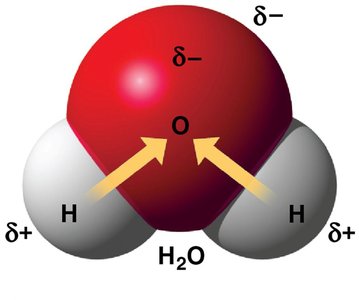
Water (H2O) molecules are composed of two hydrogen atoms covalently bonded to one oxygen atom. The oxygen atom is more electronegative, pulling shared electrons closer and creating a partial negative charge (δ−) on the oxygen and partial positive charges (δ+) on the hydrogens. This makes water a polar molecule.
Polarity: The unequal sharing of electrons results in a dipole moment.
Partial Charges: Oxygen (δ−), Hydrogens (δ+).
Hydrogen Bonding Between Water Molecules
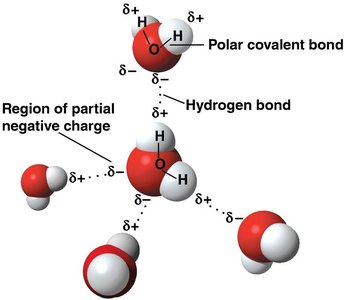
The polarity of water allows it to form hydrogen bonds—weak attractions between the slightly positive hydrogen of one molecule and the slightly negative oxygen of another. These bonds are responsible for many of water’s unique properties.
Hydrogen Bond: An intermolecular force between water molecules.
Significance: Each water molecule can form up to four hydrogen bonds, creating a highly cohesive network.
Emergent Properties of Water
Overview of Water’s Properties
Four emergent properties of water contribute to Earth’s suitability for life. All are explained by water’s polarity and ability to form hydrogen bonds:
Cohesive behavior
Ability to moderate temperature
Expansion upon freezing
Versatility as a solvent
Cohesive and Adhesive Behavior
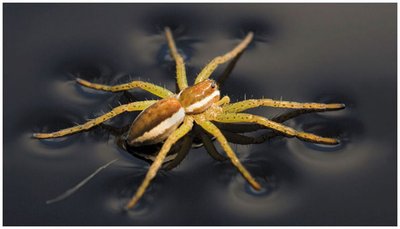
Cohesion refers to water molecules sticking to each other due to hydrogen bonding. Adhesion is water’s ability to stick to other polar substances. These properties result in high surface tension and are crucial for processes like water transport in plants.
Surface Tension: The measure of how difficult it is to stretch or break the surface of a liquid.
Biological Example: Water transport in plants (capillary action).
Ability to Moderate Temperature
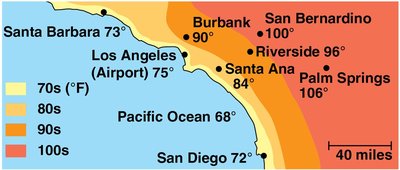
Water has a high specific heat capacity, meaning it can absorb or release large amounts of heat with only a slight change in its own temperature. This property stabilizes temperatures in organisms and environments, making Earth habitable.
Specific Heat: The amount of heat required to raise 1 gram of a substance by 1°C.
Heat of Vaporization: Water also requires a lot of energy to evaporate, which helps cool organisms (e.g., sweating).
Example: Coastal climates are moderated by the ocean’s high specific heat.
Versatility as a Solvent
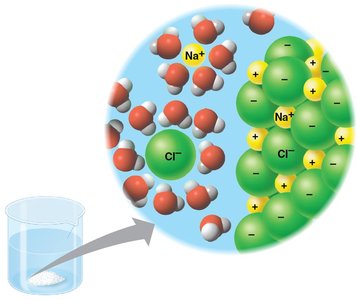
Water is known as the universal solvent because its polarity allows it to dissolve many substances, especially ionic and other polar molecules. Substances that dissolve in water are called hydrophilic, while those that do not are hydrophobic.
Solvent: The dissolving agent (water).
Solute: The substance being dissolved (e.g., salt).
Solution: A homogeneous mixture of solute and solvent.
Acids, Bases, and pH
Acidic and Basic Conditions
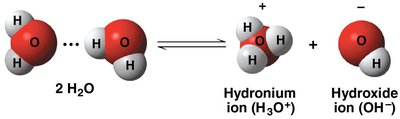
Water can dissociate into hydronium ions (H3O+) and hydroxide ions (OH−). The concentration of these ions determines the pH of a solution.
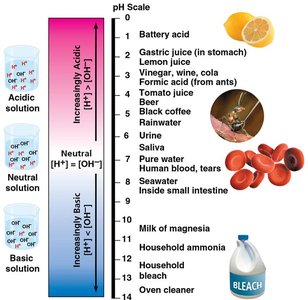
Acid: Increases the H+ concentration (pH < 7).
Base: Decreases the H+ concentration (pH > 7).
Neutral Solution: [H+] = [OH−] (pH = 7).
The pH Scale
The pH scale measures the concentration of hydrogen ions in a solution, ranging from 0 (most acidic) to 14 (most basic). Each unit represents a tenfold difference in H+ concentration.
Formula:
Examples: Lemon juice (pH 2), pure water (pH 7), bleach (pH 13).
Buffers and Homeostasis
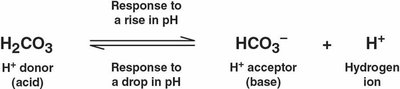
Buffers are substances that minimize changes in pH by accepting or donating hydrogen ions. They are crucial for maintaining stable internal conditions (homeostasis) in organisms.
Example: The bicarbonate buffer system in blood helps maintain pH around 7.4.
Buffer Equation:
Summary Table: Properties of Water
Property | Description | Biological Importance |
|---|---|---|
Cohesion & Adhesion | Water molecules stick to each other and to other substances | Enables transport in plants, surface tension |
High Specific Heat | Resists temperature changes | Stabilizes climate and organism temperature |
Universal Solvent | Dissolves many polar and ionic substances | Facilitates chemical reactions in cells |
Acid/Base Chemistry | Can act as acid or base; forms buffers | Maintains pH homeostasis |
