 Back
Water and Life: Properties, Structure, and Biological Importance
Study Guide - Smart Notes
 Tailored notes based on your materials, expanded with key definitions, examples, and context.
Water and Life
Introduction
Water is essential for all known forms of life and exhibits unique properties that make Earth habitable. Its molecular structure and interactions underpin many biological processes, from cellular chemistry to ecosystem stability.
Structure and Polarity of Water
Polar Covalent Bonds and Hydrogen Bonding
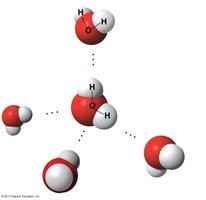
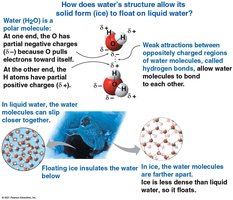
The water molecule (H2O) consists of two hydrogen atoms covalently bonded to an oxygen atom. Due to oxygen's higher electronegativity, electrons are drawn closer to the oxygen, creating a region of partial negative charge (δ–) near the oxygen and partial positive charges (δ+) near the hydrogens. This makes water a polar molecule.
Hydrogen bonds form between the partially positive hydrogen of one water molecule and the partially negative oxygen of another.
These bonds are weaker than covalent bonds but are crucial for water's properties.
Emergent Properties of Water
Cohesion and Adhesion
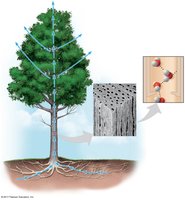
Cohesion refers to the attraction between water molecules due to hydrogen bonding, allowing water to form droplets and move as a column in plant vessels. Adhesion is the attraction between water molecules and other substances, such as plant cell walls, aiding in water transport against gravity.
Cohesion enables surface tension and the upward movement of water in plants.
Adhesion helps water stick to other surfaces, facilitating capillary action.
Moderation of Temperature
Water has a high specific heat, meaning it can absorb or release large amounts of heat with only a slight change in temperature. This property stabilizes climates and organisms' internal environments.
Heat is absorbed when hydrogen bonds break and released when they form.
This moderates temperature fluctuations in the environment and within living organisms.
Expansion Upon Freezing
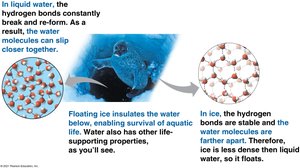
Unlike most substances, water expands as it freezes. In ice, hydrogen bonds stabilize and keep water molecules further apart, making ice less dense than liquid water. This allows ice to float, insulating aquatic life below.
Ice's lower density prevents bodies of water from freezing solid from the bottom up.
This property is vital for the survival of aquatic organisms in cold climates.
Versatility as a Solvent
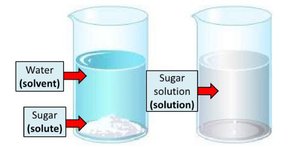
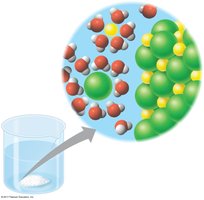
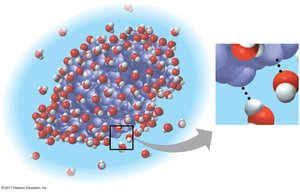
Water is known as the universal solvent due to its polarity, which allows it to dissolve a wide range of substances. Solutions in which water is the solvent are called aqueous solutions.
Solvent: the dissolving agent (water).
Solute: the substance being dissolved (e.g., salt, sugar).
Water dissolves ionic compounds by surrounding ions and separating them, and it can also dissolve polar molecules.
Hydrophilic and Hydrophobic Substances
Hydrophilic substances have an affinity for water (e.g., salts, acids, bases, carbohydrates), while hydrophobic substances do not (e.g., lipids, hydrocarbons). This distinction is crucial for biological membranes and cellular organization.
Solute Concentration in Aqueous Solutions
Moles, Molarity, and Molecular Mass
The mole (mol) is a standard unit for measuring the amount of substance, defined as 6.02 × 10²³ molecules (Avogadro's number). Molarity (M) is the number of moles of solute per liter of solution.
Molecular mass: sum of the masses of all atoms in a molecule.
To prepare a 1 M solution: dissolve 1 mole of solute in enough water to make 1 liter of solution.
Acids, Bases, and pH
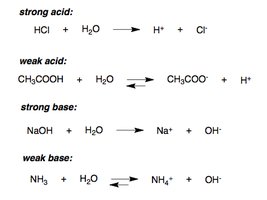
Acid-Base Chemistry in Water
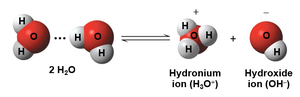
Water molecules can dissociate into hydronium ions (H3O+) and hydroxide ions (OH–). The concentrations of these ions determine the acidity or basicity of a solution.
Acid: increases H+ concentration.
Base: reduces H+ concentration (often by increasing OH–).
The pH Scale
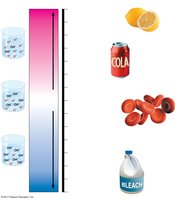
The pH scale quantifies the concentration of hydrogen ions in a solution. It is defined as:
In pure water, M, so pH = 7 (neutral).
Acidic solutions have pH < 7; basic solutions have pH > 7.
The product of and is always at 25°C:
Summary Table: Properties of Water
Property | Description | Biological Importance |
|---|---|---|
Cohesion | Hydrogen bonds hold water molecules together | Enables water transport in plants |
Adhesion | Attraction between water and other substances | Assists capillary action in plant vessels |
High Specific Heat | Absorbs/release heat with little temperature change | Stabilizes climate and organism temperature |
Expansion Upon Freezing | Ice is less dense than liquid water | Insulates aquatic life, prevents bodies of water from freezing solid |
Versatile Solvent | Dissolves many substances due to polarity | Facilitates biochemical reactions and transport |
