 Back
Water and Life: Properties, Structure, and Biological Importance
Study Guide - Smart Notes
 Tailored notes based on your materials, expanded with key definitions, examples, and context.
Chapter 3: Water and Life
3.1 The Properties of Water
Water is essential for life due to its unique chemical and physical properties, which arise from its molecular structure and hydrogen bonding. These properties make water indispensable for biological systems and the environment.
Polarity and Hydrogen Bonding
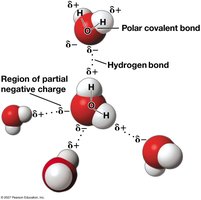
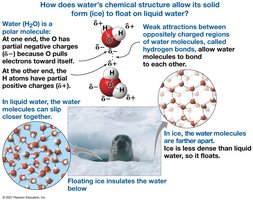
Polarity: Water (H2O) is a polar molecule. The oxygen atom has a partial negative charge (δ−), while the hydrogen atoms have partial positive charges (δ+), resulting in an uneven charge distribution.
Hydrogen Bonding: The polarity allows each water molecule to form hydrogen bonds with up to four neighboring water molecules. These are weak attractions between the partially positive hydrogen of one molecule and the partially negative oxygen of another.
Diagram: The structure of water and its hydrogen bonding is illustrated below.
Emergent Properties of Water
Cohesive Behavior: Water molecules stick together due to hydrogen bonding, resulting in high surface tension.
Ability to Moderate Temperature: Water can absorb or release large amounts of heat with only a slight change in its own temperature, stabilizing environments.
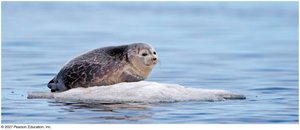
Expansion Upon Freezing: Water is less dense as a solid (ice) than as a liquid, allowing ice to float.
Versatility as a Solvent: Water dissolves a wide variety of substances due to its polarity.
Cohesion and Adhesion
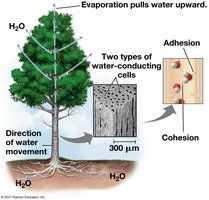
Cohesion: The attraction between water molecules, which contributes to surface tension and the movement of water in plants.
Adhesion: The attraction between water molecules and other substances, such as plant cell walls, aiding in water transport against gravity.
Example: Water moves from roots to leaves in trees due to cohesion and adhesion.
Heat and Temperature
Heat: The total kinetic energy due to molecular motion in a body of matter.
Temperature: The average kinetic energy of molecules in a substance.
Example: Coastal areas have milder climates because water moderates temperature changes; ocean temperatures fluctuate less than land temperatures.
Surface Tension and Water Behavior
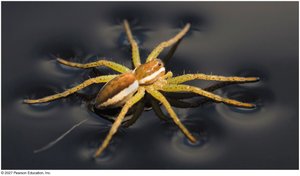
Surface Tension: High surface tension allows insects like water striders to walk on water without breaking the surface.
Example: A water strider walking on a pond demonstrates water's surface tension.
Evaporative Cooling
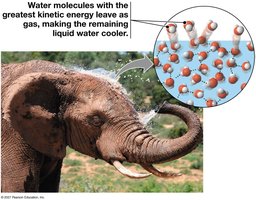
Evaporation: The transformation of water from liquid to gas removes heat, cooling the surface.
Heat of Vaporization: The amount of heat required to convert 1 g of liquid water to gas.
Example: Sweating in humans and panting in dogs are mechanisms for evaporative cooling.
Floating of Ice on Liquid Water
Density of Ice: Ice is less dense than liquid water because hydrogen bonds keep water molecules farther apart in the solid state.
Biological Importance: Floating ice insulates water below, protecting aquatic life in cold climates.
3.2 The Solvent of Life
Water's polarity makes it an excellent solvent, capable of dissolving a wide range of substances, which is crucial for biological processes.
Solutions, Solvents, and Solutes
Solution: A homogeneous mixture of two or more substances.
Solvent: The dissolving agent (e.g., water in an aqueous solution).
Solute: The substance that is dissolved (e.g., salt in saltwater).
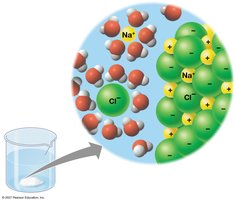
Example: Table salt (NaCl) dissolving in water forms an aqueous solution.
Hydration Shells and Solubility
Hydration Shell: When ionic compounds dissolve, water molecules surround each ion, forming a hydration shell.
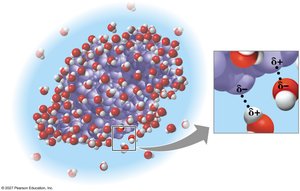
Solubility of Polar Molecules: Water can dissolve polar molecules and even large molecules like proteins if they have ionic or polar regions.
Hydrophilic and Hydrophobic Substances
Hydrophilic: Substances with an affinity for water (e.g., salts, sugars).
Hydrophobic: Substances that repel water, usually nonpolar (e.g., oils, major components of cell membranes).
3.3 The Dissociation of Water Molecules
Water can dissociate into ions, affecting the pH and chemical environment of biological systems.
Dissociation of Water
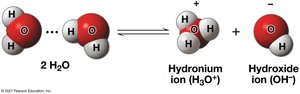
Process: A hydrogen atom in a hydrogen bond between two water molecules can shift, resulting in a hydronium ion (H3O+) and a hydroxide ion (OH−).
Equation:
Acids, Bases, and pH
Acid: A substance that increases the hydrogen ion concentration of a solution.
Base: A substance that reduces the hydrogen ion concentration.
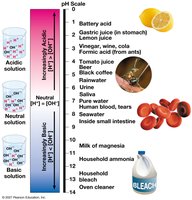
pH Scale: Measures the concentration of hydrogen ions; acidic solutions have pH < 7, basic solutions have pH > 7.
Equation:
Examples: Battery acid (pH 0), pure water (pH 7), bleach (pH 13).
Buffers and Biological Importance
Buffer: A substance that minimizes changes in pH by accepting or donating hydrogen ions.
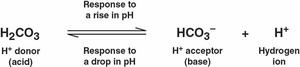
Bicarbonate Buffer System: Maintains pH in blood and other fluids.
Equation:
Environmental Impact
Acid Precipitation: Burning fossil fuels releases sulfur and nitrogen oxides, forming acids in the atmosphere that lower the pH of rainwater.
Ocean Acidification: Increased atmospheric CO2 dissolves in oceans, forming carbonic acid and lowering ocean pH, which can harm marine life.
