 Back
Water and Life: Properties, Structure, and Biological Importance
Study Guide - Smart Notes
 Tailored notes based on your materials, expanded with key definitions, examples, and context.
Water and Life
Introduction to Water's Role in Biology
Water is essential for all known forms of life and exhibits unique properties that make Earth habitable. It is the only common substance found naturally in all three physical states—solid, liquid, and gas. The structure and interactions of water molecules underpin its critical biological functions. 
Structure of Water Molecules
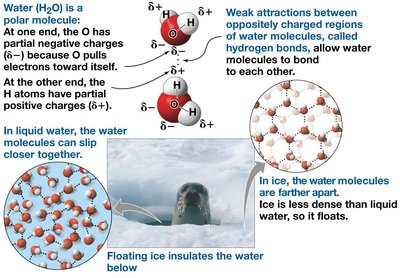
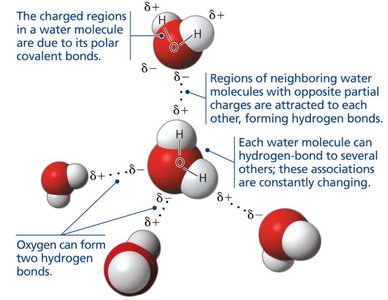
The water molecule (H2O) consists of two hydrogen atoms covalently bonded to one oxygen atom. The electrons are shared unequally, making water a polar molecule.
Polar Covalent Bonds: Oxygen is more electronegative, pulling electrons closer and creating partial negative (δ–) and positive (δ+) charges.
Hydrogen Bonding: The polarity allows water molecules to form hydrogen bonds with each other, which are weak attractions between the δ+ hydrogen of one molecule and the δ– oxygen of another.
Emergent Properties of Water
Water's structure gives rise to four emergent properties that are vital for life:
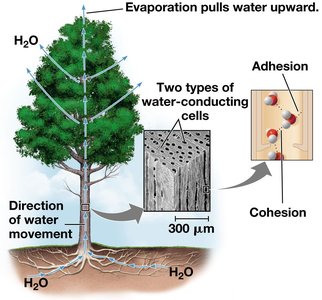
Cohesion: Hydrogen bonds hold water molecules together, resulting in high surface tension. This allows certain organisms, like insects, to walk on water.
Adhesion: Water molecules are attracted to other substances, such as plant cell walls, aiding in water transport against gravity.
Moderation of Temperature: Water has a high specific heat, meaning it can absorb or release large amounts of heat with minimal temperature change. This stabilizes environmental and organismal temperatures.
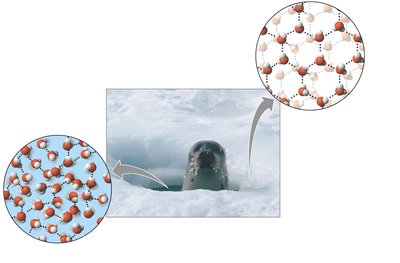
Expansion Upon Freezing: Ice is less dense than liquid water because hydrogen bonds in ice are more ordered, causing it to float and insulate aquatic life below.
Versatility as a Solvent: Water's polarity enables it to dissolve a wide range of substances, making it the "solvent of life."

Temperature and Heat
Kinetic Energy: The energy of motion; thermal energy is the kinetic energy of molecules.
Specific Heat: The amount of heat required to change the temperature of 1 g of a substance by 1°C. Water's high specific heat is due to hydrogen bonding.
Evaporative Cooling: As water evaporates, the surface cools, helping regulate temperature in organisms and environments.

Floating Ice and Density
Ice Floats: In ice, hydrogen bonds are stable and molecules are farther apart, making ice less dense than liquid water.
Biological Importance: Floating ice insulates water below, allowing aquatic life to survive in cold climates.
Water as a Solvent
Solution: A homogeneous mixture of substances.
Solvent: The dissolving agent (water in aqueous solutions).
Solute: The substance dissolved.
Aqueous Solution: Water is the solvent.
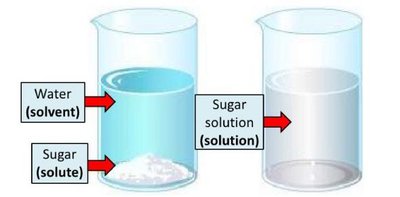
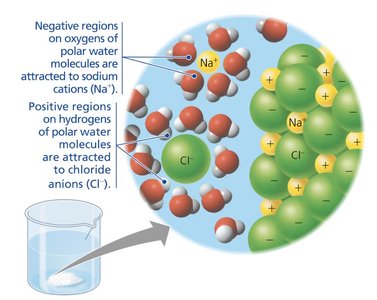
Water's Versatility as a Solvent
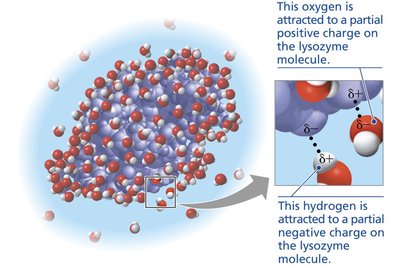
Water dissolves ionic compounds (e.g., salts) and polar molecules due to its polarity.
Hydrophilic Substances: Affinity for water (ionic and polar).
Hydrophobic Substances: No affinity for water (nonpolar).
Solute Concentration and Molarity
Molecular Mass: Sum of atomic masses in a molecule.
Mole: 6.02 × 10²³ molecules.
Molarity (M): Moles of solute per liter of solution.
Acidic and Basic Conditions
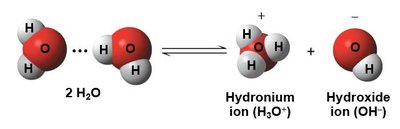
Water can dissociate into ions, affecting biological systems.
Hydronium Ion (H3O+): Formed when a hydrogen atom leaves its electron behind.
Hydroxide Ion (OH–): The molecule that lost the proton.
Acids and Bases
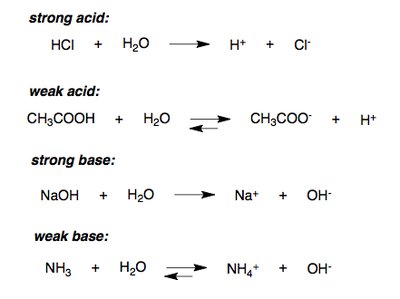
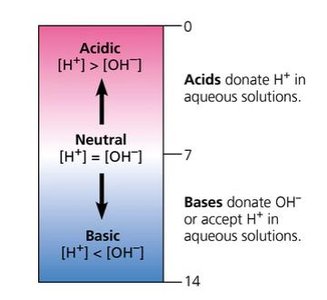
Acid: Increases H+ concentration.
Base: Reduces H+ concentration.
The pH Scale
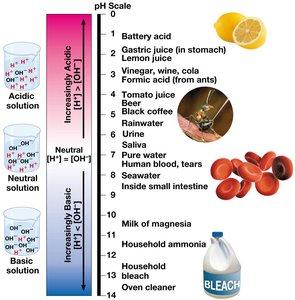
The pH of a solution is defined as the negative logarithm of the H+ concentration:
pH 7 is neutral; lower pH is acidic, higher pH is basic.
In pure water: ,
The product at 25°C.
Buffers
Buffers are substances that minimize changes in pH by accepting or releasing H+ ions.
Most buffers consist of a weak acid and its conjugate base.
They help maintain the internal pH of living cells near 7.
Acidification and Ocean Health
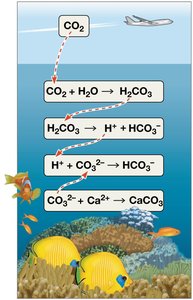
Human activities, such as burning fossil fuels, increase atmospheric CO2, which dissolves in oceans and forms carbonic acid, leading to ocean acidification.
Ocean acidification threatens marine life by altering carbonate availability.
Summary of Key Concepts
Polar covalent bonds in water molecules result in hydrogen bonding.
Four emergent properties of water contribute to Earth's suitability for life: cohesive behavior, moderation of temperature, expansion upon freezing, and versatility as a solvent.
Acidic and basic conditions affect living organisms, with buffers helping to maintain stable pH.
