 Back
Water and Life: Properties, Structure, and Biological Importance
Study Guide - Smart Notes
 Tailored notes based on your materials, expanded with key definitions, examples, and context.
Water and Life
Introduction
Water is essential for all known forms of life. Its unique chemical and physical properties, arising from its molecular structure and hydrogen bonding, make it indispensable for biological systems. This chapter explores the life-supporting properties of water, including cohesion, adhesion, expansion upon freezing, and its role as a universal solvent.
Water's Life-Supporting Properties
Polarity and Hydrogen Bonding
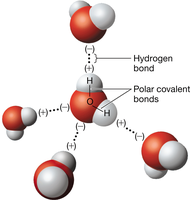
The water molecule (H2O) is polar, with a partial negative charge near the oxygen atom and partial positive charges near the hydrogen atoms. This polarity allows water molecules to form hydrogen bonds with each other and with other polar substances, giving rise to many of water's unique properties.
Polarity: The unequal sharing of electrons between oxygen and hydrogen creates a dipole moment.
Hydrogen Bonding: The attraction between the hydrogen atom of one water molecule and the oxygen atom of another.
Cohesive Behavior of Water
Cohesion and Surface Tension
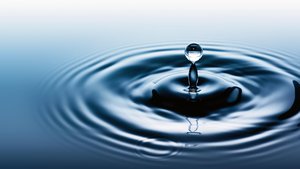
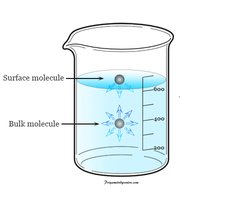
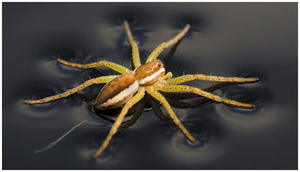
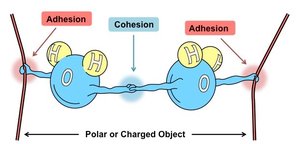
Cohesion refers to the tendency of water molecules to stick together due to hydrogen bonding. This property is responsible for water's high surface tension, allowing it to behave as if covered by an invisible film.
Cohesion: The attraction between molecules of the same substance (water to water).
Surface Tension: The measure of how difficult it is to stretch or break the surface of a liquid.
Adhesion
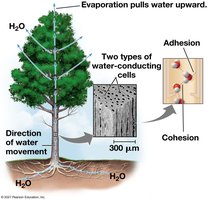
Adhesion is the attraction between water molecules and different substances, such as the walls of plant vessels. This property, along with cohesion, enables water to move against gravity in processes like capillary action.
Adhesion: The attraction between different substances (e.g., water and plant cell walls).
Capillary Action: The movement of water within narrow spaces, important for water transport in plants.
Expansion Upon Freezing
Physical States of Water
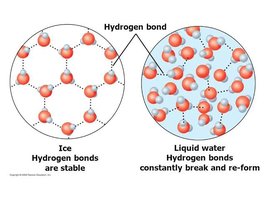
Water exists in three physical states: solid (ice), liquid, and gas (water vapor). The arrangement and behavior of hydrogen bonds differ in each state, affecting density and structure.
Solid (Ice): Hydrogen bonds are stable and form a lattice structure, making ice less dense than liquid water.
Liquid: Hydrogen bonds constantly break and reform, allowing molecules to be closer together.
Gas: Molecules move freely with minimal hydrogen bonding.
Biological Importance of Ice Floating
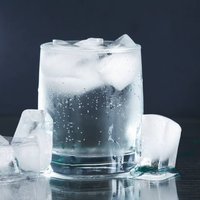
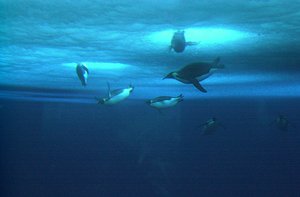
Because ice is less dense than liquid water, it floats. This property insulates aquatic environments, protecting organisms during cold periods and preventing bodies of water from freezing solid.
Insulation: Floating ice acts as a barrier, maintaining stable temperatures below.
Ecological Impact: Aquatic life can survive under the ice layer during winter.

Global Warming and Ice
Global warming leads to the melting of glaciers and sea ice, threatening species that depend on icy habitats and altering global ecosystems.
Loss of Habitat: Species such as polar bears and seals are at risk.
Climate Impact: Reduced ice cover affects Earth's energy balance and sea levels.
Water as the Solvent of Life
Solubility and Solutions
Water's polarity makes it an excellent solvent, capable of dissolving a wide range of substances. Solutions consist of a solvent (the dissolving agent, often water) and a solute (the substance dissolved).
Aqueous Solution: A solution in which water is the solvent.
Hydration Shell: The sphere of water molecules surrounding each ion in solution.
Example: When table salt (NaCl) dissolves in water, Na+ and Cl- ions are surrounded by water molecules, forming hydration shells.
Hydrophilic and Hydrophobic Substances
Substances that dissolve in water are hydrophilic (water-loving), while those that do not are hydrophobic (water-fearing). Hydrophobic molecules, such as oils and lipids, are key components of cell membranes.
Hydrophilic: Ionic and polar compounds (e.g., salts, sugars).
Hydrophobic: Nonpolar compounds (e.g., oils, lipids).
Acids, Bases, and pH
Dissociation of Water
Water molecules can dissociate into hydrogen ions (H+) and hydroxide ions (OH-). In pure water, the concentrations of H+ and OH- are equal, resulting in a neutral solution.
Hydronium Ion (H3O+): Formed when a water molecule gains a proton.
Hydroxide Ion (OH-): Formed when a water molecule loses a proton.
Acids and Bases
Acids increase the concentration of H+ in solution, while bases decrease it. Strong acids and bases dissociate completely in water, while weak acids and bases do so partially and reversibly.
Acid: Substance that increases H+ concentration (e.g., HCl).
Base: Substance that decreases H+ concentration (e.g., NaOH, NH3).
The pH Scale
The pH scale measures the acidity or basicity of a solution, ranging from 0 (most acidic) to 14 (most basic). Neutral solutions have a pH of 7.
Acidic: pH < 7
Neutral: pH = 7
Basic: pH > 7
Buffers
Buffers are substances that minimize changes in pH by accepting or donating H+ ions. The bicarbonate buffer system in human blood is a key example, maintaining blood pH around 7.4.
Buffer: Maintains stable pH in biological systems.
Bicarbonate Buffer System: Involves carbonic acid (H2CO3) and bicarbonate ion (HCO3-).
Acidification: A Threat to Our Oceans
Ocean Acidification
Human activities, such as burning fossil fuels, increase atmospheric CO2, a portion of which is absorbed by oceans. This forms carbonic acid, lowering ocean pH and threatening marine life, especially organisms that build shells or reefs.
CO2 Absorption: Oceans absorb about 25% of human-generated CO2.
Impact: Ocean acidification harms corals and other marine organisms.
Summary Table: Properties of Water
Property | Description | Biological Importance |
|---|---|---|
Cohesion | Water molecules stick together via hydrogen bonds | Surface tension, water transport in plants |
Adhesion | Water molecules stick to other substances | Capillary action, water movement in plants |
Expansion upon freezing | Ice is less dense than liquid water | Insulates aquatic life, prevents bodies of water from freezing solid |
Versatility as a solvent | Dissolves many substances due to polarity | Facilitates chemical reactions in cells |
Buffering capacity | Minimizes changes in pH | Maintains stable internal environments |
