Back
Water and Life: Properties, Structure, and Biological Importance
Study Guide - Smart Notes
 Tailored notes based on your materials, expanded with key definitions, examples, and context.
Water and Life
Polar Covalent Bonds and Hydrogen Bonding in Water
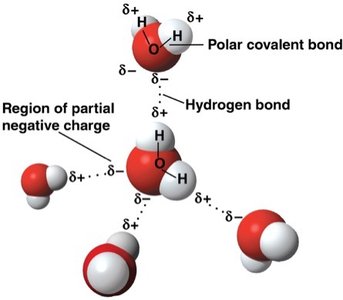
Water molecules possess unique chemical properties due to their structure, which is essential for life. The oxygen atom in water is more electronegative than hydrogen, resulting in polar covalent bonds and partial charges that enable hydrogen bonding.
Polar Covalent Bond: A bond where electrons are shared unequally, creating a partial negative charge near the oxygen and partial positive charges near the hydrogens.
Hydrogen Bond: A weak attraction between the hydrogen atom of one water molecule and the oxygen atom of another, responsible for many of water's emergent properties.
Region of Partial Negative Charge: The oxygen atom in water carries a partial negative charge, while the hydrogen atoms carry partial positive charges.
Example: Water's polarity allows it to form hydrogen bonds with other water molecules and with other polar substances.
Emergent Properties of Water Facilitating Life
Water exhibits several emergent properties that make it indispensable for life on Earth. These properties arise from hydrogen bonding and molecular polarity.
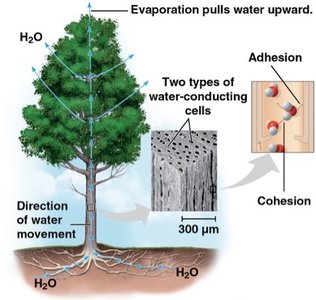
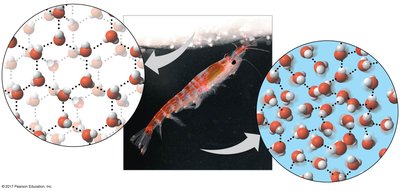
Cohesion: Water molecules stick together due to hydrogen bonding, enabling surface tension and the movement of water in plants.
Adhesion: Water molecules are attracted to other substances, such as plant cell walls, aiding capillary action.
Moderation of Temperature: Water has a high specific heat, which allows it to buffer temperature changes and maintain stable environments.
Expansion Upon Freezing: Water is less dense as a solid than as a liquid, allowing ice to float and insulate aquatic life.
Versatile Solvent: Water's polarity enables it to dissolve a wide range of substances, supporting biochemical reactions.
Moderation of Temperature by Water
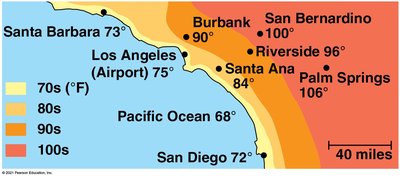
Water's high specific heat capacity allows it to absorb and release heat with minimal temperature change, which is crucial for maintaining life-supporting environments.
Specific Heat: The amount of heat required to change the temperature of 1 gram of a substance by 1°C. Water's specific heat is high due to hydrogen bonding.
Heat Absorption and Release: Heat is absorbed when hydrogen bonds break and released when they form, moderating temperature fluctuations.
Example: Coastal regions experience milder temperatures compared to inland areas due to water's thermal properties.
Expansion of Water Upon Freezing
Unlike most substances, water expands when it freezes, making ice less dense than liquid water. This property is vital for aquatic ecosystems.
Hydrogen Bond Stability: In ice, hydrogen bonds are stable and keep water molecules apart, resulting in lower density.
Liquid Water: Hydrogen bonds constantly break and reform, allowing molecules to be closer together.
Example: Ice floating on water insulates the liquid below, protecting aquatic life during cold periods.
Water as a Versatile Solvent
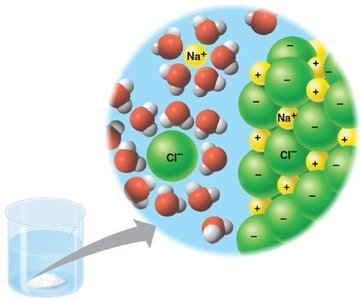
Water's polarity enables it to dissolve ionic and polar substances, making it a universal solvent in biological systems.
Hydration Shell: When ionic compounds dissolve, each ion is surrounded by water molecules, forming a hydration shell.
Example: Sodium chloride (NaCl) dissolves in water, with Na+ and Cl- ions surrounded by water molecules.
Hydrophilic vs. Hydrophobic Substances
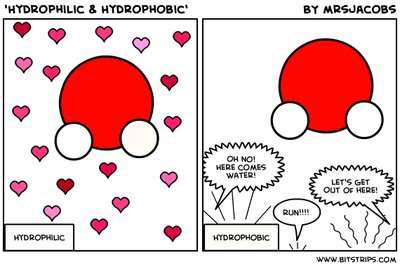
Substances interact with water differently based on their polarity. Hydrophilic substances are attracted to water, while hydrophobic substances repel it.
Hydrophilic: Polar or charged molecules that readily dissolve in water.
Hydrophobic: Nonpolar molecules, such as oils, that do not mix with water and are major components of cell membranes.
Example: Cell membranes are composed of hydrophobic molecules, creating a barrier to water.
Acidic and Basic Conditions Affect Living Organisms
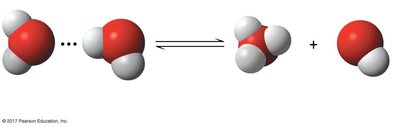
The concentration of hydrogen ions (H+) in water determines its pH, which is critical for biological processes. Water can dissociate into hydronium (H3O+) and hydroxide (OH-) ions.
pH: A measure of hydrogen ion concentration; most living cells maintain a pH close to 7.
Acid: A substance that increases H+ concentration.
Base: A substance that reduces H+ concentration.
Example: Even slight changes in pH can disrupt cellular function.
Acidification: A Threat to Our Oceans
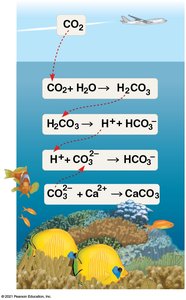
Human activities, such as fossil fuel combustion, increase atmospheric CO2, which dissolves in oceans and forms carbonic acid, leading to ocean acidification. This process threatens marine ecosystems, especially coral reefs.
CO2 Absorption: Oceans absorb CO2, which reacts with water to form carbonic acid ().
Acidification Effects: Increased acidity reduces carbonate ion availability, impairing the formation of calcium carbonate () structures in corals and shellfish.
Example: Coral reefs are particularly vulnerable to acidification, leading to ecosystem-wide changes.