 Back
Water and Life: Properties, Structure, and Biological Importance
Study Guide - Smart Notes
 Tailored notes based on your materials, expanded with key definitions, examples, and context.
Water: Structure and Polarity
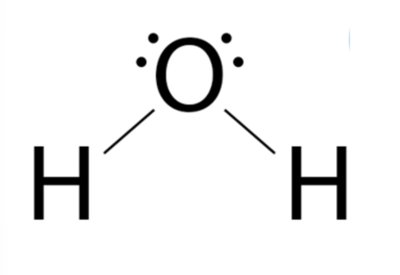
Molecular Structure of Water
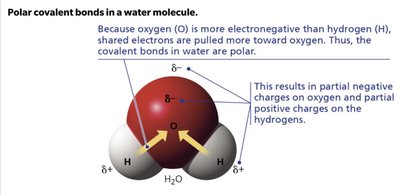
Water (H2O) is a polar molecule, meaning it has an uneven distribution of charge due to its asymmetrical shape and the difference in electronegativity between oxygen and hydrogen atoms. The oxygen atom is more electronegative, attracting shared electrons more strongly than hydrogen, resulting in partial negative (𝛿-) and partial positive (𝛿+) regions within the molecule.
Polar Covalent Bonds: The bonds between oxygen and hydrogen are polar covalent, leading to the molecule's polarity.
Hydrophilic Nature: Polar molecules like water are hydrophilic (water-loving).
Electron Distribution: Oxygen is electron-rich (𝛿-), while hydrogen is electron-poor (𝛿+).
Comparison: Water vs. Carbon Dioxide
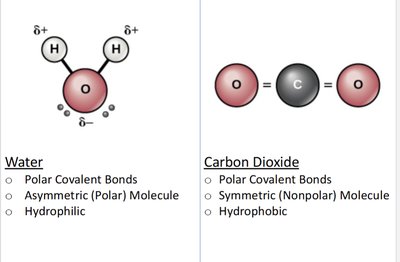
Water and carbon dioxide both contain polar covalent bonds, but their molecular symmetry determines their overall polarity and solubility in water.
Water: Asymmetric (polar), hydrophilic
Carbon Dioxide: Symmetric (nonpolar), hydrophobic
Hydrogen Bonds and Their Biological Significance
Formation and Properties of Hydrogen Bonds
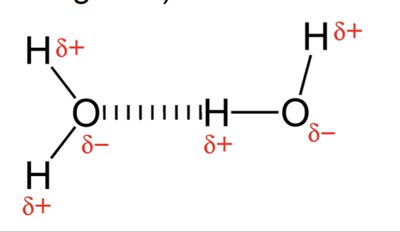
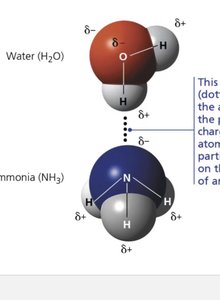
Hydrogen bonds are weak, noncovalent interactions formed between a partially positive hydrogen atom (𝛿+) and a partially negative atom (𝛿-), typically oxygen or nitrogen. In water, hydrogen bonds occur between adjacent molecules, not within the same molecule.
Strength: Each hydrogen bond is about 5% as strong as a covalent bond, but their cumulative effect is significant.
Electrostatic Attraction: Hydrogen bonds do not involve electron sharing; they are based on electrostatic attraction.
Polarity: The polarity of water enables it to dissolve polar solutes.
Biological Roles of Hydrogen Bonds
Hydrogen bonds are crucial for maintaining the structure and function of biological macromolecules.
DNA: Hydrogen bonds hold the two strands of the DNA double helix together.
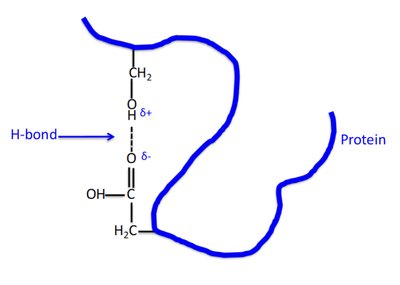
Proteins: The folding and stability of proteins depend on hydrogen and ionic bonds; breaking these bonds leads to denaturation.
Basic Properties of Water
Surface Tension
Surface tension is the resistance of the surface of a liquid to breaking or stretching, caused by the cohesive forces between water molecules due to hydrogen bonding.
Biological Importance: Enables small organisms to walk on water and supports capillary action in plants.
Density of Ice
Unlike most substances, ice is less dense than liquid water because hydrogen bonds stabilize into a crystal structure at low temperatures, causing ice to float.
Ecological Impact: Floating ice insulates aquatic life, preventing bodies of water from freezing solid.
Cohesion and Adhesion
Cohesion refers to water molecules sticking to each other, while adhesion is water sticking to other surfaces (e.g., plant cell walls).
Plant Transport: Water moves up plant stems via cohesion and adhesion without energy input from the plant.
Heat of Vaporization and Specific Heat
Water has a high heat of vaporization and specific heat, meaning it absorbs and releases heat slowly, moderating temperature changes in environments.
Example: Coastal areas experience less temperature fluctuation due to water's heat absorption.
Universal Solvent
Water is known as the universal solvent because it dissolves many polar and ionic substances, such as salts and sugars, but not nonpolar molecules like oils.
Biological Relevance: Water is the solvent in blood, cells, and plant sap.
Salt vs. Sugar: Salt (ionic) dissolves faster than sugar (polar, but not ionic).
pH and Water Ionization
Water Ionization and pH
Water can ionize to form hydrogen ions (H+) and hydroxide ions (OH-). The concentration of H+ determines the pH of a solution.
Neutral pH: Water is neutral when [H+] = [OH-], typically at pH 7.
Ionization Equation:
pH Calculation:
pH | [H+] |
|---|---|
1 | 0.1 |
3 | 0.001 |
7 | 0.0000001 |
10 | 0.0000000001 |
Acids, Bases, and Buffers
Acids are molecules that donate H+ ions, lowering pH, while bases accept H+ ions, raising pH. Buffers are chemicals that resist changes in pH, maintaining stability in biological systems.
Acids: Donate protons (H+), decrease pH.
Bases: Accept protons (H+), increase pH.
Buffer: Maintains pH by neutralizing added acids or bases.
pH Scale and Biological Impact
The pH scale is logarithmic; a difference of one unit represents a tenfold change in H+ concentration. pH affects the shape and function of biomolecules, influencing biological processes.
Example: pH 6 has 10x higher [H+] than pH 7; pH 8 has 10x lower [H+] than pH 7.
Summary Table: Water Properties and Biological Importance
Property | Biological Importance |
|---|---|
Polarity | Dissolves polar/ionic substances, enables biochemical reactions |
Hydrogen Bonding | Stabilizes DNA, proteins, and cell structures |
Surface Tension | Supports capillary action, aquatic life |
Density of Ice | Insulates aquatic environments |
Cohesion/Adhesion | Enables water transport in plants |
High Specific Heat | Moderates environmental temperature |
Universal Solvent | Facilitates transport and reactions in cells |
pH | Affects biomolecule structure/function |
Additional info: The notes expand on the original content by providing definitions, examples, and equations for pH, as well as a summary table for clarity.
