 Back
Water and Life: Properties, Structure, and Biological Importance
Study Guide - Smart Notes
 Tailored notes based on your materials, expanded with key definitions, examples, and context.
Water and Life
Introduction to Water's Role in Biology
Water is essential for all known forms of life and is the most abundant molecule in living organisms. It exists naturally on Earth in all three physical states: solid, liquid, and gas. The unique structure of water molecules allows them to interact extensively with each other and with other molecules, giving rise to emergent properties that are critical for life.
The Structure and Polarity of Water
Polarity of Water Molecules
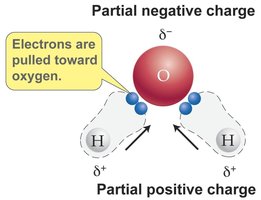
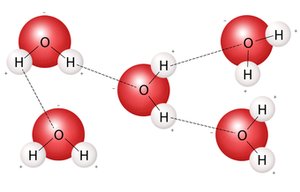
Water (H2O) is a polar molecule due to the high electronegativity of oxygen compared to hydrogen. The electrons in the O—H bonds are more attracted to the oxygen atom, resulting in a partial negative charge (δ−) near the oxygen and partial positive charges (δ+) near the hydrogens. This polarity leads to an uneven distribution of charge across the molecule.
Hydrogen Bonding in Water
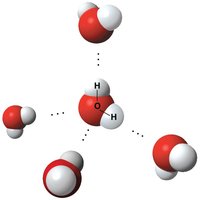
The polarity of water molecules enables them to form hydrogen bonds with each other. The partially negative oxygen atom of one water molecule is attracted to the partially positive hydrogen atom of another. These hydrogen bonds are responsible for many of water's unique properties.
Emergent Properties of Water
Overview of Water's Four Key Properties
Hydrogen bonding among water molecules gives rise to four emergent properties that are vital for life:
Cohesion and adhesion
Ability to moderate temperature
Expansion upon freezing
Versatility as a solvent
Property #1: Cohesion and Adhesion
Cohesion is the attraction between molecules of the same substance. In water, hydrogen bonds hold molecules together, resulting in high surface tension. Adhesion is the attraction between different substances, such as water and plant cell walls. Both cohesion and adhesion are crucial for water transport in plants.
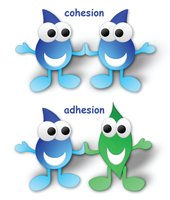
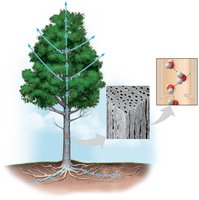
Example: Water moves upward through plant vessels due to cohesion (water molecules sticking together) and adhesion (water molecules sticking to vessel walls).
Property #2: Ability to Moderate Temperature
Water has a high specific heat, meaning it can absorb or release a large amount of heat with only a slight change in its own temperature. This property helps stabilize temperatures in organisms and environments. Heat is the transfer of thermal energy from a warmer object to a cooler one, and water's high specific heat is due to the energy required to break hydrogen bonds before increasing molecular motion.
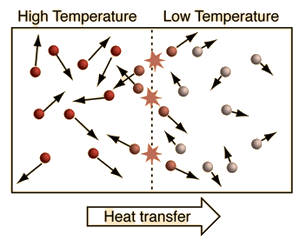
Example: Coastal regions experience milder climates because large bodies of water absorb and release heat slowly, moderating air temperatures nearby.

Evaporative Cooling
Evaporation is the transformation of a substance from liquid to gas. As water evaporates, the fastest-moving molecules escape, leaving the remaining liquid cooler—a process called evaporative cooling. This helps organisms regulate temperature.
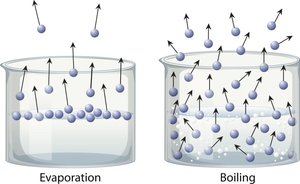
Example: Sweating and panting are biological mechanisms that use evaporative cooling to lower body temperature.

Property #3: Expansion Upon Freezing
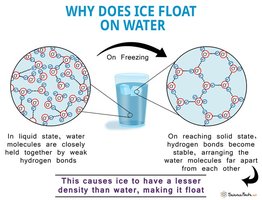
When water freezes, hydrogen bonds stabilize into a hexagonal lattice, holding molecules farther apart than in liquid water. This makes ice less dense than liquid water, causing it to float. Floating ice insulates the water below, allowing aquatic life to survive under frozen surfaces.
Property #4: Versatility as a Solvent
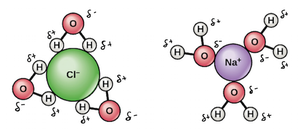
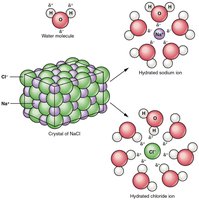
Water is known as the "solvent of life" because it dissolves more substances than any other liquid. Its polarity allows it to surround and separate ions and polar molecules, forming aqueous solutions. Water can dissolve ionic compounds (like NaCl) and polar molecules, but not nonpolar substances (like oils).
Hydrophilic vs. Hydrophobic Substances
Hydrophilic substances have charged or polar regions that interact favorably with water and tend to dissolve. Examples include ions, alcohols, and DNA. Hydrophobic substances are mostly nonpolar and do not dissolve in water, such as oils and fats. Large biological molecules can have both hydrophilic and hydrophobic regions.
Water Dissociation and pH
Dissociation of Water Molecules
Water molecules can dissociate into ions: a hydrogen ion (H+) and a hydroxide ion (OH−). The chemical equation for this process is:

At equilibrium, the rate of dissociation equals the rate of recombination, maintaining a constant concentration of ions in pure water.
Acids, Bases, and Buffers
Acids increase the concentration of H+ in a solution, while bases decrease it by accepting H+ or releasing OH−. Buffers help maintain a stable pH by reacting with excess H+ or OH−.
pH Scale
The pH of a solution is a measure of its hydrogen ion concentration. The scale ranges from 0 (most acidic) to 14 (most basic), with 7 being neutral. At neutral pH, [H+] = [OH−]. As pH decreases, acidity increases; as pH increases, basicity increases.
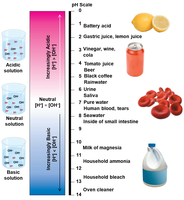
Example: Human blood is slightly basic (pH ≈ 7.4), and even small changes in pH can disrupt cellular processes.
Summary Table: Properties of Water and Their Biological Importance
Property | Description | Biological Importance |
|---|---|---|
Cohesion & Adhesion | Hydrogen bonds hold water molecules together and allow them to stick to other substances | Enables water transport in plants; high surface tension |
High Specific Heat | Water absorbs/releases heat with little temperature change | Stabilizes climate and organismal temperature |
Expansion Upon Freezing | Ice is less dense than liquid water | Insulates aquatic habitats in winter |
Versatility as a Solvent | Polarity allows water to dissolve many substances | Facilitates biochemical reactions in cells |
Practice Questions
List the four major properties of water. For each, explain how hydrogen bonding contributes to that property.
Give a specific example of how each property of water impacts life on Earth.
Diagram how water molecules would interact with: a polar NH3 molecule, a Ca2+ cation, and a nonpolar CH4 molecule.
Write the chemical equation for water dissociation. What ions are produced by a single dissociation event?
Compare the relative concentrations of H+ and OH− in acidic (pH < 7), neutral (pH = 7), and basic (pH > 7) solutions.
