 Back
Water and Life: Properties, Structure, and Biological Importance
Study Guide - Smart Notes
 Tailored notes based on your materials, expanded with key definitions, examples, and context.
Water and Life
Introduction
Water is essential for all known forms of life. Its unique chemical and physical properties make Earth habitable and support biological processes. This chapter explores the molecular structure of water, its emergent properties, and its role in biological systems.
Polar Covalent Bonds and Hydrogen Bonding in Water
Structure of the Water Molecule
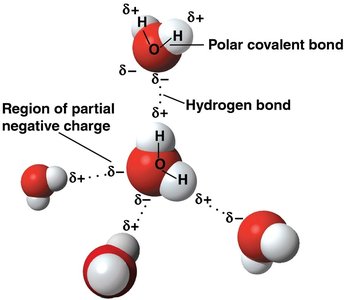
Polar covalent bonds in water result from the unequal sharing of electrons between oxygen and hydrogen atoms.
Oxygen is more electronegative, so electrons spend more time near the oxygen atom, giving it a partial negative charge (δ−) and the hydrogens partial positive charges (δ+).
This polarity allows water molecules to form hydrogen bonds with each other, where the partially positive hydrogen of one molecule is attracted to the partially negative oxygen of another.
Emergent Properties of Water
Overview of Four Key Properties
Cohesive behavior
Ability to moderate temperature
Expansion upon freezing
Versatility as a solvent
Cohesion and Adhesion
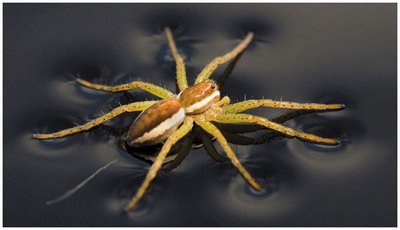
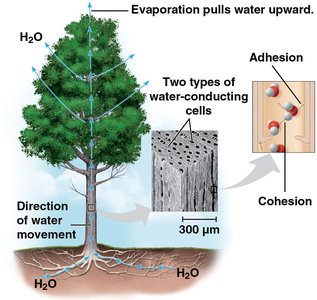
Cohesion is the attraction between water molecules due to hydrogen bonding, resulting in high surface tension.
Adhesion is the attraction between water molecules and other substances, such as plant cell walls, aiding in water transport against gravity in plants.
Moderation of Temperature
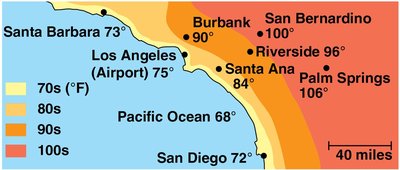
Water absorbs heat from warmer air and releases heat to cooler air, moderating temperature changes.
Specific heat is the amount of heat required to change the temperature of 1 g of a substance by 1°C. Water has a high specific heat (1 cal/g°C), allowing it to resist temperature changes.
Hydrogen bonds must break for water to heat up, and form as it cools, buffering temperature fluctuations.
Evaporative Cooling
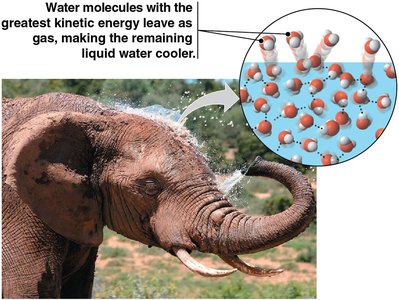
Evaporation is the transformation of a liquid to a gas. The heat of vaporization is the heat required for 1 g of liquid to become gas.
As water evaporates, the surface cools, a process called evaporative cooling, which helps regulate temperature in organisms and environments.
Expansion Upon Freezing
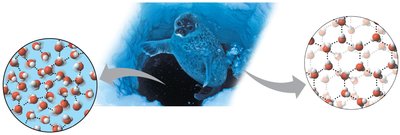
Water is less dense as a solid (ice) than as a liquid because hydrogen bonds form a stable lattice, keeping molecules further apart.
This property allows ice to float, insulating bodies of water and enabling aquatic life to survive in cold climates.
Versatility as a Solvent
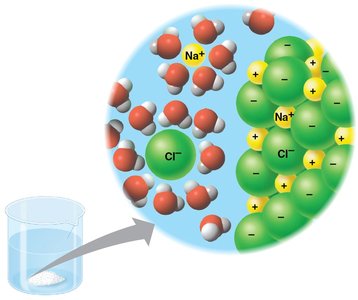
Water is known as the universal solvent due to its polarity, which allows it to dissolve many substances.
When ionic compounds dissolve, water forms hydration shells around each ion, separating and surrounding them.
Water can also dissolve polar molecules, including large biological molecules like proteins, if they have ionic or polar regions.
Hydrophilic and Hydrophobic Substances
Definitions and Biological Importance
Hydrophilic substances have an affinity for water (e.g., salts, sugars).
Hydrophobic substances do not interact with water (e.g., oils), often due to nonpolar bonds. These molecules are important in forming cell membranes.
Solute Concentration in Aqueous Solutions
Calculating Concentrations
Molecular mass is the sum of the masses of all atoms in a molecule.
The mole (mol) is a unit for counting molecules; 1 mol = molecules (Avogadro's number).
Molarity (M) is the number of moles of solute per liter of solution.
Acidic and Basic Conditions
Dissociation of Water
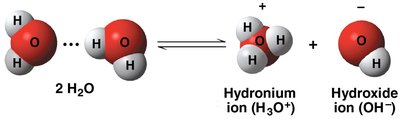
Water molecules can dissociate into hydronium ions (, often written as ) and hydroxide ions ().
This process is rare but crucial for biological systems, as both ions are highly reactive.
Acids, Bases, and the pH Scale
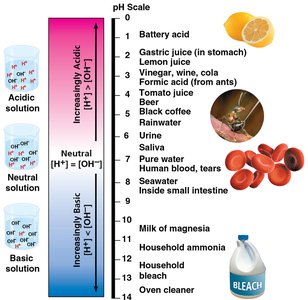
Acids increase the concentration in a solution; bases decrease it.
The pH scale measures the acidity or basicity of a solution: .
At 25°C, .
Acidic solutions: pH < 7; Basic solutions: pH > 7; Neutral: pH = 7.
Buffers
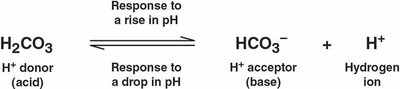
Buffers are substances that minimize changes in pH by accepting or donating ions as needed.
Most buffers consist of a weak acid and its corresponding base, maintaining pH stability in biological systems.
Summary Table: Four Emergent Properties of Water
Property | Description | Biological Importance |
|---|---|---|
Cohesion | Hydrogen bonds hold water molecules together | Enables water transport in plants, high surface tension |
Moderation of Temperature | High specific heat and heat of vaporization | Stabilizes climate and organismal temperature |
Expansion upon Freezing | Ice is less dense than liquid water | Insulates aquatic habitats, prevents bodies of water from freezing solid |
Versatility as a Solvent | Polarity allows dissolution of many substances | Facilitates chemical reactions in cells |
Possible Evolution of Life on Other Planets
Water as a Requirement for Life
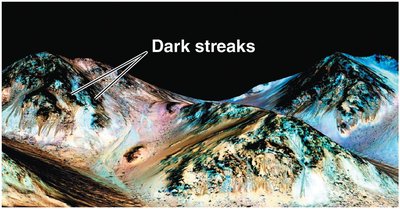
Biologists search for extraterrestrial life by looking for water, as its properties are essential for life as we know it.
Evidence of water vapor has been found on some exoplanets and on Mars within our solar system.
Key Equations
Relationship between hydrogen and hydroxide ion concentrations:
pH definition:
Molarity:
Conclusion
Water’s unique structure and properties are fundamental to life on Earth. Its ability to form hydrogen bonds leads to cohesion, temperature moderation, expansion upon freezing, and versatility as a solvent. Understanding these properties is essential for studying biological systems and the chemistry of life.
