 Back
BackWater and Life: Structure, Properties, and Biological Importance
Study Guide - Smart Notes
 Tailored notes based on your materials, expanded with key definitions, examples, and context.
Q1. Diagram and Describe the Structure of a Single Water Molecule
Background
Topic: Molecular Structure of Water
This question tests your understanding of the atomic arrangement, bonding, and charge distribution in a water molecule (H2O).
Key Terms and Concepts:
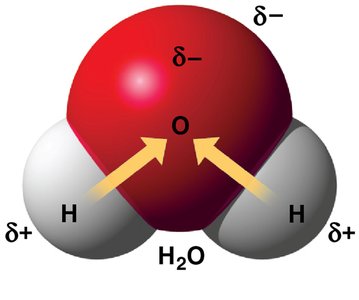
Polar Covalent Bond: A type of covalent bond where electrons are shared unequally, resulting in partial charges.
Partial Charges (δ+ and δ-): Indicate regions of slight positive or negative charge due to unequal electron sharing.
Bent Shape: The molecular geometry of water, with an angle of about 104.5° between the hydrogen atoms.
Step-by-Step Guidance
Draw a central oxygen atom (O) with two hydrogen atoms (H) attached, forming a bent shape.
Label the bonds between O and H as polar covalent bonds.
Indicate a partial negative charge (δ-) near the oxygen atom and partial positive charges (δ+) near each hydrogen atom.
Make sure the overall shape reflects the bent geometry, not a straight line.
Try solving on your own before revealing the answer!
Final Answer:
A single water molecule consists of one oxygen atom covalently bonded to two hydrogen atoms in a bent shape. The O-H bonds are polar covalent, with the oxygen atom carrying a partial negative charge (δ-) and each hydrogen a partial positive charge (δ+). This charge separation makes water a polar molecule.
Q2. Diagram and Describe Hydrogen Bonding Between Five Water Molecules
Background
Topic: Hydrogen Bonding and Water's Cohesive Properties
This question assesses your understanding of how water molecules interact through hydrogen bonds, both within and between molecules.
Key Terms and Concepts:
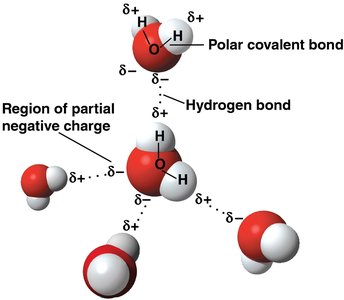
Intramolecular Bonds: Polar covalent bonds within a single water molecule.
Intermolecular Bonds: Hydrogen bonds between different water molecules.
Hydrogen Bond: A weak attraction between the partially positive hydrogen of one molecule and the partially negative oxygen of another.
Step-by-Step Guidance
Draw five water molecules, each with correct O and H atom labels and partial charges (δ- on O, δ+ on H).
Label the polar covalent bonds within each molecule.
Show dashed lines between the δ- oxygen of one molecule and the δ+ hydrogen of a neighboring molecule to represent hydrogen bonds.
Ensure that each hydrogen bond connects different molecules, not atoms within the same molecule.
Try solving on your own before revealing the answer!
Final Answer:
Five water molecules are arranged so that the partially negative oxygen of one molecule forms a hydrogen bond (dashed line) with the partially positive hydrogen of a neighboring molecule. Each molecule has polar covalent bonds within (O-H) and participates in hydrogen bonding between molecules, demonstrating water's cohesive properties.
Q3. How Do Humidity and Air Movement Affect the Rate of Transpiration in Plants?
Background
Topic: Plant Water Transport and Transpiration
This question explores how environmental factors influence the rate at which water evaporates from plant leaves (transpiration).
Key Terms:
Transpiration: The process by which water evaporates from plant leaves, driving water movement through the plant.
Humidity: The amount of water vapor in the air.
Air Movement: Wind or airflow that can affect evaporation rates.
Step-by-Step Guidance
Consider how decreasing humidity affects the water vapor gradient between the inside of the leaf and the surrounding air.
Think about how increased air movement (wind) influences the removal of water vapor from the leaf surface.
Relate these changes to the rate of water loss from the plant (transpiration).
Try solving on your own before revealing the answer!
Final Answer:
Decreasing humidity increases the rate of transpiration because the gradient for water vapor loss is steeper. Increasing air movement also increases transpiration by removing humid air from around the leaf, maintaining a high gradient for evaporation.
Q4. Propose a Hypothesis for How a Drought-Resistant Tree Might Adapt to Limit Water Loss While Maintaining Water Transport
Background
Topic: Plant Adaptations to Drought
This question asks you to hypothesize structural adaptations that allow trees to survive in dry, windy environments while still transporting water efficiently.
Key Terms:
Transpiration Loss: Water lost from leaves to the atmosphere.
Xylem Vessels: Tubes that transport water from roots to leaves.
Cohesion: The attraction between water molecules that helps maintain a continuous water column.
Step-by-Step Guidance
Think about physical features that could reduce water loss from leaves (e.g., cuticle, stomata).
Consider how the structure of xylem vessels might change to prevent breakage of the water column under high tension.
Relate these adaptations to the plant's ability to survive drought conditions.
Try solving on your own before revealing the answer!
Final Answer:
A drought-resistant tree might develop a thick waxy cuticle or sunken stomata to reduce water loss, and maintain narrow xylem vessels to preserve cohesive water columns under high tension. These adaptations help limit transpiration and prevent cavitation during drought.
Q5. Explain Why Ice Floats on Liquid Water and Describe the Stratification of a Lake in Winter
Background
Topic: Density of Water and Ice, Lake Stratification
This question examines the molecular basis for the density differences between ice and liquid water, and how this affects aquatic environments in winter.
Key Terms and Concepts:
Density: Mass per unit volume; determines whether a substance sinks or floats.
Hydrogen Bonding: Causes water molecules to form a crystalline lattice in ice.
Stratification: Layering of water in a lake based on temperature and density.
Step-by-Step Guidance
Recall how hydrogen bonds arrange water molecules in ice compared to liquid water.
Compare the density of ice at 0°C to that of liquid water at 0°C and 4°C.
Predict how these density differences cause ice to float and how water layers form in a winter lake.
Try solving on your own before revealing the answer!
Final Answer:
Ice is less dense than liquid water because hydrogen bonds lock water molecules into an expanded lattice, making ice float. In winter, lakes stratify with ice on top, cold water (0–3°C) beneath, and the densest (4°C) water at the bottom, allowing aquatic life to survive in the warmer, denser layer.
Q6. Explain Why Water is Called the Universal Solvent and Describe the "Like Dissolves Like" Principle
Background
Topic: Solubility and Polarity
This question tests your understanding of why water dissolves many substances and the role of molecular polarity in solubility.
Key Terms:
Polarity: Distribution of electrical charge over the atoms in a molecule.
Solvent: The substance that dissolves another to form a solution.
"Like Dissolves Like": Polar solvents dissolve polar/ionic solutes; nonpolar solvents dissolve nonpolar solutes.
Step-by-Step Guidance
Identify the types of substances that dissolve in water (polar and ionic) versus those that dissolve in nonpolar solvents (nonpolar).
Explain how water's polarity enables it to interact with and dissolve other polar or ionic substances.
Contrast this with the inability of water to dissolve nonpolar substances like oil.
Try solving on your own before revealing the answer!
Final Answer:
Water is called the universal solvent because its polarity allows it to dissolve many polar and ionic substances by surrounding and separating their molecules or ions. Nonpolar substances do not dissolve in water, illustrating the "like dissolves like" principle.
Q7. Compare the Solubility of Salt, Sugar, Oil, and Cholesterol in Water and Hexane, and Explain the Mechanism
Background
Topic: Solubility Mechanisms and Molecular Interactions
This question asks you to explain why certain substances dissolve in water but not in hexane, and vice versa, based on molecular interactions.
Key Terms:
Electrostatic Attraction: The force between charged or partially charged particles.
Hydrogen Bonding: Attraction between a hydrogen atom and an electronegative atom (like oxygen).
Nonpolar Molecules: Molecules with no significant charge separation.
Step-by-Step Guidance
Classify salt and sugar as ionic or polar, and oil and cholesterol as nonpolar.
Describe how water's partial charges interact with salt and sugar to dissolve them.
Explain why nonpolar hexane dissolves oil and cholesterol but not salt or sugar.
Try solving on your own before revealing the answer!
Final Answer:
Salt and sugar dissolve in water due to strong electrostatic and hydrogen bonding interactions with water's partial charges, but not in hexane. Oil and cholesterol dissolve in nonpolar hexane because of similar nonpolar interactions, but remain insoluble in water, which prefers to hydrogen-bond with itself.
Q8. Which Solution is Most Effective at Resisting pH Changes When Base is Added, and Why?
Background
Topic: Buffers and pH Regulation in Biological Systems
This question evaluates your understanding of how buffers work to maintain stable pH in biological systems.
Key Terms:
Buffer: A solution that resists changes in pH when acids or bases are added.
pH: A measure of hydrogen ion concentration; lower pH is more acidic, higher is more basic.
Phosphate Buffer: A common biological buffer system.
Step-by-Step Guidance
Compare the pH changes observed in beakers with distilled water, phosphate buffer, and dilute acid after adding base.
Identify which beaker showed the smallest change in pH.
Explain how the buffer's components neutralize added base ions to resist pH change.
Try solving on your own before revealing the answer!
Final Answer:
The phosphate buffer (Beaker B) was most effective at resisting pH changes because its weak acid/base components neutralized the added base, resulting in only a minimal increase in pH.
