 Back
Water and Life: Structure, Properties, and Biological Importance
Study Guide - Smart Notes
 Tailored notes based on your materials, expanded with key definitions, examples, and context.
Water’s Unique Structure
Single Water Molecule
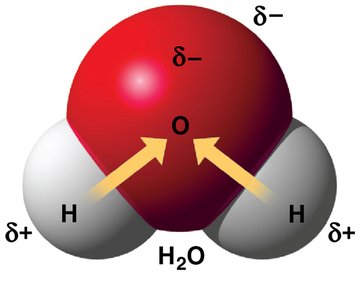
Water (H2O) is a polar molecule composed of one oxygen atom covalently bonded to two hydrogen atoms, forming a bent molecular shape. The oxygen atom is more electronegative, resulting in an unequal sharing of electrons and the creation of partial charges.
Polar Covalent Bonds: The bonds between oxygen and hydrogen are polar covalent, meaning electrons are shared unequally, giving oxygen a partial negative charge (δ−) and hydrogens partial positive charges (δ+).
Molecular Polarity: The bent shape and charge separation make water a highly polar molecule, which is critical for its interactions with other molecules.
Partial Charges: The oxygen atom carries a partial negative charge, while each hydrogen carries a partial positive charge.
Hydrogen Bonding Between Water Molecules
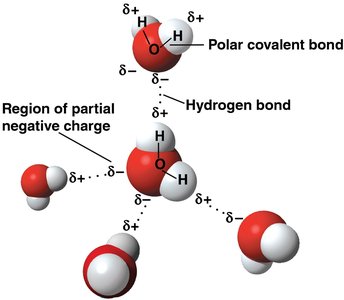
Water molecules interact with each other through hydrogen bonds, which are weak attractions between the partially positive hydrogen of one molecule and the partially negative oxygen of another. These interactions are responsible for many of water’s unique properties.
Intramolecular Bonds: Within each water molecule, polar covalent bonds hold the atoms together.
Intermolecular Bonds: Hydrogen bonds form between water molecules, connecting the δ+ hydrogen of one molecule to the δ− oxygen of another.
Significance: Hydrogen bonding leads to high cohesion, surface tension, and other emergent properties of water.
Water’s Cohesive Properties
Transpiration and Plant Adaptations
Water’s cohesive and adhesive properties are essential for the movement of water through plants (transpiration). Environmental factors and plant adaptations influence the rate of water loss.
Humidity: Lower humidity increases transpiration by enhancing the water vapor gradient between leaf and air.
Air Movement: Increased air movement (wind) raises transpiration rates by removing humid air around leaves.
Drought Adaptations: Drought-resistant trees may develop thick waxy cuticles or sunken stomata to reduce water loss, and narrow xylem vessels to maintain water column cohesion under tension.
Example: Pine trees in arid climates often have needle-like leaves with sunken stomata and thick cuticles to minimize transpiration.
Density of Ice vs. Liquid Water
Density Changes with Temperature
Water exhibits unusual density behavior as it cools and freezes, which has important ecological consequences.
Maximum Density: Water reaches its maximum density at 4°C (). Cooling below this temperature causes density to decrease as water approaches freezing.
Ice vs. Liquid Water: Ice (solid water) at 0°C is less dense () than liquid water at 0°C () due to the formation of a stable, open crystalline lattice by hydrogen bonds.
Example: Ice floats on liquid water, insulating aquatic environments and allowing life to persist beneath the surface during winter.
Winter Lake Stratification
Stratification: In winter, lakes form layers: ice on top, cold liquid water (0–3°C) below, and the densest (4°C) water at the bottom.
Ecological Importance: The floating ice layer insulates the water below, preventing the entire lake from freezing and protecting aquatic organisms.
Water as the Universal Solvent
Polarity and Solubility
Water’s polarity allows it to dissolve a wide variety of substances, earning it the title of “universal solvent.”
Like Dissolves Like: Polar and ionic substances dissolve in polar solvents (like water), while nonpolar substances dissolve in nonpolar solvents (like hexane).
Mechanism: Water’s partial charges attract and surround ions and polar molecules, breaking them apart and keeping them in solution. Nonpolar molecules, such as oils, do not interact favorably with water and remain insoluble.
Example: Table salt (NaCl) dissolves in water but not in hexane; vegetable oil dissolves in hexane but not in water.
pH & Buffers in Biological Systems
Buffering Capacity
Biological systems use buffers to maintain stable pH levels, which is critical for proper cellular function.
Buffer Action: Buffers, such as phosphate buffer, resist changes in pH by neutralizing added acids or bases.
Experimental Comparison: When base is added, distilled water’s pH rises sharply, dilute acid’s pH rises slightly, but phosphate buffer’s pH remains nearly constant.
Example: Blood contains bicarbonate and phosphate buffers to maintain a narrow pH range essential for enzyme activity and metabolic processes.
