 Back
Water and the Chemistry of Life: Atomic Structure, Bonding, and Properties
Study Guide - Smart Notes
 Tailored notes based on your materials, expanded with key definitions, examples, and context.
Water and the Chemistry of Life
Structure Defines Function
In biology, the structure of molecules and atoms determines their function and behavior in living systems. Understanding atomic structure is fundamental to grasping how biological molecules interact and how life is sustained at the molecular level.
Basic Atomic Structure
Subatomic Particles
Atoms are composed of three main subatomic particles:
Protons: Positively charged particles found in the nucleus.
Neutrons: Neutral particles also located in the nucleus.
Electrons: Negatively charged particles that orbit the nucleus.
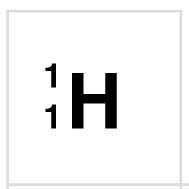
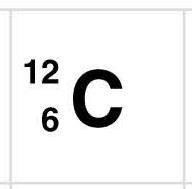
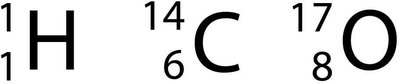
The atomic number is the number of protons in an atom, while the mass number is the sum of protons and neutrons.
Isotopes
Isotopes are variants of elements with different numbers of neutrons. For example, carbon has three common isotopes:
Carbon-12: 6 protons, 6 neutrons
Carbon-13: 6 protons, 7 neutrons
Carbon-14: 6 protons, 8 neutrons (radioactive)
Isotopes are important in science for tracking compounds, structural analysis (NMR), and medical imaging (MRI).
The Periodic Table and Elements in Biology
Abundant Elements in Living Cells
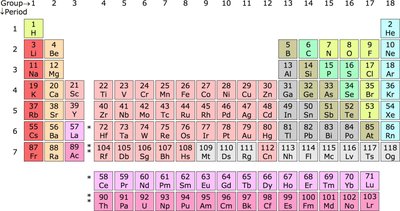
The most abundant elements in living organisms are hydrogen (H), carbon (C), nitrogen (N), oxygen (O), phosphorus (P), and sulfur (S). These elements make up over 99% of atoms in the human body.
Electron Shells and Valence
Valence Electrons and Bonding
Electrons are arranged in shells around the nucleus. The outermost shell, called the valence shell, determines an atom's chemical reactivity. Atoms with incomplete valence shells tend to form bonds to achieve stability.
Covalent Bonds
Bond Formation and Types
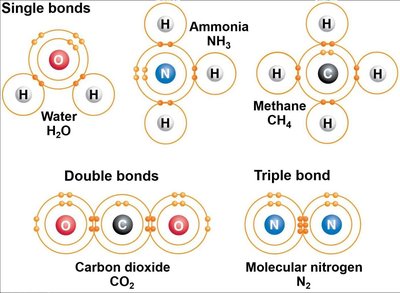
Covalent bonds occur when atoms share valence electrons. The number of unpaired electrons determines how many bonds an atom can form. Covalent bonds can be single, double, or triple.
Single bond: One pair of shared electrons
Double bond: Two pairs of shared electrons
Triple bond: Three pairs of shared electrons
Polar vs Nonpolar Covalent Bonds
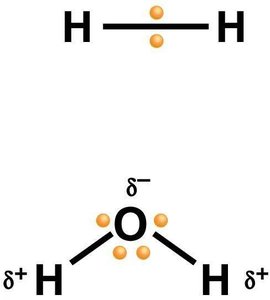
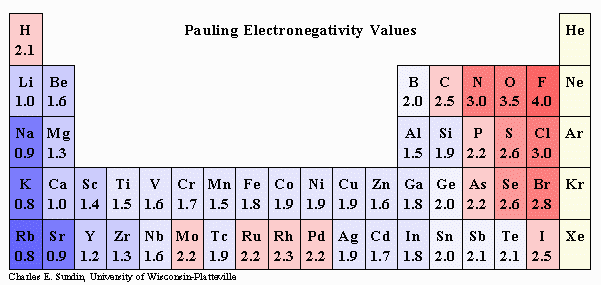
Electrons are not always shared equally. Electronegativity is an atom's ability to attract electrons. The difference in electronegativity between atoms determines bond polarity:
Nonpolar covalent bond: Electrons are shared equally (e.g., H2).
Polar covalent bond: Electrons are shared unequally, creating partial charges (e.g., H2O).
Ionic Bonds and Ion Formation
Ion Formation
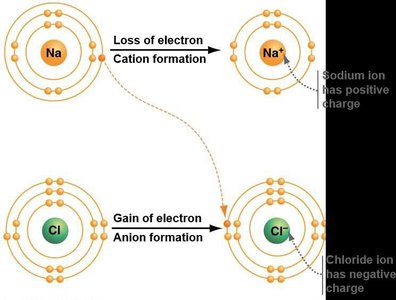
Ionic bonds form when electrons are transferred from one atom to another, resulting in charged ions:
Cation: Atom loses an electron, becomes positively charged.
Anion: Atom gains an electron, becomes negatively charged.
Water: Structure and Properties
Water as the Universal Solvent
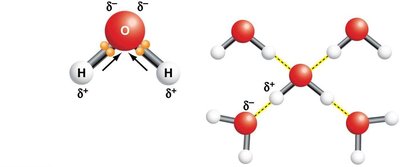
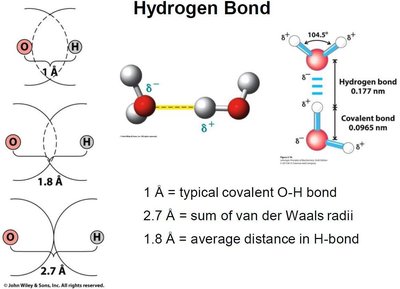
Water makes up about 75% of typical cells and is essential for all biochemical reactions. Its polarity allows it to dissolve many substances, making it the "universal solvent." Water molecules participate in hydrogen bonding, a weak attraction between a hydrogen atom (δ+) and an electronegative atom (δ-).
Hydrogen Bonds
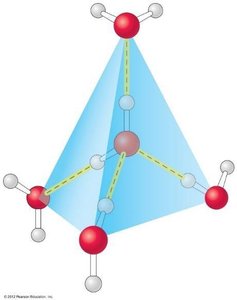
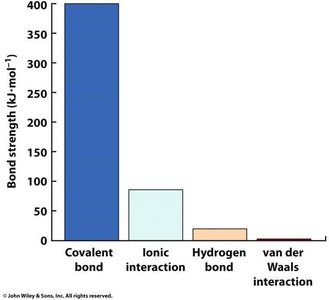
Hydrogen bonds are intermolecular forces that occur between molecules containing hydrogen bonded to N, O, or F. These bonds are weaker than covalent or ionic bonds but are crucial for the structure and properties of water and biological molecules.
Properties of Water
Cohesion and Adhesion
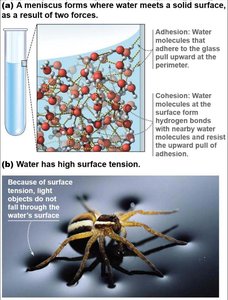
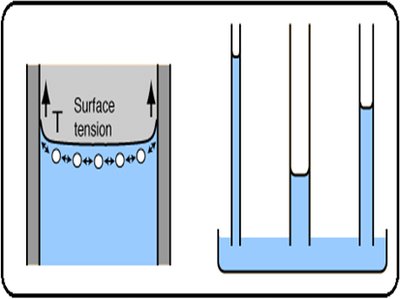
Water molecules exhibit cohesion (attraction to each other) and adhesion (attraction to other substances). Cohesion leads to high surface tension, allowing small objects to "walk" on water. Adhesion enables capillary action, important for water transport in plants.
Thermal Properties
Water can absorb large amounts of energy due to its high specific heat and heat of evaporation:
Specific heat: Energy required to raise the temperature of 1 gram of water by 1°C.
Heat of evaporation: Energy required to convert 1 gram of water from liquid to gas.
These properties help regulate temperature in organisms and environments.
Acids, Bases, and pH
Dissociation of Water
Water can dissociate into hydronium (H3O+) and hydroxide (OH-) ions:
Acid: Proton (H+) donor
Base: Proton acceptor or hydroxide donor
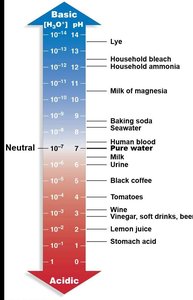
The pH scale measures the concentration of protons in solution:
Neutral water: , pH = 7
Buffers and Homeostasis
Buffer Systems
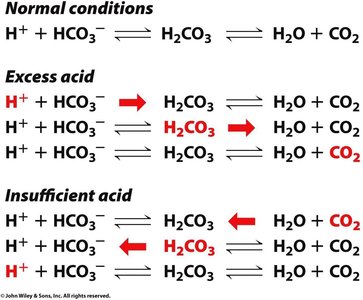
Buffers are weak acids or bases that minimize changes in pH by absorbing excess H+ or OH-. They are essential for maintaining homeostasis in biological systems, such as blood.
Example: Carbonic acid buffer system in blood
Le Chatelier's principle: Equilibrium shifts to counteract changes in concentration
Summary Table: Types of Chemical Bonds
Bond Type | Strength (kJ/mol) | Example |
|---|---|---|
Covalent | ~400 | H2, O2 |
Ionic | ~100 | NaCl |
Hydrogen | 2-20 | H2O, DNA |
van der Waals | <2 | Nonpolar molecules |
Learning Outcomes
Understand and use key vocabulary related to atomic structure and bonding
Identify elements and isotopes based on their atomic structure
Describe types of bonds and their relative strengths
Sort molecules by polarity
List and describe properties of water
Explain dissociation of water, pH, and pOH
Demonstrate the relationship between [H+], [OH-], and pH
Understand the concept of buffering and its importance in homeostasis
