 Back
Water, Chemical Bonds, and Biomolecules: Foundations for Life
Study Guide - Smart Notes
 Tailored notes based on your materials, expanded with key definitions, examples, and context.
Water and Chemical Bonds
Types of Chemical Bonds
Chemical bonds are the forces that hold atoms together in molecules. The type of bond formed depends on the difference in electronegativity between the atoms involved.
Covalent Bonds: Atoms share electrons to fill their valence shells. Can be nonpolar (equal sharing) or polar (unequal sharing).
Ionic Bonds: Electrons are transferred from one atom to another, resulting in oppositely charged ions that attract each other.
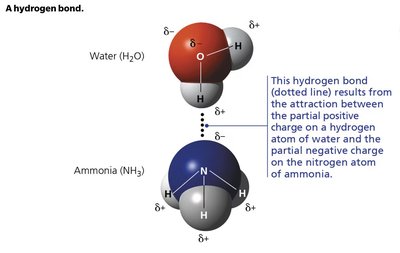
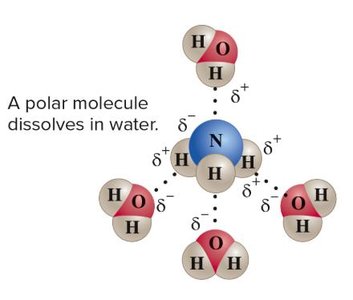
Hydrogen Bonds: Weak attractions between a partially positive hydrogen atom and a highly electronegative atom (O or N) in another molecule.
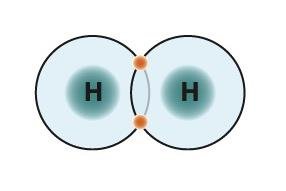

Electronegativity and Bond Polarity
Electronegativity is the ability of an atom to attract shared electrons. The greater the difference in electronegativity, the more polar the bond.
Nonpolar Covalent Bonds: Electrons are shared equally (e.g., H-H, C-H).
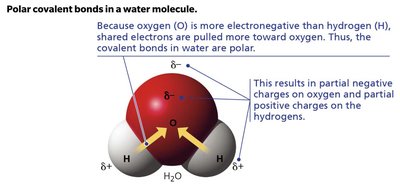
Polar Covalent Bonds: Electrons are shared unequally (e.g., O-H, C=O), resulting in partial charges (δ+ and δ–).
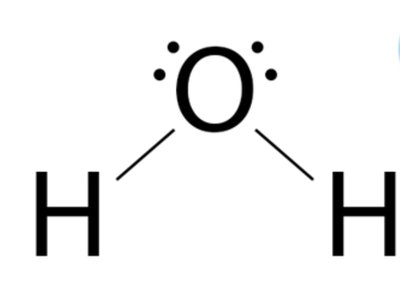
Water: Structure and Polarity
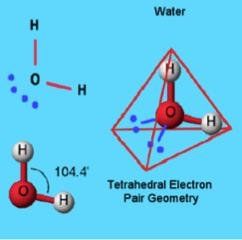
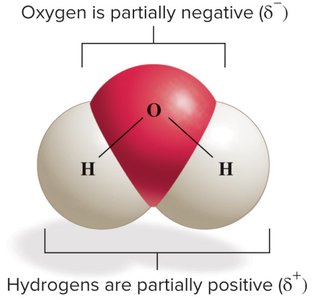
Water (H2O) is a polar molecule due to its bent shape and the high electronegativity of oxygen. This results in partial negative charge on oxygen and partial positive charges on hydrogens.
Asymmetrical shape: The bent geometry (104.5°) leads to a separation of charge.
Polarity: Water molecules have distinct positive and negative regions, making them excellent solvents for other polar substances.
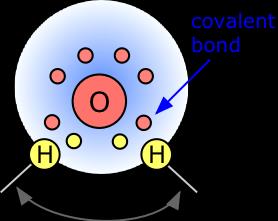
Comparison of Molecular Polarity
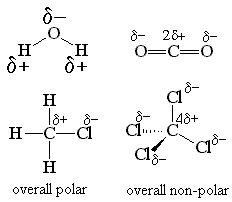
The polarity of a molecule depends on both the type of bonds and the molecular shape.
Bond Type | Molecular Shape | Molecular Type |
|---|---|---|
Water | Bent | Polar |
Methane | Tetrahedral | Nonpolar |
Carbon Dioxide | Linear | Nonpolar |
Hydrogen Bonding and Emergent Properties of Water
Hydrogen Bonds
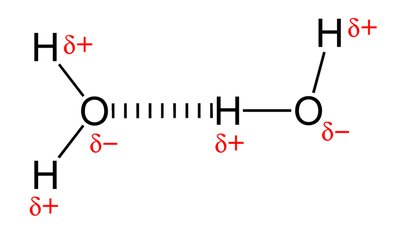
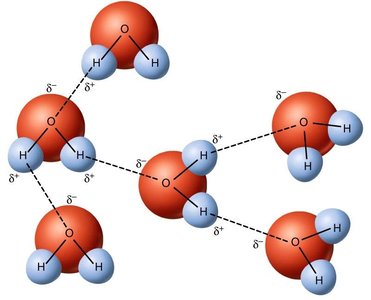
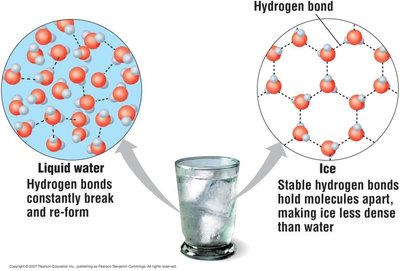
Hydrogen bonds are weak, noncovalent interactions that occur between a partially positive hydrogen atom and a partially negative atom (usually O or N). Although individually weak, collectively they have significant effects on the properties of water and biological molecules.
Emergent Properties of Water
Hydrogen bonding gives rise to several unique properties of water essential for life:
Cohesion and Adhesion: Water molecules stick to each other (cohesion) and to other polar substances (adhesion), enabling capillary action in plants.
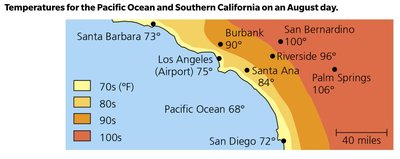
High Specific Heat: Water resists temperature changes, stabilizing environments and organisms.
High Heat of Vaporization: Large amounts of energy are required to convert water from liquid to gas, allowing for evaporative cooling.
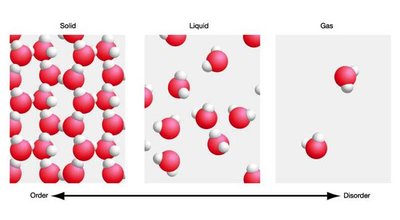
Ice Floats: Solid water (ice) is less dense than liquid water due to stable hydrogen bonds, allowing aquatic life to survive under ice.
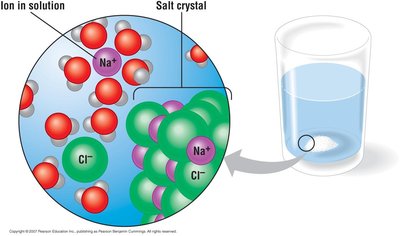
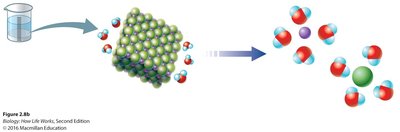
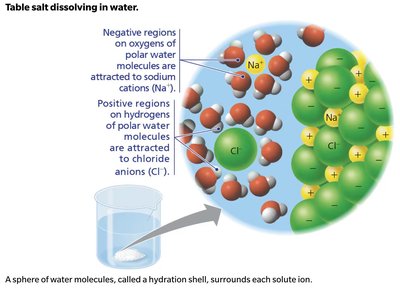
Excellent Solvent: Water dissolves many polar and ionic substances, facilitating biochemical reactions.
Water as a Solvent
Hydrophilic and Hydrophobic Substances
Water's polarity allows it to dissolve other polar molecules (hydrophilic) and ionic compounds, but not nonpolar molecules (hydrophobic).
Hydrophilic: Substances that interact well with water (e.g., salts, sugars).
Hydrophobic: Substances that do not interact with water (e.g., oils, lipids).
pH, Acids, Bases, and Buffers
Water Ionization and the pH Scale
Water can ionize to form hydrogen ions (H+) and hydroxide ions (OH–). The concentration of H+ in solution is measured as pH:
pH = -log10[H+]
Neutral water: [H+] = 1 × 10⁻⁷ M, pH = 7
The pH scale is logarithmic: each unit change represents a tenfold change in [H+]
Acids donate H+ ions, lowering pH. Bases accept H+ ions, raising pH.
Buffers
Buffers are substances that minimize changes in pH by absorbing or releasing H+ ions. They are crucial for maintaining stable pH in biological systems.
Biomolecules: The Chemistry of Life
Macromolecules and Monomers
Cells are composed of four major classes of macromolecules, each built from smaller subunits (monomers):
Carbohydrates: Monomer = monosaccharide (e.g., glucose)
Lipids: Not true polymers, but built from fatty acids and glycerol
Proteins: Monomer = amino acid
Nucleic Acids: Monomer = nucleotide
Macromolecules are assembled by dehydration synthesis (removal of water) and broken down by hydrolysis (addition of water).
Functional Groups
Functional groups are specific groups of atoms within molecules that determine the chemical properties and reactions of those molecules. Examples include hydroxyl, carbonyl, carboxyl, amino, phosphate, and sulfhydryl groups.
Proteins and Nucleic Acids
Proteins: Structure and Function
Proteins are polymers of amino acids linked by peptide bonds. Their structure is organized into four levels:
Primary: Sequence of amino acids
Secondary: Alpha helices and beta sheets formed by hydrogen bonding
Tertiary: 3D folding due to side chain interactions
Quaternary: Association of multiple polypeptide chains
Protein function depends on its shape, which can be altered (denatured) by changes in temperature or pH.
Nucleic Acids: DNA and RNA
Nucleic acids store and transmit genetic information. DNA is double-stranded and stable, while RNA is single-stranded and more versatile. Nucleotides are linked by phosphodiester bonds, and base pairing (A-T, G-C in DNA; A-U, G-C in RNA) is stabilized by hydrogen bonds.
Central Dogma of Molecular Biology
Information Flow
The central dogma describes the flow of genetic information:
DNA → RNA → Protein
Transcription: DNA is transcribed into mRNA
Translation: mRNA is translated into protein
Gene expression is regulated at multiple levels, primarily at the initiation of transcription.
Summary Table: Types of Bonds and Their Roles
Bond Type | Strength | Role in Biology |
|---|---|---|
Covalent | Strong | Stabilizes primary structure of biomolecules |
Hydrogen | Weak (individually) | Stabilizes secondary/tertiary structure, base pairing in DNA |
Ionic | Moderate | Stabilizes protein structure, forms salts |
Additional info: This guide integrates foundational concepts from chemistry and biology, emphasizing the importance of water, chemical bonds, and macromolecules in living systems. Understanding these principles is essential for further study in cell biology, genetics, and biochemistry.
