Back
BackWater, Hydrogen Ions, and the Chemistry of Life
Study Guide - Smart Notes
 Tailored notes based on your materials, expanded with key definitions, examples, and context.
Water and Life
Hydrogen Ions and Water Dissociation
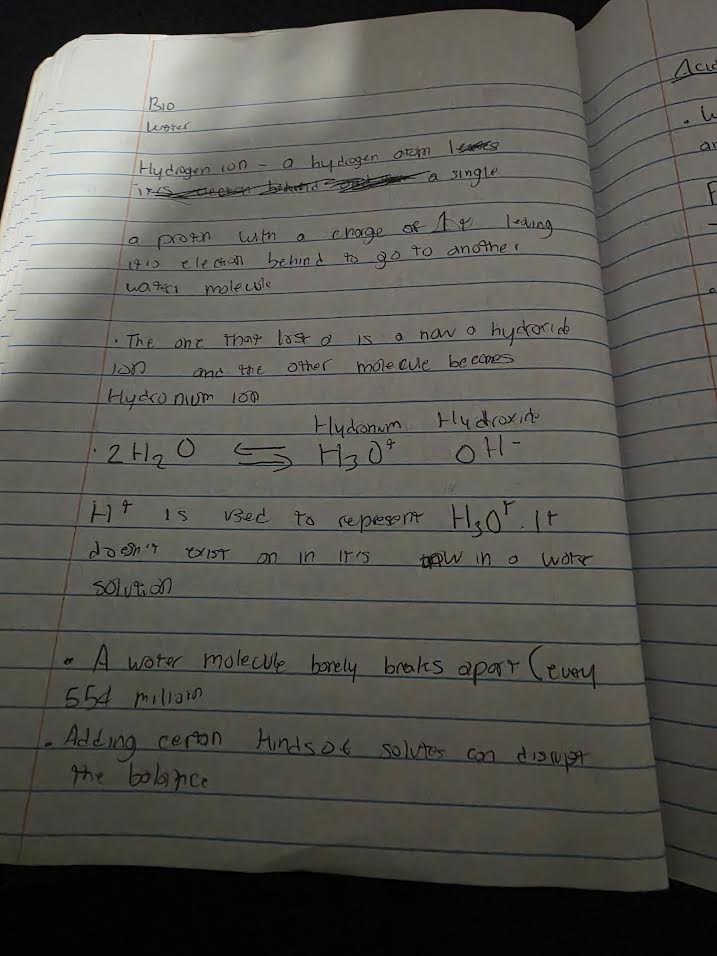
Water molecules can undergo dissociation, a process where a hydrogen atom leaves its electron behind and transfers as a proton to another water molecule. This process is fundamental to understanding acids, bases, and pH in biological systems.
Hydrogen Ion (H+): A hydrogen atom that has lost its electron, leaving behind a single proton with a positive charge.
Hydronium Ion (H3O+): When a water molecule gains a proton (H+), it becomes a hydronium ion.
Hydroxide Ion (OH-): The water molecule that loses a proton becomes a hydroxide ion.
Chemical Equation for Water Dissociation:
H+ Notation: H+ is often used to represent H3O+, but in reality, free protons do not exist alone in water; they are always associated with water molecules as hydronium ions.
Properties and Rarity of Water Dissociation
The dissociation of water is a rare event, but it is crucial for the chemistry of life.
Frequency: A single water molecule dissociates only about once every 554 million molecules at any given time.
Effect of Solutes: Adding certain kinds of solutes can disrupt the balance of hydrogen and hydroxide ions, affecting the pH of the solution.
Example: The addition of acids or bases to water will shift the balance of H3O+ and OH- ions, changing the solution's pH.