 Back
BackWater in Plant Life: Absorption, Transpiration, and Translocation
Study Guide - Smart Notes
 Tailored notes based on your materials, expanded with key definitions, examples, and context.
Water in Plant Life
Introduction
Water is essential for plant life, playing a critical role in physiological processes such as absorption, transpiration, and translocation. The structure of roots, stems, and leaves is intricately related to the movement of water and minerals throughout the plant body.
Plant Root Systems
Types of Root Systems
Plants have evolved different root systems to optimize water and nutrient uptake from the soil.
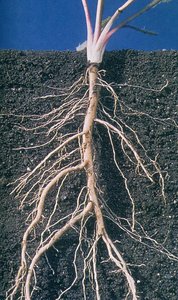
Taproot System: Characterized by a single, large primary root that grows deep into the soil, with smaller lateral roots branching off. Common in dicots.
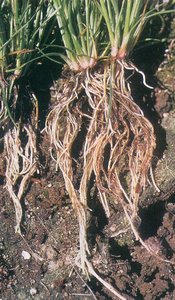
Fibrous Root System: Consists of many roots of similar diameter that spread out in the soil, typical of monocots.
Adventitious Roots: Roots that arise from non-root tissues, such as stems or leaves, often for specialized functions.
Root Hairs
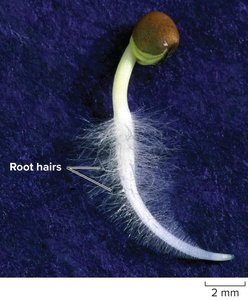
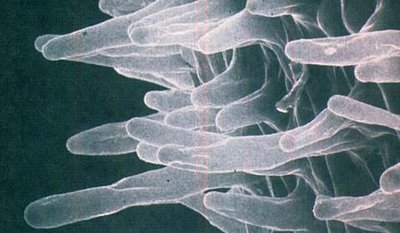
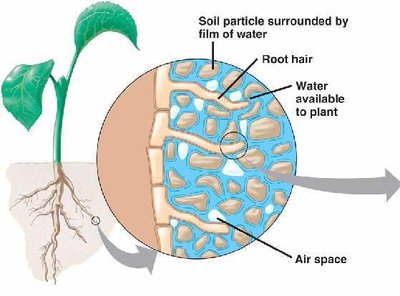
Root hairs are tubular extensions of individual epidermal cells that greatly increase the root's surface area and efficiency of absorption. They are distinct from lateral roots and are crucial for water and mineral uptake.
Root Structure and Organization
Regions of the Root
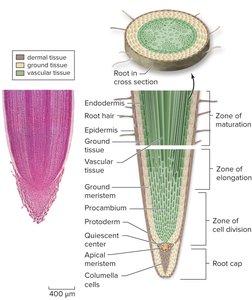
Roots have a simpler pattern of organization compared to stems, with four main regions:
Root Cap: Protects the delicate tissues behind it and is involved in gravity perception.
Zone of Cell Division: Contains actively dividing cells of the root apical meristem.
Zone of Elongation: Cells increase in length, pushing the root tip further into the soil.
Zone of Maturation: Cells differentiate into various specialized cell types.
Contact of Root and Soil
The interface between root hairs and soil particles is stabilized by mucilage from the root cap, forming a rhizosheath that enhances water and nutrient uptake.
Plant Tissues in Roots
Basic Tissue Types
Roots, shoots, and leaves contain three basic tissue types:
Dermal Tissue: The outer protective covering.
Ground Tissue: Functions in storage, photosynthesis, and secretion (cortex in roots).
Vascular Tissue: Conducts fluids and dissolved substances (xylem and phloem).
Endodermis and Pericycle
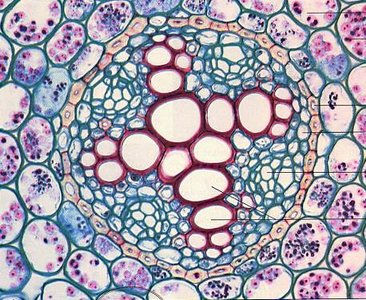
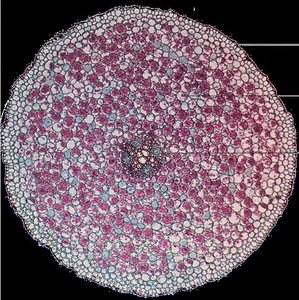
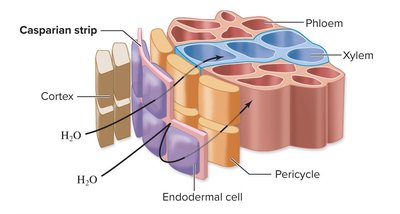
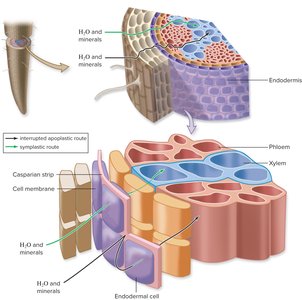
The endodermis is a single layer of cells forming a boundary between the cortex and the vascular cylinder. The pericycle is a layer of cells just inside the endodermis, giving rise to lateral roots.
Transport Mechanisms in Roots
Pathways of Water Movement
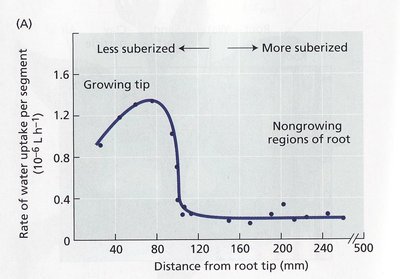
Water moves from the soil into the roots and then to the xylem, rising through the plant due to a combination of physical and physiological factors. Most water exits through the stomata in the leaves.
Transport Routes Through Cells
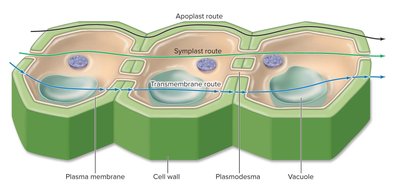
There are three main routes for water and mineral movement through root tissues:
Apoplast Route: Movement through cell walls and spaces between cells, avoiding membrane transport.
Symplast Route: Movement through the cytoplasm, interconnected by plasmodesmata.
Transmembrane Route: Movement across cell membranes and vacuoles, allowing the greatest control.
Casparian Strip and Endodermal Barrier
The Casparian strip is a band of suberin in the endodermal cell walls that blocks the apoplast route, forcing water and solutes to cross the plasma membrane into the symplast before entering the xylem. This selective barrier regulates the uptake of minerals and prevents backflow.
Water Movement at the Cellular Level
Osmosis and Aquaporins
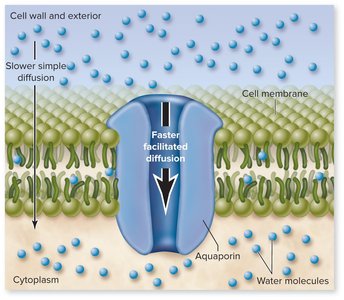
Water moves across cell membranes by osmosis, from regions of higher water potential to lower water potential. Aquaporins are water-selective pores in the plasma membrane that facilitate rapid water movement without altering its direction.
Water Potential (Ψw)
Water potential is a measure of the free energy of water and predicts the direction of water movement. It is measured in megapascals (MPa) and is determined by two main components:
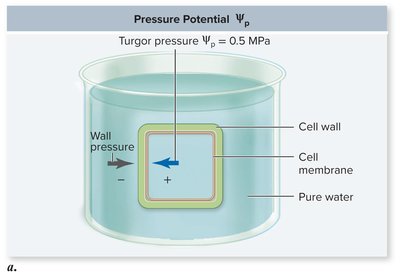
Pressure Potential (Ψp): The physical pressure on a solution, mainly from turgor pressure in cells.
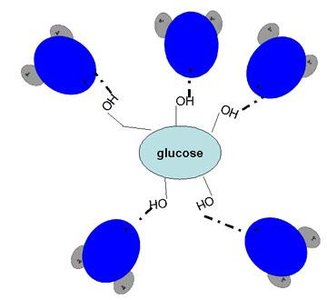
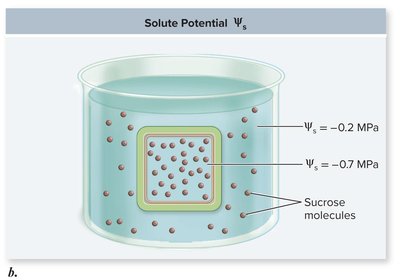
Solute Potential (Ψs): The effect of dissolved solutes; as solute concentration increases, Ψs becomes more negative.
The total water potential is given by:
Calculating Water Potential
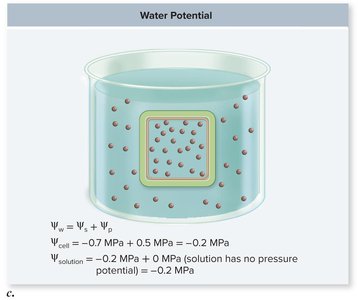
Water moves from regions of higher to lower water potential. When Ψw inside a cell equals that of the surrounding solution, there is no net movement of water.
Osmosis and Cellular Changes
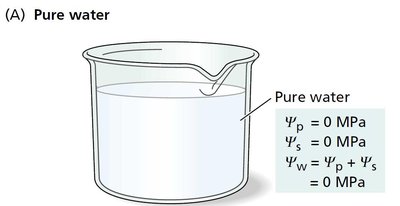
When a plant cell is placed in pure water, water enters by osmosis, causing the cell to become turgid. In a hypertonic solution (high solute concentration), water leaves the cell, resulting in plasmolysis (cell shrinkage).
Summary Table: Water Potential Components
Condition | Ψp (MPa) | Ψs (MPa) | Ψw (MPa) | Cell Status |
|---|---|---|---|---|
Pure Water | 0 | 0 | 0 | Turgid |
1 M Sucrose Solution | 0 | -0.244 | -0.244 | Plasmolyzed |
Cell in Solution | 0.5 | -0.7 | -0.2 | Equilibrium |
Key Terms
Transpiration: The loss of water vapor from plant aerial parts, mainly through stomata.
Translocation: The movement of water and solutes through the plant, primarily via the xylem and phloem.
Plasmolysis: Shrinking of the cell membrane away from the cell wall due to water loss.
Turgor Pressure: The pressure exerted by the plasma membrane against the cell wall as a result of water uptake.
Additional info: This guide integrates foundational concepts from plant anatomy and physiology, focusing on water movement and its regulation at both the tissue and cellular levels, as covered in introductory college biology courses.
