 Back
Water, pH, and Buffers: Foundations for Life
Study Guide - Smart Notes
 Tailored notes based on your materials, expanded with key definitions, examples, and context.
Water and Life: pH and Buffers
Dissociation of Water
Water molecules can occasionally dissociate, forming ions that are crucial for many biological processes. This rare event underlies the concept of acids, bases, and pH in biology.
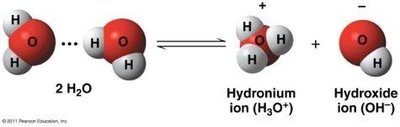
Dissociation Process: A hydrogen atom in a hydrogen bond between two water molecules can shift, leaving its electron behind. This results in the formation of a hydronium ion (H3O+) and a hydroxide ion (OH-).
Frequency: Only about 1 in 10 million water molecules dissociates at any given time in pure water.
Concentration in Pure Water: [H+] = [OH-] = 1 × 10⁻⁷ M, which defines a neutral solution.
Acids and Bases
Acids and bases are substances that alter the concentration of hydrogen ions in a solution, affecting its chemical properties and biological functions.
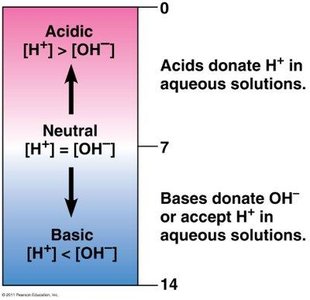
Acids: Substances that increase the concentration of H+ ions in solution (e.g., HCl dissociates into H+ and Cl-).
Bases: Substances that decrease the concentration of H+ ions, often by releasing OH- ions (e.g., NaOH dissociates into Na+ and OH-).
Neutral Solutions: Have equal concentrations of H+ and OH- ions.
The pH Scale
The pH scale is a logarithmic scale used to measure the concentration of hydrogen ions in a solution, providing a standardized way to express acidity or basicity.
Definition: pH = negative logarithm (base 10) of the hydrogen ion concentration.
Formula:
Neutral Water:
Acids: Higher [H+], lower pH (1-6).
Bases: Lower [H+], higher pH (8-14).
Logarithmic Nature: Each pH unit represents a tenfold difference in [H+]. For example, a solution at pH 4 is 100 times more acidic than one at pH 6.
Acids and Bases: Proton Donors and Acceptors
Acids and bases can be classified by their ability to donate or accept protons (H+).
Acids: Proton (H+) donors.
Bases: Hydroxyl (OH-) donors or proton (H+) acceptors.
Buffers
Buffers are compounds that minimize changes in pH when acids or bases are added to a solution. They are essential for maintaining stable conditions in biological systems.
Function: Buffers can accept or donate H+ ions as needed to maintain pH balance.
Example: The carbonic acid-bicarbonate buffer system in blood.
Carbonic Acid-Bicarbonate Buffer System
This buffer system is crucial for maintaining the pH of blood and other bodily fluids.
Reactions:
CO2 + H2O ↔ H2CO3 (carbonic acid)
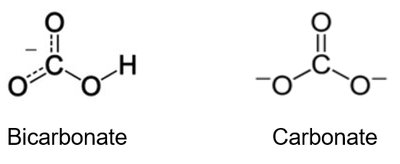
H2CO3 ↔ HCO3- (bicarbonate) + H+
HCO3- ↔ CO32- (carbonate) + H+
Reversibility: Buffer reactions are reversible, allowing the system to respond to increases or decreases in H+ concentration.
Biological Importance: Maintains blood pH at approximately 7.4. Without buffers, even small additions of acid or base would cause drastic pH changes.
Blood pH and Homeostasis
Maintaining a stable blood pH is vital for life. Even small deviations can have serious physiological consequences.
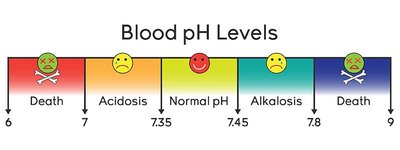
Normal Range: Blood pH is tightly regulated around 7.35–7.45.
Consequences of Imbalance: Acidosis (pH < 7.35) and alkalosis (pH > 7.45) can be life-threatening.
Buffering Capacity: Blood buffers prevent large pH swings when acids or bases are introduced.
Ocean Acidification
Ocean acidification is a process where increased atmospheric CO2 leads to lower ocean pH, affecting marine life and ecosystems.
Process: CO2 dissolves in seawater, forming carbonic acid, which dissociates to release H+ ions, increasing acidity.
Impact: Excess H+ ions can harm organisms that rely on carbonate ions for shell and skeleton formation, such as corals and shellfish.
Summary Table: Properties of Acids, Bases, and Buffers
Property | Acid | Base | Buffer |
|---|---|---|---|
Effect on [H+] | Increases | Decreases | Minimizes change |
pH Range | < 7 | > 7 | Near neutral (7.35–7.45 in blood) |
Example | HCl | NaOH | H2CO3/HCO3- |
Additional info: The notes above expand on the original content by providing definitions, equations, and examples for clarity and completeness, as well as a summary table for comparison.
