 Back
BackWater, pH, and Hydrogen Bonding: Study Notes for Biology
Study Guide - Smart Notes
 Tailored notes based on your materials, expanded with key definitions, examples, and context.
Water and Life
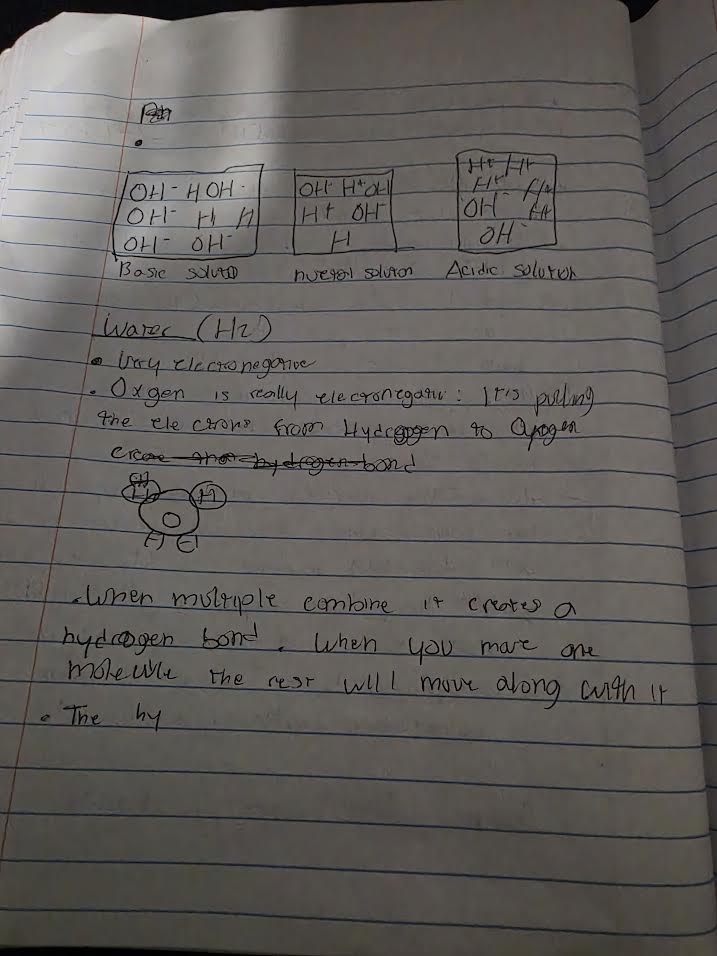
pH and Types of Solutions
The concept of pH is fundamental in biology, as it describes the acidity or basicity of a solution. pH is determined by the concentration of hydrogen ions (H+) in a solution.
Basic Solution: Contains more hydroxide ions (OH-) than hydrogen ions. These solutions have a pH greater than 7.
Neutral Solution: Contains equal concentrations of hydrogen ions and hydroxide ions. The pH is exactly 7.
Acidic Solution: Contains more hydrogen ions than hydroxide ions. These solutions have a pH less than 7.
Example: Pure water is a neutral solution, while lemon juice is acidic and bleach is basic.
Type of Solution | Relative Ion Concentration | pH Range |
|---|---|---|
Basic Solution | More OH- than H+ | > 7 |
Neutral Solution | Equal OH- and H+ | 7 |
Acidic Solution | More H+ than OH- | < 7 |
Properties of Water (H2O)
Water is a unique molecule essential for life, largely due to its chemical structure and properties.
Electronegativity: Oxygen is highly electronegative, meaning it strongly attracts electrons.
Polarity: The water molecule is polar because oxygen pulls electrons away from hydrogen, creating a partial negative charge on oxygen and partial positive charges on hydrogen.
Hydrogen Bonding: The polarity of water allows molecules to form hydrogen bonds with each other. These bonds are weak individually but strong collectively, giving water its unique properties.
Example: Water's polarity allows it to dissolve many substances, making it an excellent solvent.
Hydrogen Bonds and Cohesion
When multiple water molecules interact, they form hydrogen bonds. This leads to cohesion, where water molecules stick together. If one molecule moves, others follow due to these bonds.
Hydrogen Bond: A weak bond between the hydrogen atom of one water molecule and the oxygen atom of another.
Cohesion: The tendency of water molecules to stick together, important for processes like water transport in plants.
Example: Water droplets form because of cohesion; in plants, cohesion helps pull water up through roots and stems.
Additional info: Water's hydrogen bonding also contributes to its high specific heat, surface tension, and ability to moderate temperature.
