 Back
Water, pH, Functional Groups, and Biomolecules: Foundations of Biochemistry
Study Guide - Smart Notes
 Tailored notes based on your materials, expanded with key definitions, examples, and context.
Water: Structure and Properties
The Unique Nature of Water
Water is essential for life, covering three-quarters of Earth's surface and comprising the majority of living cells. Its unique properties arise from its molecular structure and the interactions between water molecules.
Polarity: Water molecules are polar, with an uneven distribution of charge due to polar covalent bonds between hydrogen and oxygen.
Hydrogen Bonding: The partial positive charge on hydrogen atoms and partial negative charge on oxygen atoms allow water molecules to form hydrogen bonds with each other.
Emergent Properties: Cohesion, temperature moderation, expansion upon freezing, and solvent versatility all stem from hydrogen bonding.
pH, Acids, Bases, and Buffers
Water Ionization and the pH Scale
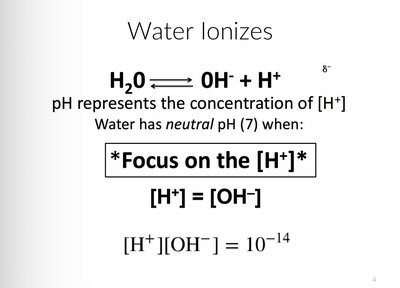
Water can ionize to form hydrogen ions (H+) and hydroxide ions (OH−). The concentration of these ions determines the pH of a solution, which is crucial for biological processes.
Ionization Equation:
Neutral pH: Water is neutral when .
Ion Product of Water:
The Logarithmic pH Scale
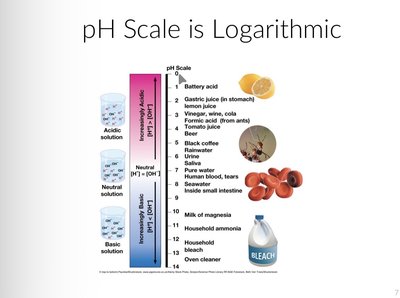
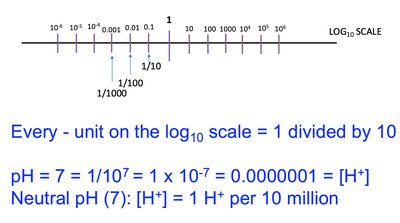
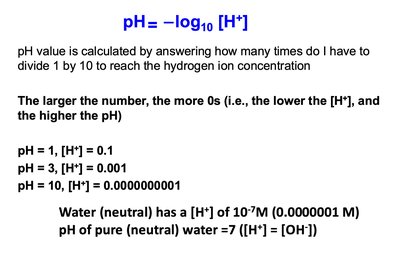
The pH scale measures the concentration of hydrogen ions in a solution and is logarithmic, meaning each unit change represents a tenfold difference in [H+].
pH Formula:
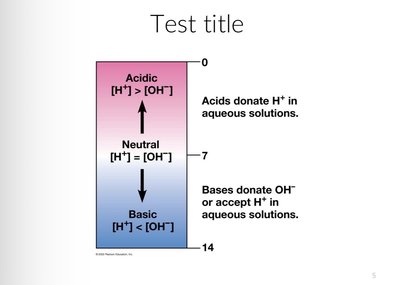
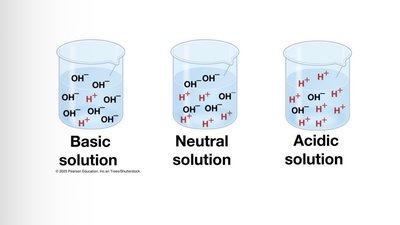
Acidic Solutions: pH < 7, [H+] > [OH−]
Neutral Solutions: pH = 7, [H+] = [OH−]
Basic Solutions: pH > 7, [H+] < [OH−]
Acids, Bases, and Buffers
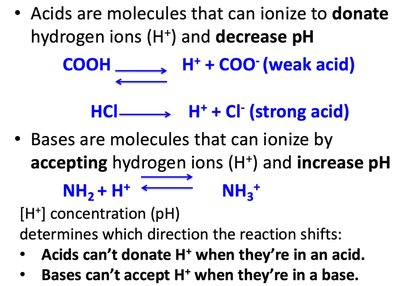
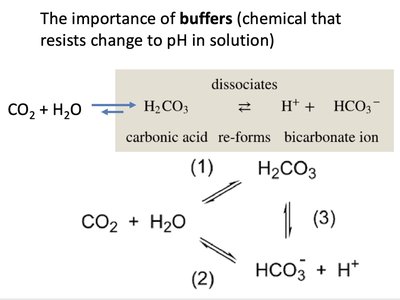
Acids donate hydrogen ions, lowering pH, while bases accept hydrogen ions, raising pH. Buffers are substances that minimize changes in pH by absorbing or releasing H+ ions.
Acids: Release H+ (e.g., HCl, COOH groups)
Bases: Accept H+ or release OH− (e.g., NH2 groups)
Buffers: Maintain pH stability in biological systems (e.g., bicarbonate buffer system in blood)
Functional Groups and Molecular Diversity
Key Functional Groups in Biological Molecules
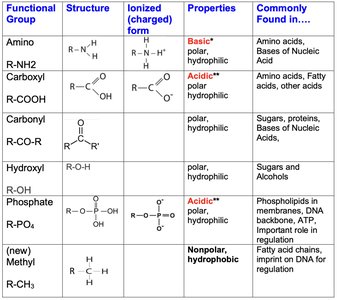
Functional groups are specific groups of atoms attached to carbon skeletons that determine the chemical properties and reactivity of organic molecules.
Functional Group | Structure | Ionized (charged) form | Properties | Commonly Found in…. |
|---|---|---|---|---|
Amino | R-NH2 | R-NH3+ | Basic, polar, hydrophilic | Amino acids, bases of nucleic acids |
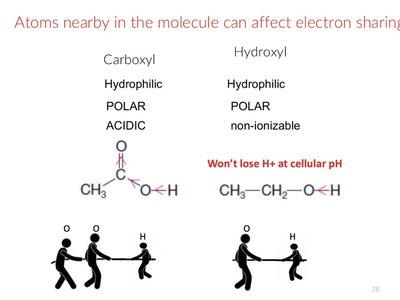
Carboxyl | R-COOH | R-COO− | Acidic, polar, hydrophilic | Amino acids, fatty acids, other acids |
Carbonyl | R-CO-R' | — | Polar, hydrophilic | Sugars, proteins, bases of nucleic acids |
Hydroxyl | R-OH | — | Polar, hydrophilic | Sugars, alcohols |
Phosphate | R-PO4 | R-PO4− | Acidic, polar, hydrophilic | Phospholipids, DNA, ATP |
Methyl | R-CH3 | — | Nonpolar, hydrophobic | Fatty acid chains, DNA regulation |
Macromolecules: Structure and Synthesis
Classes of Biomolecules
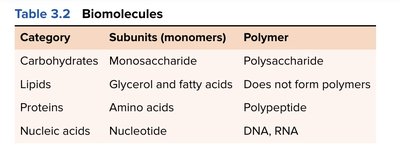
Cells are composed of four major classes of organic macromolecules, each with distinct monomers and polymers.
Category | Subunits (monomers) | Polymer |
|---|---|---|
Carbohydrates | Monosaccharide | Polysaccharide |
Lipids | Glycerol and fatty acids | Does not form polymers |
Proteins | Amino acids | Polypeptide |
Nucleic acids | Nucleotide | DNA, RNA |
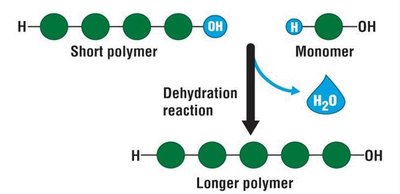
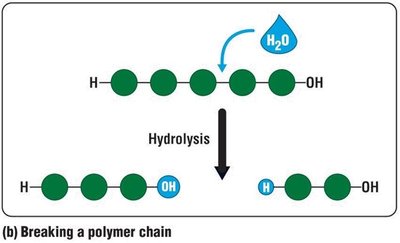
Polymerization: Dehydration Synthesis and Hydrolysis
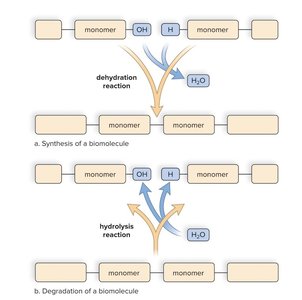
Macromolecules are assembled and disassembled by two key reactions:
Dehydration Synthesis (Condensation): Monomers are joined by covalent bonds with the removal of a water molecule.
Hydrolysis: Polymers are broken down into monomers by the addition of water.
Proteins and Enzymes
Protein Structure and Function
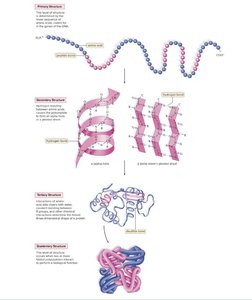
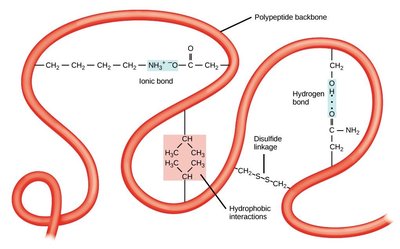
Proteins are polymers of amino acids linked by peptide bonds. Their structure determines their function, and they play diverse roles in cells, including catalysis, defense, and structure.
Primary Structure: Sequence of amino acids.
Secondary Structure: Alpha helices and beta sheets formed by hydrogen bonding.
Tertiary Structure: Overall 3D shape due to side chain interactions.
Quaternary Structure: Association of multiple polypeptide subunits.
Enzymes: Biological Catalysts
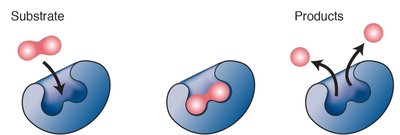
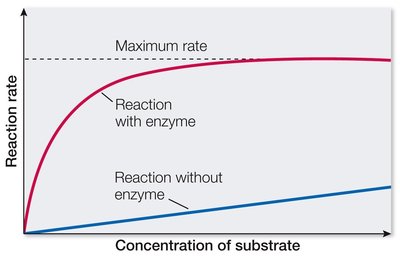
Enzymes are proteins that accelerate chemical reactions by lowering activation energy. They are highly specific for their substrates and are not consumed in the reaction.
Active Site: The region where the substrate binds and the reaction occurs (lock-and-key model).
Factors Affecting Enzyme Activity: Substrate concentration, inhibitors (competitive and noncompetitive), activators, pH, and temperature.
Summary Table: Biomolecules
Category | Subunits (Monomers) | Polymer |
|---|---|---|
Carbohydrates | Monosaccharide | Polysaccharide |
Lipids | Glycerol and fatty acids | Does not form polymers |
Proteins | Amino acids | Polypeptide |
Nucleic acids | Nucleotide | DNA, RNA |
Additional info: This guide covers foundational concepts from General Biology, including water chemistry, pH, functional groups, macromolecule synthesis, and enzyme function, all of which are essential for understanding cellular processes and biochemistry.
